• Welcome to Photrio!
    Registration is fast and free. Join today to unlock search, see fewer ads, and access all forum features.
    Click here to sign up

General exposure question - probably zone system related

Tractor & Tulips

A
Tractor & Tulips

  • 1
  • 1
  • 34
Tree with Big Shadows

Tree with Big Shadows

  • 3
  • 0
  • 82

Forum statistics

Threads
203,458
Messages
2,855,080
Members
101,853
Latest member
DJFOX
Recent bookmarks
0
The relationship between the metered exposure point and the speed point is different with the Zone System and the ISO B&W speed standard. Zone System is 1.30 logs and ISO is 1.0. This is the primary cause for the general EI discrepancy seen between the two methods.

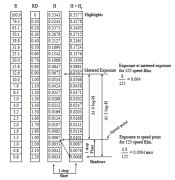
Hg = P * shutter speed. P = ~8 lxs (also known as K1 in the meter calibration equation). For a 125 speed film Hg = 8/125 = 0.064 lxs. Speed point equation is 0.8/Hm. For 125 speed film, Hm is 0.8/125 = 0.0064 lxs. For a 125 speed film, Hg = 0.064 and Hm = 0.0064 or 10x or 1.0 log-H difference between Hg and Hm.

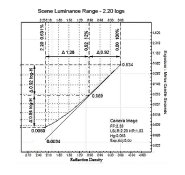
Here is an example of where 12% reflectance falls in relationship to the subject luminance range and the camera's illuminance range with one stop flare. Please note that the diffused highlight is considered 100% reflectance. For the record, the statistical average luminance range is 2.20 logs (7 1/3 stops).
Middle Gray.jpg

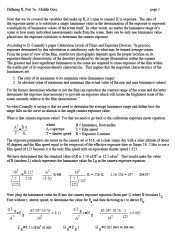
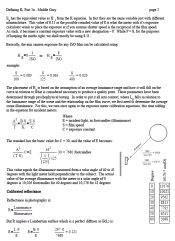
Here are two pages dealing with middle gray from the thread "Is the K factor relevant to me or should I cancel it out?"
Defining K, part 5a p1.jpg Defining K, part 5a p2.jpg
 
unfortunately because adams writings in the Negative are centred around target values which are only verifiable if you own a densitometer, which most people don't, you don't know if you are doing what adams suggests. And then when you get a densitometer you find his values don't make sense.
I have always taken the view that practical evaluation is the proof of the pudding and always use practical evaluation to ensure that "My System" is doing what I want it to. Having said that, the reason I know that "My System" is working and that I have 100% confidence in it, is because I've been through the Zone system theory, tested it, ironed out the anomalies and constructed my own methodolgy around it.
So now I'm using "My System" which is based largely on Zone system Zones but is adapted for roll film and variable contrast printing.
I don't target numbers but I know certain numbers will blow or block my results so it makes sense to check things with a densitometer from time to time (or with a new film/paper) which saves a lot of time when doing a practical evaluation with print tests.
Each to his own.

I'm really not into all the technical stuff. I was but I realised that I wasn't enjoying my photography because of it so I cut it out as much as possible. And the grey card only being 2.5 stops less than 100% is a really confusing thing when using "the zone system" once you realise it. I haven't used a grey card since I realised it. Much better to meter the actual subject based on practical evaluation which also takes out any problems due to flare that people keep referring to. I'm not going there. Flares a non issue for me unless I'm pointing my camera lens into the sun.
 
Last edited by a moderator:
I'll just state this: When I was a teenager the Zone System taught me a lot. That was a very long time ago and I'm now comfortable with visual inspection of both negatives and prints to determine what adjustments must be made to determine 'standards' and to determine how adjustment variables effect outcome. I will always expose for shadows then develop and selenium tone for highlights. Honestly, that's as complicated as my failing cognition and lessening patience allow for these days. I will always use a spot meter whenever possible.
 
unfortunately because adams writings in the Negative are centred around target values which are only verifiable if you own a densitometer, which most people don't, you don't know if you are doing what adams suggests. And then when you get a densitometer you find his values don't make sense.

This is a failing inherent in any simplification of any subject. I have no doubt that Adams knew full well he was leaving things out. His audience was not people who knew the rules, he was helping the average Joe learn how to do things.

There are many subjects that we were all taught simplified (& flawed) versions of, to get us started, then we had to relearn the subject.
 
Sorry to divert from the OP with this question, but should we judge AA from a technical or aesthetic objective?
 
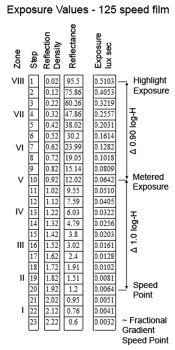
Here is the exposure breakdown based on Zone V. It's slightly different from the standard model because the scale is centered on the metered exposure point. In this example highlight reflectance is 95.5% where as the standard model is 100%.

Exposure for 125 speed film a.jpg

Compared to the standard model

Standard Model .jpg
 
Last edited by a moderator:
Sorry to divert from the OP with this question, but should we judge AA from a technical or aesthetic objective?

If he hadn't written his trilogy of books, The Camera, The Negative and The Print would we know him as anything other than an accomplished photographer/printer? I think not. He is better known, at least to me, for "The Zone System" than his prints. Maybe in the USA that is not the case and he is known as much if not more for his prints as his books but if you say Ansel Adams to me I would immediately think, Zone System and then acknowledged Master Printer in that order and not the other way round.
 
Sorry to divert from the OP with this question, but should we judge AA from a technical or aesthetic objective?

Or even, a political objective - e.g. his work with the Sierra Club.
 
Or even, a political objective - e.g. his work with the Sierra Club.

Yeah but do you know about his involvement with the Sierra club because of his notoriety as a photographer and his photographic books? i.e. If he hadn't published his photo books my bet is you you would only have known about him in passing.
What I'm saying is, that it was his books that have given him fame and kept all landscape photographers interested enough to talk about his methodolgy. Through the books you are brought to his prints.

I mean just look at any web forum like this one. The discussion is nearly all about the zone system and not much about his prints.
 
Yeah but do you know about his involvement with the Sierra club because of his notoriety as a photographer and his photographic books? i.e. If he hadn't published his photo books my bet is you you would only have known about him in passing.
What I'm saying is, that it was his books that have given him fame and kept all landscape photographers interested enough to talk about his methodolgy. Through the books you are brought to his prints.

I mean just look at any web forum like this one. The discussion is nearly all about the zone system and not much about his prints.

I beleive the only reason his books were important, was that his photography was important and that he was commercially successful. People wanted to know how.
 
The great thing about photography as a hobby is that it has so many facets of potential enjoyment and satisfaction. It doesn't have to be all about the print. These different facets are not mutually exclusive; pick as many as you want. Examples are: creating a great image, collecting gear, testing lens resolution and bokeh, darkroom work, and mastering negative exposure.
 
I wish we could, Bill.

I discovered Adams through his pictures, and was mesmerized by ...

Me too. A friend of mine had AA prints. I would house sit for her when she travelled. Before seeing those I hadn't heard the man's name. As I was learning photography this lady gave me a copy of The Negative with the following good advise: you'll probably never be a photographic master like Adams, nor will you ever become a marketing master like him, nor will you ever be able to replicate his working methods... but it might be good to understand his working methods since they will teach you some very useful aspects of photography. She has been correct on all 3 comments.
 
why is it that in web forums people continuously claim
AA invented the zone system?
from reports of people here on apug who have seen his work
in exhibits, some of it seem poorly printed ( almost lifeless by comparison to later works ).
later in his life he interpreted the same negatives in different ways to give them more life.

was this due to failing vision, and the need to see things with more contrast?
earlier work is more mid-tone ( almost 19th century print aesthetic ),
while later work is more full-scale
 
...in exhibits, some of it seem poorly printed ( almost lifeless by comparison to later works ).
later in his life he interpreted the same negatives in different ways to give them more life.

was this due to failing vision, and the need to see things with more contrast?
earlier work is more mid-tone ( almost 19th century print aesthetic ),
while later work is more full-scale

Aside the very nice scenery, that is the aspect of his life work that I've always found interesting - the change over time.
 
why is it that in web forums people continuously claim
AA invented the zone system?

Particularly since for every 2 photographers there are 3 interpretations of what he really meant.
Personally I like Fred Archer's system. Or Paul Anderson's. Or any other of dozens that published Instructional books and magazine articles.
 
My god, how many times will this debate be re-hashed!

Lets get down some information that we can agree on or disagree on:
  • I personally think that Ansel Adams made some very fine images during his lifetime (debate).
  • I also think that his earlier years produced the better images for my taste (debate).
  • I also prefer his later interpretations of his negatives. He is truly guilty of coining the phrase of ‘the negative is the score and the print is the performance’ - but doesn’t the debate about “I prefer the early prints - no I prefer the later prints” actually indicate that this (very oft repeated comment) is actually true.
  • When Weston, Adams and Van Dyke were working to move photography from the prevailing pictorialism (which they were also most adapt at in producing images in this style) to a newer (purer in their opinion) of photography, earning money from print sales were the complete exception from the rule.
  • Adams for the majority of his life earned his income from commercial photography - something that he excelled at because the customers found his images to be technically superior to those of his contemporaries (despite, I suspect really knowing why).
  • Adams had a desire to impart his knowledge to others that came from both a natural desire to do so and a pressing need to earn more money to take care of his family.
  • The Zone System, as we understand it, was first formulated by Ansel Adams as a way of codifying what he was teaching to his students.
  • His aim was import to his students the technical skills necessary to interpret a scene in a way that the print expressed what they wanted rather than being a literal translation of the scene.
  • The Zone System is only one of many approaches out there and the proof of the pudding is if it helps you to get the prints to look how you want them. Nothing more or less.
  • There has developed a mujahidin, taliban, NSA, ISIS gang of people all claiming to have the Tora, Bible or Koran of the Zone System but that is totally pointless shit direction to debate - the whole point is to embrace a system that helps YOU get then results that you want.

I personally was inspired by his prints (at the Land Exhibition at the V&A exhibition in London) that were so far more expressive and technically superior than the ‘greats’ that I knew from the RPS and London Salon. I avidly read his books (and those of Minor White, Frec Archer, et al) and absorbed a ‘concept’ of how to approach the control of my images. I quickly found my own path but it was inspired by Adams. Anyone today who is slavishly following his advice has not noticed with the changes in materials available to us - OR more importantly - that he was trying to deliver a set off skills to enable you to make images that look how you want them.

There are a million ways to enjoy photography and thechnically good prints that express your response to the subject is but one of many. However, if this is what you want to achieve, the principles that Adams taught remain your best starting point.

Bests,

David.
www.dsallen.de
 
So wit that manifesto are you indicating that there should be no further discussion? :laugh:
 
Is that an opinion or a comment?

My post included (debate) and called for responses that stopped being about this tribal response but simply I was asking whether what worked for me worked for others, why it worked for me and, for my way of looking at things, that I 'bought in' to Adams approach because the results that I saw matched my aspirations and his system worked for me (and, I may add, for 100s of people that I have taught).

This was asking (was it not clear - then I apologise) ) for some people to explain what they mean by some of Adams prints 'seem poorly printed'. Which era are we talking about? His style developed over time and, god help me, mine will also develop in response to current 'Fads' and my own tastes.

May I remind everyone, that the Op's question was about the use of the gray card and I believe that I have answered it fairly. All the subsequent debate on this thread will give nothing to the OP but seems to be a point scoring conservation that will in no way help the OP.

Bests,

David.
www.dsallen.de
 
[*]The Zone System, as we understand it, was first formulated by Ansel Adams as a way of codifying what he was teaching to his students.
www.dsallen.de

Words matter and history should be as accurate as possible.
Here is a thread concerning Davenport's previous contribution.

(there was a url link here which no longer exists)

It is unbecoming to leave out less famous people (such as Archer) in factual statements.
 
Actually David it was neither comment or opinion but a question... Which you Answered. Thank you.
 
The ZS gives people targets to aim at. Those targets are different for every individual but once a person recognizes the targets and learns how to hit the centers then they have the controls they need. Me... I'll get close by eyeballing and not worry about it. The ZS did teach me how to eyeball though.
 
Adams inspired me in several ways, but when you get down to it, the Zone System, even when misinterpreted, "works for people", "gives them the results they want", etc. largely because they believe it to be working. Perception is reality, that sort of thing.

We, as humans, don't always worry about the things that actually matter. We get lost in the technical minutia and social nonsense that surrounds us and our activities in life.

I truly believe that Adams greatest achievement was in getting people past their hangups and actually out doing the most important thing in photography; pushing the shutter button on a loaded camera.

Adams' prints provided the inspiration, the books (even when poorly followed) provided the confidence.

Photography with negatives is a very forgiving craft as Kodak proved "You push the button, we do the rest."
 
i am refering to a post that ian grant made years ago
about a traveling exhibition of work which contained
several ansel adams prints. maybe i am getting it wrong
maybe i am mis-remembering what he said, but when he posted the
information to a thread, maybe 6-10 years ago, he claimed the
prints were not well printed and he was sort of underwhelmed.

i dont' think i am misremembering what i read, but i couldn't find
where he posted it, i searched and came up empty.
i'm not suggesting adams didn't deserve the fame he got, that he wasn't a good photographer
or became a good printer and a human of photo-godlike stature. but sometimes people forget
that not all his prints are not printed the same. and if they are reproductions or posters or calendars
they might not look like the original at all. i know i have seen issues of VC magazine over the years
and the reproduction quality was not the best, and what might have looked breathtaking in person,
well it wasn't not breathaking in print ...

i have to also admit i went to a show with some "big names" last sprint or summer
at a local museum. i don't remember who they were, but sortof the who's who
from maybe 1890 to present day ... and i wasn't really impressed by the imagery or the printing.
so maybe it is a matter of taste ?

i don't think there is a debate, i think people are able to have different opinions. if everyone believed
the same things or like the same things life would be boring ... some people don't like adams or use the zone system, who cares.
it isn't like it even matters, and when people stand on some sort of soapbox and scream and pound their chest &c abouti how great
the ZS is and adams is, that is great too. it doesn't matter to me, unless they have such zeal they are nasty and harsh to people with differing
opinions, insulting them, calling them fools who have no idea what they are doing, and wasting their time and precious film .. whatever ...

thank you bill. i appreciate your input about the other people who worked on and helped reformulate/recreate
what what is now called the zone system, something often times adams gets sole ownership of.
its like kenny g claiming he invented "free breathing" when it is something that has been done for hundreds
( maybe thousands ) of years whether you are smoking tabac in a hooka or playing a zourna, oboe or clarinet ...
 
Last edited by a moderator:
i am refering to a post that ian grant made years ago
about a traveling exhibition of work which contained
several ansel adams prints. maybe i am getting it wrong
maybe i am mis-remembering what he said, but when he posted the
information to a thread, maybe 6-10 years ago, he claimed the
prints were not well printed and he was sort of underwhelmed.

i dont' think i am misremembering what i read, but i couldn't find
where he posted it, i searched and came up empty.
i'm not suggesting adams didn't deserve the fame he got, that he wasn't a good photographer
or became a good printer and a human of photo-godlike stature. but sometimes people forget
that not all his prints are not printed the same. and if they are reproductions or posters or calendars
they might not look like the original at all. i know i have seen issues of VC magazine over the years
and the reproduction quality was not the best, and what might have looked breathtaking in person,
well it wasn't not breathaking in print ...

...

I don't know what Ian saw and commented on, but I had similar reaction back in the 1980s after seeing an exhibit at the Friends of Photography Gallery. The focus was on how AAs printing changed over the years and prints of the same image were presented to demonstrate. I was quite underwhelmed by many of them. Not knowing much at the time I couldn't really discern if it was the "visualization" that I didn't like or the printing style or the printing quality.
 
Photrio.com contains affiliate links to products. We may receive a commission for purchases made through these links.
To read our full affiliate disclosure statement please click Here.

PHOTRIO PARTNERS EQUALLY FUNDING OUR COMMUNITY:


Ilford ADOX Freestyle Photographic Stearman Press Weldon Color Lab Blue Moon Camera & Machine
Top Bottom