• Welcome to Photrio!
    Registration is fast and free. Join today to unlock search, see fewer ads, and access all forum features.
    Click here to sign up

Fungus? Separation?

Texas

A
Texas

  • 6
  • 1
  • 79

Forum statistics

Threads
203,433
Messages
2,854,572
Members
101,839
Latest member
jkang007
Recent bookmarks
0

Dan Daniel

Subscriber

Joined
Jul 4, 2009
Messages
3,142
Location
upstate New York
Format
Medium Format
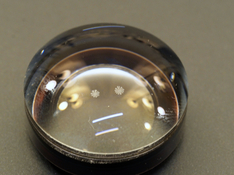
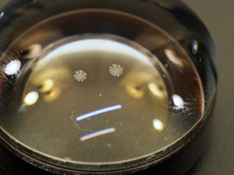
In the middle of a cemented pair. The two snowflake shapes. This is back pair of the front group of a Schneider Xenotar 2.8 (Rolleiflex D), from about 1955.

Opinions on what this is? Thanks.
 

Attachments

  • zeno 1_EP57220.jpg
    zeno 1_EP57220.jpg
    530.6 KB · Views: 153
  • zeno 2_EP57216.jpg
    zeno 2_EP57216.jpg
    515.9 KB · Views: 150
I would vote for separation.

In my experience, fungus has some form of texture to it; this looks very "mirror-like".
 
Seperation, I've a Meyer Satz Plasmat with this issue, only one snowflake in mine. Whenever I've seen this, it occurs just off center of the lens.
 
Those are balsam separation artifacts. It's relatively common on Schneider Xenon lenses from the mid-fifties as well. This specific type of separation is due to the presence of a tiny particle of dust in the adhesive layer which primes the cemented pair for separation after years of temperature cycling.
You may find you can make those disappear by gently heating the lens group with a hair dryer and then gently pressing from both side of the group. I've done it once with one of my own and it succeeded.
 
Interesting! I have an Ektar from a Bantam Special with one of these 'snowflakes'. Will try the hair dryer fix and see if it goes away.
 
Thanks all. Very helpful info. Now I need to decide if I want to risk heating the elements. Being much larger than the Xenons, I'll find a slower way to bring it up to temperature?
 
Keep in mind there is a risk of upsetting the alignment between elements with heat. Maybe you can mitigate by holding the doublet between V-blocks.
 
The melting point of Canadian Balsam is about 93 F 93C and the flash point is about 102F 102C according to a MSDS I found online, so take care with the heat!

 
Last edited by a moderator:
The melting point of Canadian Balsam is about 93 F and the flash point is about 102F according to a MSDS I found online, so take care with the heat!


Thank you for the MSDS. (that is 93C, not F)

The material they are using contains xylene. nasty stuff!
Keep in mind there is a risk of upsetting the alignment between elements with heat. Maybe you can mitigate by holding the doublet between V-blocks.

Yeah, I'll need to make a jig. Especially if I plan to apply pressure. The top element is convex on the otr surface and concave on the lower surface so one slip and the top element could just roll off.
 
Check the outside diameters of the two elements with an accurate caliper. if they are not the same ( often the case - deliberately ) then you will not be able to re-set the two elements using v-blocks. You will need an optical check using reflections and a rotating bearing. The tolerances in an f/2.8 Xenotar will be pretty tight.
 
The material they are using contains xylene. nasty stuff!
thats in the fresh stuff, there wont be any left in the doublet now
And the quantity there is minimal even if you were to redo the pair from scratch, its not like you sniff it everyday
 
thats in the fresh stuff, there wont be any left in the doublet now
And the quantity there is minimal even if you were to redo the pair from scratch, its not like you sniff it everyday
I think that the xylene component is what leads to most of the warnings. Like the section 5 flash point of 48C. And yes, once the xylene, a carrier solvent, evaporates the balsam itself will be of minimal to no danger.

But dang, I don't like xylene! I can feel my liver melting just looking at a can of it.
 
But are you sure it's in the balsam? I seem to remember something about dust-speck in the coating process may give raise to this bype of blooms?
 
Apparently all you need to do is locally heat that spot, so I would be sorely tempted to try to do it with light. I doubt that a laser available in household use would have enough power, but there's always a magnifying glass and the sun. You'd need to experiment a little with the focus point since the element of the lens itself would have some power. However, you also probably don't want a perfectly focused point of heat, rather to move it around to heat the area of separation. It would be nice to experiment on a less valuable lens, if one could find a less valuable lens with the same problem. That goes for any of these methods, I imagine.
 
Photrio.com contains affiliate links to products. We may receive a commission for purchases made through these links.
To read our full affiliate disclosure statement please click Here.

PHOTRIO PARTNERS EQUALLY FUNDING OUR COMMUNITY:



Ilford ADOX Freestyle Photographic Stearman Press Weldon Color Lab Blue Moon Camera & Machine
Top Bottom