
• Welcome to Photrio!
    Registration is fast and free. Join today to unlock search, see fewer ads, and access all forum features.
    Click here to sign up

Framed RC prints: Seal contaminants in or out?

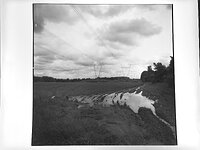
Puddle

Puddle

  • 2
  • 2
  • 70

Recent Classifieds

Forum statistics

Threads
202,728
Messages
2,844,711
Members
101,487
Latest member
Bmattei
Recent bookmarks
1
RC prints always do this when framed ... stewing in their own juice so to speak

Exposing RC prints to bright light is also suspected in RC bronzing/silvering. I don't know what the results are for unframed exhibited prints.

The best guide to the future is the past - by this criteria RC paper can't be considered archival. I use it "For Novelty Purposes Only", and don't loose any sleep over its properties.
 
I understand that RC prints can "silver out" easily, but I don't understand why FB papers supposedly do not. What about all the many prints I've seen from before the 50s that have silvered out? There weren't any RC papers then, so how did this happen? Just bad processing?

I explained that in an earlier post. Silver ions can escape into the paper fibers but cannot penetrate the PE layer in RC prints, and consequently, accumulate at the surface to metallic silver. I have never seen 'silvering' in FB prints only in RC. Like to see an example if possible. I've often seen sulfide staining, and residual silver stains, both yellow, but never 'silvering' in FB. Sistan was developed to prevent this from happening in RC.
 
Bronzing and silvering out issues do plague RC papers. The problem seems to stem from the titanium dioxide layer used to brighten the whites.

That's what I've read too but don't understand. The titanium oxide and the silver emulsion are separated by a PE layer. How can they affect each other?

I have found that RC prints always do this when framed, photos in my cupboard are not affected.

That makes sense, the production of silver ions needs light, humidity and temperature.

Oh, fibre paper will silver out if it's not fixed correctly.

That is something different. Silvering happens at the boundaries of highlights and silver-rich areas, shadows. Not properly fixed prints suffer from staining highlights, mostly turning brown or fading.

Again, I have never seen silvering in FB prints, but I'm not saying that it isn't possible. Just haven't seen it yet.
 
The best guide to the future is the past - by this criteria RC paper can't be considered archival. I use it "For Novelty Purposes Only", and don't loose any sleep over its properties.

Wise choice. I have adopted the same procedure for my prints.
 
Read the article by Ctein. The bronzing of RC images, according to his tests, comes from overwashing. Most prints on FB are slightly underwashed and retain a bit of sulfur which "tones" the image and protects it.

This was apparently confirmed by others running similar tests. Sistan takes advantage of this by adding a bit of sulfur to the coating to prevent bronzing.

PE
 
Read the article by Ctein. The bronzing of RC images, according to his tests, comes from overwashing. Most prints on FB are slightly underwashed and retain a bit of sulfur which "tones" the image and protects it.

This was apparently confirmed by others running similar tests. Sistan takes advantage of this by adding a bit of sulfur to the coating to prevent bronzing.

PE

This makes sense but leaves me puzzled with the relation to titanium oxide. But, I believe it, because in my tests, even light polysulphide toning of PC prints prevents the issue.
 
Ralph;

TiO2 is light sensitive and generates free radicals. It must be quenched to prevent spread of these radicals. Early versions were not well quenched and the radicals spread from the TiO2 to the RC to the image degrading everything on the way.

Kodak and Fuji led the way along with Ilford. Now I guess Schoeller does it, but probably using patents and licenses from the major mfgrs.

PE
 
Ralph;

TiO2 is light sensitive and generates free radicals. It must be quenched to prevent spread of these radicals. Early versions were not well quenched and the radicals spread from the TiO2 to the RC to the image degrading everything on the way.

Kodak and Fuji led the way along with Ilford. Now I guess Schoeller does it, but probably using patents and licenses from the major mfgrs.

PE

That explains it. Thanks. Who is Schoeller?
 
I thought silvering of FB paper was not uncommon. I have several portraits of the 1910-1920's wherein parts of the shadows have change to a mirror like surface. I alwways presumed this was what people called silvering.
 
I wonder, with the demise of Agfa, is Sistan still available?

Tony

The production for Sistan was never stopped in Germany. Agfa Photo in Munic took the production over, but the problem was that they did not sell to end customers and dealers had to take a minimum quantity of at least (?) bottle, which for many dealers was just too much to keep on their shelves.
 
I thought silvering of FB paper was not uncommon. I have several portraits of the 1910-1920's wherein parts of the shadows have change to a mirror like surface. I alwways presumed this was what people called silvering.

Do you it's possible to post a scan? It sounds right from your writing. The silver typically shows at the borders of dark shadows and highlights.
 
I thought silvering of FB paper was not uncommon. I have several portraits of the 1910-1920's wherein parts of the shadows have change to a mirror like surface. I alwways presumed this was what people called silvering.

I've seen this too. I don't have any examples that I can find now to scan and post. Bill, please post some examples if you can.
 
Photrio.com contains affiliate links to products. We may receive a commission for purchases made through these links.
To read our full affiliate disclosure statement please click Here.

PHOTRIO PARTNERS EQUALLY FUNDING OUR COMMUNITY:


Ilford ADOX Freestyle Photographic Stearman Press Weldon Color Lab Blue Moon Camera & Machine
Top Bottom
