• Welcome to Photrio!
    Registration is fast and free. Join today to unlock search, see fewer ads, and access all forum features.
    Click here to sign up

fp4+ vs delta 100 vs PLUS-X 125 vs NEOPAN 100 ACROS

Our Local Pub

A
Our Local Pub

  • 3
  • 4
  • 60
_Z721531-positive.JPG

H
_Z721531-positive.JPG

  • 4
  • 0
  • 42

Recent Classifieds

Forum statistics

Threads
202,028
Messages
2,834,028
Members
101,078
Latest member
Thetallman
Recent bookmarks
0

RalphLambrecht

Subscriber
Allowing Ads
Joined
Sep 19, 2003
Messages
14,947
Location
K,Germany
Format
Medium Format
It's been a quarter century since I've shot and processed B&W for the shear joy of making fine prints. Overexposure and underdevelopment were part of my process along with selenium toning the film to extend highlight details more linearly than with development alone. Shadow details were excellent and highlights were open and very textured. I also selenium toned the prints which had a similar effect... darkening shadows without blocking them. I'm not against overexposure... just the sacrifice of highlight detail... unless those aren't present to begin with. :smile:

Film was Agfapan 25 and 100 processed in Rodinal 1:50 (usually). Paper was Ilford Gallery DW fiber (grade 2 or 3 with the latter prefered) developed on Phenidol?... whatever Ilford's phendone-base developer was called... and selenium toned for density and color.

And I still say I can see a little highlight compression in those examples. :D

Mike

Don't be fooled by looking at scans on your monitor, which might be different than mine. You need to see the prints.
 

Mike1234

Member
Allowing Ads
Joined
Jul 6, 2009
Messages
1,908
Location
South Texas,
Format
4x5 Format
Mike... Don't be fooled by looking at scans on your monitor, which might be different than mine. You need to see the prints.

If they were scanned separately you certainly have a point but if they were scanned simultaneously side-by-side then they definitely differ, IMHO. I'm not trying to argue but if they were scanned together then I can see the tonal compression in the highlights. However, I DON'T disagree that negative film can often be grossly overexposed and still make nice-looking prints. Or are you saying you scanned the film and not the prints... different story there.

BTW, if one is scanning and printing digitally PS Curves can really work magic if one knows how to use that tool.
 
Last edited by a moderator:

RalphLambrecht

Subscriber
Allowing Ads
Joined
Sep 19, 2003
Messages
14,947
Location
K,Germany
Format
Medium Format
I didn't miss any point anywhere...

I'm afraid, you did if you call my statement unqualified.

...Translation for the non-technical - if you really truly "overexpose" by 8 stops you will more likely than not actually block a significant amount of highlight values.

No you won't. 7 stops of subject brightness range + 8 stops of overexposure = 15 stops of required film exposure range. Many B&W negative film can give you that easily unless you develop them to roll off the highlights.
 

RalphLambrecht

Subscriber
Allowing Ads
Joined
Sep 19, 2003
Messages
14,947
Location
K,Germany
Format
Medium Format
If they were scanned separately you certainly have a point but if they were scanned simultaneously side-by-side then they definitely differ, IMHO. I'm not trying to argue but if they were scanned together then I can see the tonal compression in the highlights. However, I DON'T disagree that negative film can often be grossly overexposed and still make nice-looking prints.

BTW, if one is scanning and printing digitally PS Curves can really work magic if one knows how to use that tool.

They were scanned separately. My scanner is not that big.
 

rwboyer

Member
Allowing Ads
Joined
Oct 16, 2009
Messages
522
Location
MD USA
Format
Medium Format
Not fine, but the film can handle it, no probs.

Ralph,

I do not mean any disrespect whatsoever - I like your work and generally think you probably know what you are doing and talking about.

Now - without going to idiotic extremes to prove a point (like metering only the sky outside and setting your camera to what the meter "says") I dare anyone to load up any one of these films we are discussing. Set your camera's meter or any other meter for that mater to as low as it will go ISO wise (most meters will not even go low enough for 8 stops overexposure, mine goes to three) then add more exposure (3 stops in my case) - meter as you will usually do and shoot the scenes you normally shoot and then process as you normally process.

I will personally guarantee you will end up with most of the highlights blocked no matter how you print - there will be no differentiation in lots and lots of highlight areas, probably even areas that should be "mids".

And I am not even talking about overexposing based on true shadow speeds - let's just stick with "box" speed.

Ralph if you are claiming that these three film have no DMAX that you are going to reach with 8 stops of even close to true overexposure I have to say that you are not correct and that that statement is at best misleading.

RB

Ps. I know that this diatribe has nothing to do with the OPs inability to control or even know what exposure is being obtained.
 

RalphLambrecht

Subscriber
Allowing Ads
Joined
Sep 19, 2003
Messages
14,947
Location
K,Germany
Format
Medium Format
...Ralph if you are claiming that these three film have no DMAX that you are going to reach with 8 stops of even close to true overexposure I have to say that you are not correct and that that statement is at best misleading...

RB

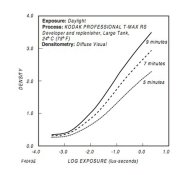
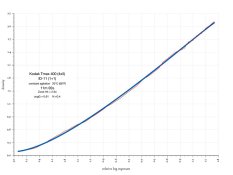
That's exactly what I'm saying, and it is correct and hopefully not misleading. Here is my proof:

Attached are two Kodak Tmax-400 graphs. The first is from Kodak from their tech-publication F4043 and shows that this film is able to reach a Dmax well over 3.2 without ever showing a shoulder. The second is from one of my tests over an exposure range of 16 stops. I took a different developer and a different time than Kodak but got to a similar Dmax, and again without a shoulder. The film will show a shoulder eventually, of course, but not over this range. This film is able to capture a normal subject brightness range of 7 stops, and still be overexposed by 9 stops or more without compressing the highlight detail. Not that I wold do that, because this film would be very hard to print and EIs of 1 are no fun to expose, but it can be done without the disadvantages you claim. By the way, TriX is almost as good but shows the first signs of a shoulder at a density of 3.2. PlusX shows a shoulder at about 2.7. Delta 100 is similar to PlusX and Neopan similar to TriX in Dmax. FP4 might be the exception, but HP5 will work.

Convinced?
 

Attachments

  • Tmax400-F4043.jpg
    Tmax400-F4043.jpg
    40.5 KB · Views: 177
  • TmaxRange.jpg
    TmaxRange.jpg
    40.4 KB · Views: 163
Last edited by a moderator:

rwboyer

Member
Allowing Ads
Joined
Oct 16, 2009
Messages
522
Location
MD USA
Format
Medium Format
RB

That's exactly what I'm saying, and it is correct and hopefully not misleading. Here is my proof:

Attached are two Kodak Tmax-400 graphs. The first is from Kodak from their tech-publication F4043 and shows that this film is able to reach a Dmax well over 3.2 without ever showing a shoulder. The second is from one of my tests over an exposure range of 16 stops. I took a different developer and a different time than Kodak but got to a similar Dmax, and again without a shoulder. The film will show a shoulder eventually, of course, but not over this range. This film is able to capture a normal subject brightness range of 7 stops, and still be overexposed by 9 stops or more without compressing the highlight detail. Not that I wold do that, because this film would be very hard to print and EIs of 1 are no fun to expose, but it can be done without the disadvantages you claim. By the way, TriX is almost as good but shows the first signs of a shoulder at a density of 3.2. PlusX shows a shoulder at about 2.7. Delta 100 is similar to PlusX and Neopan similar to TriX in Dmax. FP4 might be the exception, but HP5 will work.

Convinced?

Nope.

Instead of us both adding a bunch of arbitrary numbers together to prove various points I'll send you a negative that I "accidentally" overexpose by 8 stops without really trying to shoulder it on purpose or anything and an identical one that has decent zone III and IV shadow detail of the same scene as soon as I have some time.

IF you cannot see the difference in highlight separation/compression from one to the other with your eyes I will retract my statement that 8 stops overexposure is NOT "fine".

Peace

RB
 

RalphLambrecht

Subscriber
Allowing Ads
Joined
Sep 19, 2003
Messages
14,947
Location
K,Germany
Format
Medium Format
Nope.

Instead of us both adding a bunch of arbitrary numbers together to prove various points I'll send you a negative that I "accidentally" overexpose by 8 stops without really trying to shoulder it on purpose or anything and an identical one that has decent zone III and IV shadow detail of the same scene as soon as I have some time.

IF you cannot see the difference in highlight separation/compression from one to the other with your eyes I will retract my statement that 8 stops overexposure is NOT "fine".

Peace

RB


RB

I don't doubt that you have a different experience. Some emulsion don't reach quite a high of a Dmax, and if there is not enough developing agent in the mix, the shoulder will roll off even sooner. But the data I have posted is not arbitrary. This is manufacturer data and actual test results, and it shows curves without highlight compression up to a 16 stop range. If that doesn't convince you, I have to give up and move on.

All the best.
 

photojoejoe

Member
Allowing Ads
Joined
Sep 20, 2011
Messages
2
Format
35mm
:munch:
The way you asked the question, you'll get four groups of people all voting for their favorite film. The truth is, all B&W films have an enormous latitude towards overexposure. You can print these films even if overexposed by several stops (4-8 stops no problem). You will have to live with long exposure times in the darkroom, but you will be rewarded with great shadow detail. Underexposure is a different matter. There is no latitude towards underexposure, unless you are willing to give up some shadow detail.
 

photojoejoe

Member
Allowing Ads
Joined
Sep 20, 2011
Messages
2
Format
35mm
:munch: This is great advise for the younger B&W photographer! I personally shoot a full stop stronger, and use filters in the darkroom to create contrast. To obtain true black and pure white. An under exposed or developed film will be a very boring gray. I am still a fan of D-76 developer used with Ilford delta 100 film.
 

StoneNYC

Member
Allowing Ads
Joined
Aug 5, 2012
Messages
8,345
Location
Antarctica
Format
8x10 Format
*scratches head*

I don't think this is helping Dennis the beginner, too much tech speak and argumentative back and forth.

Just sayin' get a room boys :wink:


~Stone

The Important Ones - Mamiya: 7 II, RZ67 Pro II / Canon: 1V, AE-1 / Kodak: No 1 Pocket Autographic, No 1A Pocket Autographic

Sent from my iPad using Tapatalk
 

Stephanie Brim

Member
Allowing Ads
Joined
Jul 28, 2005
Messages
1,603
Location
Iowa
Format
Multi Format
The last post in this thread was over a year ago.
 

StoneNYC

Member
Allowing Ads
Joined
Aug 5, 2012
Messages
8,345
Location
Antarctica
Format
8x10 Format
The last post in this thread was over a year ago.

Haha this app I use displays the dates ultra small and I found this thread searching for opinions on the films before I test the top few I like personally. I hate testing a million films because unlike everyone else I test by taking a boring picture of a sign with the ISO written on it and bracket, and do this with all the films so it's like I have to waste 8 rolls... Ugh haha


~Stone

The Important Ones - Mamiya: 7 II, RZ67 Pro II / Canon: 1V, AE-1 / Kodak: No 1 Pocket Autographic, No 1A Pocket Autographic

Sent from my iPad using Tapatalk
 

StoneNYC

Member
Allowing Ads
Joined
Aug 5, 2012
Messages
8,345
Location
Antarctica
Format
8x10 Format
Also either way the guy never commented again haha


~Stone

The Important Ones - Mamiya: 7 II, RZ67 Pro II / Canon: 1V, AE-1 / Kodak: No 1 Pocket Autographic, No 1A Pocket Autographic

Sent from my iPad using Tapatalk
 

grommi

Member
Allowing Ads
Joined
Mar 14, 2010
Messages
165
Location
continental
Format
Multi Format
What's bad about excavating old threads? This is a great one, although it may appear a bit ridiculous on the first sight. It isn't. Not at all. I didn't read this one before and it's imho a great discussion explaning the basics of exposure. Read the data sheets from the manufacturers, learn the basics of densitometry and always be aware that there is a huge difference between subject contrast, film contrast and paper contrast. And it explains why silver based photography is still miles ahead over digital capture regarding contrast handling. This is real high dynamic range (HDR) with one single shot. The most advanced bw film probably is Acros 100, expose it from about EI 3 to EI 400 on a single roll of film and get great negs. Basically it works with many (not all!) bw and colour negative films with boxspeeds from 100 to 400. Look at the density curves from the data sheets and you will know what works and what doesn't. Acros is easy, FP4+ may be difficult.

Still you often can read that the "modern" (hahaha, Tmax is how old?) emulsions have to be exposed very exactly. This of course is nonsense. The old rule "if in doubt, add one stop" still is fine. Or two, or three :smile:

Best - Reinhold
 
Last edited by a moderator:

StoneNYC

Member
Allowing Ads
Joined
Aug 5, 2012
Messages
8,345
Location
Antarctica
Format
8x10 Format
Expose Acros at ISO 3??? In god's name why?

Maybe if it's 20 years old? Lol


~Stone

The Important Ones - Mamiya: 7 II, RZ67 Pro II / Canon: 1V, AE-1 / Kodak: No 1 Pocket Autographic, No 1A Pocket Autographic

Sent from my iPad using Tapatalk
 

Dismayed

Member
Allowing Ads
Joined
Feb 26, 2011
Messages
438
Location
Boston
Format
Med. Format RF
Expose Acros at ISO 3??? In god's name why?

Errors happen. Now I know that I should go ahead and develop the film instead of tossing.
 

wblynch

Member
Allowing Ads
Joined
Feb 9, 2009
Messages
1,697
Location
Mission Viejo
Format
127 Format
never toss the film before you develop it. You might be surprised at what you get from it.
 

AndreasT

Member
Allowing Ads
Joined
Sep 15, 2006
Messages
326
Location
Berlin
Format
Multi Format
I think this threat is very good.
This should be very soothing information for people using rollfilm.
As long as you expose for the shadows all the rest nearly falls in place. Of course this is a big generalisation but one in my opinion does not have to be overly concerned about all other factors to a reasonable extend.
Just don't underexpose in my oppinion is the most important thing to say.
Although I remember once photographing with acros 35mm film on a sunny day. I exposed the film with 40 iso developed it in Xtol I think it was, using a tripod and the results were extremly unsharp negatives. I presume because of light scattering within the emulsion.
 

pentaxuser

Member
Joined
May 9, 2005
Messages
20,374
Location
Daventry, No
Format
35mm
The most advanced bw film probably is Acros 100, expose it from about EI 3 to EI 400 on a single roll of film and get great negs. Basically it works with many (not all!) bw and colour negative films with boxspeeds from 100 to 400. Look at the density curves from the data sheets and you will know what works and what doesn't. Acros is easy, FP4+ may be difficult.

Best - Reinhold

If this was an example of dry humour which it might be then fine but I suspect you are saying quite a lot here in a serious fashion but unfortunately not saying enough for me to understand fully. Could you expand on the above?

Why is Acros the most advanced B&W film? Why start at EI 3?

What works with b&w and colour neg films? Is this a reference to their dynamic range so that a film with a box speed of 100(Acros in this case) can be successfully exposed at 5 stops over and 2 stops under?

Why is FP4+ difficult? Is this a reference to it's smaller dynamic range compared to Acros i.e. it can handle ?s stops of both under and overexposure?

These are genuine questions on my part and not an attempt to try and take your post apart in an aggressive fashion

Thanks

pentaxuser
 

Stephanie Brim

Member
Allowing Ads
Joined
Jul 28, 2005
Messages
1,603
Location
Iowa
Format
Multi Format
I think this threat is very good.
This should be very soothing information for people using rollfilm.
As long as you expose for the shadows all the rest nearly falls in place. Of course this is a big generalisation but one in my opinion does not have to be overly concerned about all other factors to a reasonable extend.
Just don't underexpose in my oppinion is the most important thing to say.
Although I remember once photographing with acros 35mm film on a sunny day. I exposed the film with 40 iso developed it in Xtol I think it was, using a tripod and the results were extremly unsharp negatives. I presume because of light scattering within the emulsion.

The "expose for shadows, develop for highlights" philosophy is not new. Read "The Negative" by Ansel Adams.
 
Photrio.com contains affiliate links to products. We may receive a commission for purchases made through these links.
To read our full affiliate disclosure statement please click Here.

PHOTRIO PARTNERS EQUALLY FUNDING OUR COMMUNITY:



Ilford ADOX Freestyle Photographic Stearman Press Weldon Color Lab Blue Moon Camera & Machine
Top Bottom