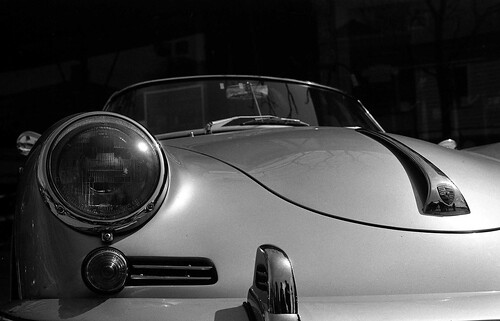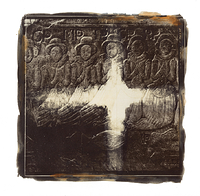
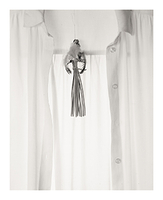

I've recently bought a lot of Foma 100 in 35mm, and since I had little prior experience with developing the film, I've decided to shoot a test roll and soup it in Foma developers that I had on hand (R09, LQN and Excel). Since I've spent several hours doing that I figured I'd archive my results here, if someone finds this helpful, all the better. This is just a quick and dirty (emphasis on dirty - first negative is the worst offender, my apologies) test, so no tripod was used (framing is incosistent and camera shake was an issue with several frames, but I tried to pick out sharpest of the bunch), temperature was a bit above the recommended 20°C at 23°C, I didn't spot dust and didn't really bother with water spots - I was mainly interested in the overall 'thickness' of the resulting negatives, and retention of shadow detail.
The combinations I've tested (development times pulled from massive dev chart):
R09 1+25 @ 4:00 min
R09 1+25 @ 6:30 (time specified for Rodinal)
R09 1+50 @ 8:00
R09 1+100 @ 10:00
LQN 1+10 @ 7:00
Excel (Xtol clone) stock @ 8:00
The last one I did just out of curiosity, since I've mixed this particular batch exactly a year ago and used it to develop three rolls of Delta 3200. Since I've read everywhere that it doesn't keep for long I wasn't actually expecting anything useable, but anyway I extended the development time from 6 minutes to 8 minutes to compensate for exhaustion (+10% for every film developed). Much to my surprise, it worked! The result was pretty close to what I got from the LQN.
I agitated for 30 seconds and then 10 seconds every whole minute, with the exception of R09 at 1:100, which was agitated for a minut at the start and then 10 seconds every two minutes, which resulted in a slight haloing around contrasty edges - an effect that I don't exactly hate.
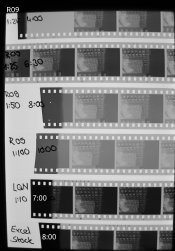
Weakest R09 dilutions resulted in (predictably?) thinnest negatives, LQN and Excel were conversely really thick, and string R09 dilution (1+25) was somewhere in the middle. Somewhat unexpectedly, the 2:30 minutes difference in developing times didn't have that much of an impact, althought the shadows seem a bit more blocked up in the second negative. An overview from a light table is attached below.
http://ext.halka.sk/apug/foma100/1 - R09 1+25 @ 4:00.jpg
http://ext.halka.sk/apug/foma100/2 - R09 1+25 @ 6:30.jpg
http://ext.halka.sk/apug/foma100/3 - R09 1+50 @ 8:00.jpg
http://ext.halka.sk/apug/foma100/4 - R09 1+100 @ 10:00.jpg
http://ext.halka.sk/apug/foma100/5 - LQN 1+10 @ 7:00.jpg
http://ext.halka.sk/apug/foma100/6 - Excel (Xtol) stock @ 8:00.jpg
These were all scanned in Vuescan using default settings on the 'Color' tab - with the exception that I pulled the blackpoint to 0. Scans were done on a Minolta 5400 at 2700 DPI.
I'm now kind of on a fence about which combination should I pursue further - I'm planning to test a single developer/dilution combination with time as a variable, but I'm not sure which one yet The scanner can handle all of these without much trouble, but if I'd want to wet print, which of these would be the easiest to handle?
The combinations I've tested (development times pulled from massive dev chart):
R09 1+25 @ 4:00 min
R09 1+25 @ 6:30 (time specified for Rodinal)
R09 1+50 @ 8:00
R09 1+100 @ 10:00
LQN 1+10 @ 7:00
Excel (Xtol clone) stock @ 8:00
The last one I did just out of curiosity, since I've mixed this particular batch exactly a year ago and used it to develop three rolls of Delta 3200. Since I've read everywhere that it doesn't keep for long I wasn't actually expecting anything useable, but anyway I extended the development time from 6 minutes to 8 minutes to compensate for exhaustion (+10% for every film developed). Much to my surprise, it worked! The result was pretty close to what I got from the LQN.
I agitated for 30 seconds and then 10 seconds every whole minute, with the exception of R09 at 1:100, which was agitated for a minut at the start and then 10 seconds every two minutes, which resulted in a slight haloing around contrasty edges - an effect that I don't exactly hate.
Weakest R09 dilutions resulted in (predictably?) thinnest negatives, LQN and Excel were conversely really thick, and string R09 dilution (1+25) was somewhere in the middle. Somewhat unexpectedly, the 2:30 minutes difference in developing times didn't have that much of an impact, althought the shadows seem a bit more blocked up in the second negative. An overview from a light table is attached below.
http://ext.halka.sk/apug/foma100/1 - R09 1+25 @ 4:00.jpg
http://ext.halka.sk/apug/foma100/2 - R09 1+25 @ 6:30.jpg
http://ext.halka.sk/apug/foma100/3 - R09 1+50 @ 8:00.jpg
http://ext.halka.sk/apug/foma100/4 - R09 1+100 @ 10:00.jpg
http://ext.halka.sk/apug/foma100/5 - LQN 1+10 @ 7:00.jpg
http://ext.halka.sk/apug/foma100/6 - Excel (Xtol) stock @ 8:00.jpg
These were all scanned in Vuescan using default settings on the 'Color' tab - with the exception that I pulled the blackpoint to 0. Scans were done on a Minolta 5400 at 2700 DPI.
I'm now kind of on a fence about which combination should I pursue further - I'm planning to test a single developer/dilution combination with time as a variable, but I'm not sure which one yet
The scanner can handle all of these without much trouble, but if I'd want to wet print, which of these would be the easiest to handle?