• Welcome to Photrio!
    Registration is fast and free. Join today to unlock search, see fewer ads, and access all forum features.
    Click here to sign up

Flattening FB prints with drymount press

Iriana

H
Iriana

  • 2
  • 0
  • 52
Puddle

Puddle

  • 4
  • 2
  • 97

Forum statistics

Threads
202,734
Messages
2,844,775
Members
101,489
Latest member
Sunnydoran
Recent bookmarks
0

brian steinberger

Member
Allowing Ads
Joined
Jan 5, 2007
Messages
3,067
Location
Pennsylvania
Format
Med. Format RF
I have recently acquired a Seal drymount press. I just used it for the first time yesterday. I'm just using the press to flatten my FB prints for now. I placed the print between two sheets of acid free matboard with a piece of release paper against the top plate (not sure I need this?). I heated for 5 minutes at about 200 degrees. The print is wonderfully flat, but it stuck to the matboard slightly and when I pulled it off carefully it left a strange marring to the print surface (Ilford MGWT glossy). Fortunately it wasn't a fine print, but I don't want to screw up the others. The prints were only drying a few hours, but felt dry to the touch. I thought to get the flattest prints they should be pressed when dry to the touch? If this is the case what kind of board or paper do I need to put in what order into the press to allow humidity to escape but also not mar the surface?

Any other advice is great too! Thanks!
 
I have recently acquired a Seal drymount press. I just used it for the first time yesterday. I'm just using the press to flatten my FB prints for now. I placed the print between two sheets of acid free matboard with a piece of release paper against the top plate (not sure I need this?). I heated for 5 minutes at about 200 degrees. The print is wonderfully flat, but it stuck to the matboard slightly and when I pulled it off carefully it left a strange marring to the print surface (Ilford MGWT glossy). Fortunately it wasn't a fine print, but I don't want to screw up the others. The prints were only drying a few hours, but felt dry to the touch. I thought to get the flattest prints they should be pressed when dry to the touch? If this is the case what kind of board or paper do I need to put in what order into the press to allow humidity to escape but also not mar the surface?

Any other advice is great too! Thanks!

I use my Seal for the same purpose but don't use a release sheet and only heat for 1 min between two clean matboards,followed by letting it coool for 5 min under a piece of 1/4 inch glass:smile:
 
, no need for the release paper... press the two pieces of rag board first to take out the moisture .. lower time to 1minute , chech the pressure
 
Hello Brian

If it's the first time you've used the boards, what will have happened is the initial heating has released inherent moisture in them. Crazy to think the board is like a piece of fruit but it will be there. When the first print goes in and the water is partly evaporated, it then reacts with the surface if the print slightly sticking. You have seen a bit of steam coming off the press? Best thing with new boards is to heat up for the first time, take them out for maybe five or ten minutes, put back in and you are ready to go. They should be OK after that. If you don't use the press and boards for a long time, you may have to repeat. Will have to do this every time you replace the boards.
 
I do use release paper, but between the print and matboard. It prevents the texture of the board from transferring to the print. Always start with a completely dry print.
As has been stated, run the matboard first.
 
I have never liked release paper , if it gets creased for any reason it will transfer to the print.... But I am sure it works
I do use release paper, but between the print and matboard. It prevents the texture of the board from transferring to the print. Always start with a completely dry print.
As has been stated, run the matboard first.
 
Bob- Do you dry mount? I find release paper a necessity for dry mounting purposes.
 
I use my Seal for the same purpose but don't use a release sheet and only heat for 1 min between two clean matboards,followed by letting it coool for 5 min under a piece of 1/4 inch glass:smile:

Ralph, when you pull it out of the press and put it under glass isn't there a risk of sticking to the glass?
 
Thanks for all the responses guys. Why only one minute? Seems quite short. Is 200 degrees a good temp?

So if I preheat the mat boards to remove moisture the print will not stick to the boards then? What about moisture in the print?
 
If the print hold moisture, it is very little compared to the mat boards. I find 30 seconds sufficient time to flatten a print, followed by cooling under a large book. 200 degrees is plenty hot. You can stack multiple prints under the book.
 
If the print hold moisture, it is very little compared to the mat boards. I find 30 seconds sufficient time to flatten a print, followed by cooling under a large book. 200 degrees is plenty hot. You can stack multiple prints under the book.

Thanks Loren. Do you use release paper between the print surface and boards?
 
What about moisture in the print?

Best to wait till prints are dry before flattening as if it has uneven levels of moisture, this can also cause it to stick, though probably more common on a gloss surface than matt as the surface is more likely to dry at a different rate to the base, hence the paper curling.
 
I have never , ever . ok lied once .. used release paper for dry mounting... I always use two pieces of 32 x40 rag board in my press, pre heat the sheets with vacumn and then mount between them.

Bob- Do you dry mount? I find release paper a necessity for dry mounting purposes.
 
A slow way to flatten dry fiber prints is to store them alternately face up and face down under a weight or in a tightly packed box. They may not stay flat when removed from this procedure and exposed to air of varying humidity.
 
To dry the board and/or print, I find it best to keep the press closed for a minute, then open and close the press a few times with 15 seconds or so between opening the press. Without opening the press a few times, the heated moisture has no where to go.

I do not use release paper.
 
I always wait until the print dries.
I used release paper, but I had problems with the photo surface.
So I bought large pieces of foam that were cut to the size cover the press (the same used by an upholsterer).
I have different densities and thickness, but so far I have used 4 mm and medium density.
I use the press at 80C to 90C for one minute.
The foam works good at these temperatures and it allows the water inside the print to get out.
 
- preheating of the mat boards is essential
- I also flatten prints in two passes through the mount press, the first only about 10-15 seconds to dissipate residual moisture, then a second pass for about 45 seconds. This is plenty, even on the lowest temperature setting. Fiber prints/watercolor papers only. I only use my press for flattening, not dry mounting.
 
I print pretty slowly, but my flattening process seems to work well for the 2-3 final prints I churn out in a night. I load them face up, then matboard on top. I'll fire up the press for a couple minutes set at 200, but it never warms all the way up. Then I'll just let the prints sit there overnight. Not totally flat, but very easy to manage at that point.
 
- preheating of the mat boards is essential
- I also flatten prints in two passes through the mount press, the first only about 10-15 seconds to dissipate residual moisture, then a second pass for about 45 seconds. This is plenty, even on the lowest temperature setting. Fiber prints/watercolor papers only. I only use my press for flattening, not dry mounting.

Do you open the press completely between passes?
 
I flatten fully air dry FB photographs at 190F in a dry mount press between a smooth 4 ply mount board under and a smooth 2 ply mount board on top. The mount boards are heated and re-heated in advance until they are dead dry and act as sponges to absorb any whiff of moisture from the photograph being flattened. After 15 seconds the hot photograph is removed from the press and placed under a big sheet of cold glass. The next photograph goes through the same cycle and goes under the glass on top of the first one...and so on.

A critical precaution is to make sure that the mount boards and the photograph do not bear the smallest speck of grit (front or back) as the photograph will have a permanently embossed ding in it. That's a flaw that no viewer sees but I can't look away from!
 
Brian,
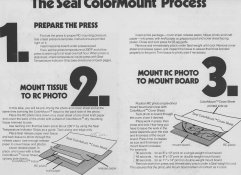
I only use Release Paper for the dry mounting process, not the print drying process. See attached step by step instructions from Seal that have worked well for many years for dry mounting prints with their dry mount tissue, either RC or fiber.
Back to the fiber print flattening technique, I only flatten after the print is fully air dried. I place the print directly on the foam pad face up in the press and place a dry mount board directly over the print. This simulates the thickness of the stack when dry mounting. The moisture in the print will dissipate into the foam pad (or the single mat board) in 30 seconds at 200 degrees. The print will come out with a slight curl. The weight of the book during cooling helps reduce the curl.
 

Attachments

  • oxford 10.jpg
    oxford 10.jpg
    642.4 KB · Views: 536
Thanks again guys for all the help. I think I feel comfortable now with the process. One last question, is it safe to say a Fb print is fully dry in 24 hours time?

I've found that in western Pennsylvania that depends largely on the day... in the winter my prints tend to dry quickly, some days in the summer or spring when the heat isn't on and it's humid out it takes longer.
 
I use release paper with one sheet placed directly on top of the print and the other on its backside. If uyou don't use release paper there is a danger that the fibers of the mat board will make small impressions on the print.

I always keep both covering boards and the release paper in the press and turn it on and let it heat-up to 190F. Right before it gets to operating temperature I the sandwich and insert the print. At 190F I please the sandwich in the press and close for about 5 seconds and open (to eliminate any trapped moisture from the print) and then close down for 60-seconds and remove and let cool. I don't use a weight for cooling and haven't had a problem. The board always cools straight.

I always wait 24 hours after printing before mounting.

Thomas
 
Photrio.com contains affiliate links to products. We may receive a commission for purchases made through these links.
To read our full affiliate disclosure statement please click Here.

PHOTRIO PARTNERS EQUALLY FUNDING OUR COMMUNITY:


Ilford ADOX Freestyle Photographic Stearman Press Weldon Color Lab Blue Moon Camera & Machine
Top Bottom