
• Welcome to Photrio!
    Registration is fast and free. Join today to unlock search, see fewer ads, and access all forum features.
    Click here to sign up

Fixing in table salt solution

Recent Classifieds

Forum statistics

Threads
201,201
Messages
2,820,355
Members
100,581
Latest member
bountsy
Recent bookmarks
0

Alan Johnson

Subscriber
Allowing Ads
Joined
Nov 16, 2004
Messages
3,363
http://www.flickr.com/groups/1924221@N25/discuss/72157629528867358/
I developed 2 test strips of Agfaphoto APX 100 for the same times in Fomadon Excel (similar to Xtol) at 23.5C.
One strip was stopped and fixed normally in proprietary chemicals.
The second strip was stopped with one wash of water at 27C then fixed for 24hrs @ 28 +/- 2 C in a solution comprising 150grams table salt in 600ml water.
The tank was kept in a warm cupboard (hot water cylinder) and agitated about every 2hrs except during 8 hrs when it was only agitated once.
Conclusion:
The print from the negative fixed in table salt solution is entirely satisfactory but held side by side with a print from the proprietary fixer negative it is slightly more grainy.
See scans of 0.1 in square sections of negative, processed identically.

 

Attachments

  • fixer-proprietary-1.jpg
    fixer-proprietary-1.jpg
    195 KB · Views: 788
  • fixer-table salt-1.jpg
    fixer-table salt-1.jpg
    219.1 KB · Views: 854

pentaxuser

Member
Joined
May 9, 2005
Messages
20,252
Location
Daventry, No
Format
35mm
Interesting experiment. Apart from the apparent extra graininess, can you be sure that table salt has actually fixed the film permanently in the way that proprietary fixer does?

Thanks

pentaxuser
 

Light Guru

Member
Allowing Ads
Joined
Jun 20, 2011
Messages
122
Format
4x5 Format
Why would you want to spend 24hours agitating every 2 hours to fix your film. It's not like buying fixer that will do the job in 5 minutes is expensive.
 

removed account4

Subscriber
Allowing Ads
Joined
Jun 21, 2003
Messages
29,832
Format
Hybrid
hi alan

love this stuff :smile:

from what i remember talbot's salt fixer sometimes wasn't permanent, sometimes it worked, and othertimes he had "troubles" ...
( that is why he was turned on to hypo ) ..

what i was told about the salt fixer is that it "preserves" the image, and sometimes it doesn't, or fix it completely. i wish i could remember who told me
and where i read it, i'd link to it for you.

i think its great to have materials to light-fast things
and develop things that are in a lot of kitchens ... the darkroomexpermente did all sorts of tests
and developed film in shallots, as well as rosemary and also what seemed to be dinner ( salad )
now with a little salt its fixed :smile:

john
 

Amphetadream

Member
Allowing Ads
Joined
Apr 28, 2013
Messages
3
Format
35mm
I wonder if this would be useful for preserving solargraphs? Standard fixer pretty much ruins the image completely, and unfixed they are doomed to slowly fade away...
 

miha

Member
Allowing Ads
Joined
Feb 15, 2007
Messages
3,016
Location
Slovenia
Format
Multi Format
Michael, but sodium thiosulfate is recommended for fixing T-grain films.
 

removed account4

Subscriber
Allowing Ads
Joined
Jun 21, 2003
Messages
29,832
Format
Hybrid
isn't ammonium thiosulfate usually recommended ( speed fixer ) for t grained films,
and fix times can sometimes still seem excessive in order to get the color tinge out of the film.
(tmy, tmx and tmz at least )
 

miha

Member
Allowing Ads
Joined
Feb 15, 2007
Messages
3,016
Location
Slovenia
Format
Multi Format
Both are recommended, at least by Kodak, but ammonium thio is twice as fast.
 

Gerald C Koch

Member
Allowing Ads
Joined
Jul 12, 2010
Messages
8,131
Location
Southern USA
Format
Multi Format
Talbot's paper negatives and prints were not fixed but merely stabilized. Examples of his work in the British Museum can only be viewed briefly in very dim light to prevent them from fading.

Sorry folks you still need to use thiosulfate or a similarly strong complexing agent.
 
OP
OP

Alan Johnson

Subscriber
Allowing Ads
Joined
Nov 16, 2004
Messages
3,363
If I may be granted a temporary indulgence to stray from the conventional, if there are no photochemicals available, film may be developed in Caffenol, fixed in salt and the image obtained on a mobile phone using the Lomography app for iphone or android, there are other similar apps.The image does not need to be archival on the film.Some countries with a different culture have mobile based banking systems.
I have not actually done this.
 

A-Shooter

Member
Allowing Ads
Joined
Feb 15, 2012
Messages
7
Format
Multi Format
The anti-caking agent in the table salt may give some fixing action depending on what agent is used. Some table salts contains small amounts of potassium or sodium thiocyanate. This is an express fixer agent. The amount in 150g salt used alone may fix he film in 10-15 minutes, but the salt really hampers the action.
So, no, salt doesn't work as a fixer. Get some ammonium thiosulfate and mix your own fixer. It can be bought on the net and shipped by mail. If you can't get it by mail, there is a great possibility that you cannot get film either. Problem solved. :smile:
 

Gerald C Koch

Member
Allowing Ads
Joined
Jul 12, 2010
Messages
8,131
Location
Southern USA
Format
Multi Format
Has anyone thought to test the film for residual silver? If not then the results are meaningless. An improperly fixed negative will eventually fade.
 
OP
OP

Alan Johnson

Subscriber
Allowing Ads
Joined
Nov 16, 2004
Messages
3,363
My table salt has sodium hexacyanoferrate II as anti-caking agent. Still it's rather surprising if all those including Fox Talbot who used salt had cyano-derivatives in it.
I did check,for example, ebay India, film can be purchased shipped from the US but not fixer, it may be related to shipping cost.
I don't think Caffenol-table salt-mobile phone as a route into film photography would appeal to many on APUG but it is very low cost if you have the phone so just mention this route exists, a search reveals some recently tried caffenol-table salt.
 

pentaxuser

Member
Joined
May 9, 2005
Messages
20,252
Location
Daventry, No
Format
35mm
Has anyone thought to test the film for residual silver? If not then the results are meaningless. An improperly fixed negative will eventually fade.

You've hit on a key question here, Gerald, as to salt's efficacy as a fixer. I look forward to somebody's test results.

pentaxuser
 

removed account4

Subscriber
Allowing Ads
Joined
Jun 21, 2003
Messages
29,832
Format
Hybrid
My table salt has sodium hexacyanoferrate II as anti-caking agent. Still it's rather surprising if all those including Fox Talbot who used salt had cyano-derivatives in it.
I did check,for example, ebay India, film can be purchased shipped from the US but not fixer, it may be related to shipping cost.
I don't think Caffenol-table salt-mobile phone as a route into film photography would appeal to many on APUG but it is very low cost if you have the phone so just mention this route exists, a search reveals some recently tried caffenol-table salt.

and current mobile phone cameras can create an image as good as some 35mm cameras ( 40mb files ) ...
i couldn't agree more alan!
john
 

cliveh

Subscriber
Allowing Ads
Joined
Oct 9, 2010
Messages
7,705
Format
35mm RF
Guys, don’t confuse Talbot’s early work with the later development of the Calotype. As Gerald points out Talbot used salt solution to stabilise his photogenic drawings not fix them. These were made with silver nitrate solution and a weak salt solution. AgN03 + NaCl = AgCl. Talbot noticed that without any stabilisation or fixing the image would fade more quickly at the edges of his prints (where he had brushed on less salt). Therefore using his clever inverse logic he used a much stronger salt solution over the entire image. This stabilised it, but as Gerald mentions it would still fade and change colour with time.
 
OP
OP

Alan Johnson

Subscriber
Allowing Ads
Joined
Nov 16, 2004
Messages
3,363
Has anyone thought to test the film for residual silver? If not then the results are meaningless. An improperly fixed negative will eventually fade.
Yes, fair comment.
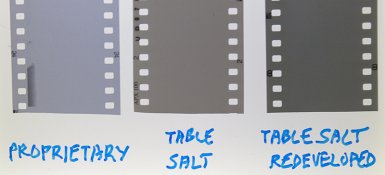
Attachment shows the fog levels with proprietary fixer, table salt fixer, and a strip fixed in table salt then redeveloped for 3x recommended time and washed only.
The darker color of the redeveloped strip suggests that the table salt strip was not quite completely fixed. Perhaps after years it would darken to the density of the redeveloped strip.
 

Attachments

  • fog levels.jpg
    fog levels.jpg
    253.6 KB · Views: 413

Gerald C Koch

Member
Allowing Ads
Joined
Jul 12, 2010
Messages
8,131
Location
Southern USA
Format
Multi Format
It would be interesting to check the fixation with other films such as a fast film and a film which has a high iodide content such as T-grain or Delta films. These films are slow to fix with thiosulfate and should prove a challenge to a salt fixer.
 
Last edited by a moderator:

Rudeofus

Member
Joined
Aug 13, 2009
Messages
5,113
Location
EU
Format
Medium Format
The anti-caking agent in the table salt may give some fixing action depending on what agent is used. Some table salts contains small amounts of potassium or sodium thiocyanate. This is an express fixer agent. The amount in 150g salt used alone may fix he film in 10-15 minutes, but the salt really hampers the action.
If you look at these tables, you will see that Silver Chloride is quite soluble in Sodium Chloride, but that Ammonium Chloride works even better. Silver Bromide and Silver Iodide, of course, won't be easy to fix that way, but fortunately most common table salt contains Iodide which works as stabilizer. Likewise, the Thiocyanate you mentioned as anti caking agent will rather work as stabilizer, not as fixer.

If you have to fix film and just can't possibly get your hands on any trace of Thiosulfate, I would recommend multiple bathes of concentrated Ammonium Chloride at elevated temperature, with each fixing step no longer than 10 minutes. There is no need to wash between fixing steps in such a setup.
 

removed account4

Subscriber
Allowing Ads
Joined
Jun 21, 2003
Messages
29,832
Format
Hybrid
hi rudeofus

i have often thought of using salt if i can't get my hands on fix ...
once the film ( or print ? ) is soaked in salt and washed ...
when it is fixed in traditional fixer are there any worries of the image
film or paper being damaged by the fixer?

thanks!
john
 

Gerald C Koch

Member
Allowing Ads
Joined
Jul 12, 2010
Messages
8,131
Location
Southern USA
Format
Multi Format
The amount of iodide in table salt is far too small to be of any use in fixing emulsions that contain silver iodide such as T-grain films.

Since a salt solution takes so very long to fix film it really is not a practical substitute for conventional fixers.
 

Rudeofus

Member
Joined
Aug 13, 2009
Messages
5,113
Location
EU
Format
Medium Format
i have often thought of using salt if i can't get my hands on fix ...
once the film ( or print ? ) is soaked in salt and washed ...
when it is fixed in traditional fixer are there any worries of the image
film or paper being damaged by the fixer?
I don't think that table salt can damage your film, but please consider that Silver Iodide is VERY insoluble (by seven orders of magnitude less than Silver Chloride!), therefore I don't think you can properly fix a modern Silver Bromide Iodide emulsion with rock salt. Note, that the tables I linked to are for Silver Chloride, not the other Halides. You should be able to fix warm tone paper with rock salt, though.

Since inability to obtain Thiosulfate based fixer can only be a temporary issue in most parts of the world, you may want to look at stabilizer recipes which should keep your film stable until you get proper fixer. There are several recipes for stabilizer in Haist's book and probably elsewhere. Since stabilizers are quite dilute compared to fixer, keeping an emergency stash of their ingredients should require very little space and monetary effort.
 
Photrio.com contains affiliate links to products. We may receive a commission for purchases made through these links.
To read our full affiliate disclosure statement please click Here.

PHOTRIO PARTNERS EQUALLY FUNDING OUR COMMUNITY:


Ilford ADOX Freestyle Photographic Stearman Press Weldon Color Lab Blue Moon Camera & Machine
Top Bottom