• Welcome to Photrio!
    Registration is fast and free. Join today to unlock search, see fewer ads, and access all forum features.
    Click here to sign up

Fixer formula using these two chemicals

Millstone, High Water

A
Millstone, High Water

  • sly
  • Dec 17, 2025
  • 2
  • 5
  • 72
The Party

A
The Party

  • 0
  • 0
  • 55

Recent Classifieds

Forum statistics

Threads
201,243
Messages
2,821,105
Members
100,614
Latest member
generic
Recent bookmarks
0

wildbill

Member
Allowing Ads
Joined
Nov 28, 2004
Messages
2,828
Location
Grand Rapids
Format
Multi Format
I've been using Arista oderless fixer for several years in liquid form. Now that I'm no longer in los angeles, the xtra shipping charges are $$$$$ and I'd rather mix my own anyway. It contains
Ammonium thiosulfate
Sodium bisulfite

Who's got a formula for me that uses these chemicals?
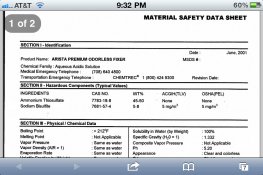
Here's the msds
 

Attachments

  • ImageUploadedByTapatalk1331433571.717926.jpg
    ImageUploadedByTapatalk1331433571.717926.jpg
    161.6 KB · Views: 625

Bruce Osgood

Membership Council
Member
Allowing Ads
Joined
Sep 9, 2002
Messages
2,642
Location
Brooklyn, N.Y.
Format
Multi Format
This is the formula from The Darkroom Cookbook for TF-3:

Ammonium thiosulfate (57-60%)..... 800 mL
Sodium sulfite.............................. 60 g.
Sodium metaborate....................... 5 g.
Add water to 1 Ltr.

Dilute 1:4 (1+3). Fix film 3 min, paper 1 min, followed by 1 min continuous wash.

Not to be used with an acid stop bath and there is no need for a Hypo wash.

I have not used this yet but I will be getting the metaborate Monday. I've been using TF-4 which I believe is TF-3 in an already liquid form.
 

Rudeofus

Member
Joined
Aug 13, 2009
Messages
5,115
Location
EU
Format
Medium Format
Bruce, your formula makes an alkaline fixer while wildbill's ingredients make a rather acidic fixer. Sodium bisulfite by itself is quite acidic and it is usually used together with sodium sulfite. Look (there was a url link here which no longer exists) for a popular recipe. Since sodium sulfite is not overly toxic there is a chance it doesn't show up on your msds.

If you are absolutely determined to make it work without sodium sulfite, think of two things:
  • If your pH drops too low, the thiosulfate will decompose and becomes ineffective. Stay above pH 4.5 at all times
  • The main reason why folks throw sulfite/bisulfite into the fixer is that it acts as preservative. If you use too little bisulfite, your fixer won't last for long (in terms of time, not capacity).
Combining these two might put you between a rock and a hard place, so I'd at least think about the recipe I linked to above.
 

ruilourosa

Member
Allowing Ads
Joined
Apr 13, 2003
Messages
797
Location
Portugal
Format
Multi Format
just put 200 ml of ammonium thiosulfate + 20 gr of bisulfite, to 1 liter, it will be acidic but if you add another 20 gr of borax it will be almost neutral, if you add more borax it will smell like ammonia and become alkaline. borax can be substituted by a smaller amount of sodium carbonate, if PH is a concern you can buy test strips in some drugstore or internet sites.
 

Ian Grant

Subscriber
Allowing Ads
Joined
Aug 2, 2004
Messages
23,370
Location
West Midland
Format
Multi Format
It's quite possible that Arista fixer contains other chemicals but below the level where they need to be listed in an MSDS.

Actually Sodium Metabisulphite has often been used in fixers with no other sulphite present but it will only be mildly acidic in an Ammonium Thiosulphate based fixer, something stronger like Acetic acid needs to be used for true acid fixers - also some form of acid buffering when a fixer's possible going to be used with a hardener.

Ian
 

nworth

Member
Allowing Ads
Joined
Aug 27, 2005
Messages
2,228
Location
Los Alamos,
Format
Multi Format
There are a good many fixers like you suggest. One is:

C-41 Fixer
Water 700 ml
Ammonium thiosulfate (58%) 189 ml
Sodium EDTA 1.5 g
Sodium bisulfite 15 g
WTM 1 l
pH = 6.5
Ref: Photo techniques, Nov/Dec 2000, pg. 20

The EDTA isn't really needed for black and white.

Another is:

GAF 203 Non-hardening fixer
Water 740 ml
Sodium thiosulfate 475 g (use 429 ml of Ammonium thiosulfate)
Potassium metabisulfite 67.5 g
WTM 1 l
Dilute 1:1 for use. Fix 5 to 10 minutes at 20C. Do not use above 21C or in conjunction with solutions containing hydrogen peroxide, like Kodak HE-1.

or:

Metabisulfite fixer (non-hardening)
Sodium thiosulfate (penta) 400 g (use 360 ml of ammonium thiosulfate)
Potassium metabisulfite 25 g
WTM 1 l

As noted, these are not compatible with alum hardeners or hydrogen peroxide.

Usually, both sodium sulfite and bisulfite are used:

Kodak F-24 fixer (non-hardening)
Sodium thiosulfate (penta) 240 g (use 216 ml of ammonium thiosulfate)
Sodium bisulfate 25 g
Sodium sulfite (anh) 10 g

or:

Kodak F-34 non-hardening fixer
Water 700 ml
Ammonium thiosulfate (58%) 185 ml
Sodium sulfite 10 g
Sodium bisulfate 8.4 g
WTM 1 l
pH=6.5 at 27C; sp.gr. 1.08.
Fix 5247 (color negative) film 2 minutes at 100F.

The conversions given are molar equivalents of ammonium thiosulfate (58%) for sodium thiosulfate pentahydrate. Usually only about 86 percent of the molar equivalent of the ammonium thiosulfate is used, but it is not critical.
 
Last edited by a moderator:

Rudeofus

Member
Joined
Aug 13, 2009
Messages
5,115
Location
EU
Format
Medium Format
Metabisulfite fixer (non-hardening)
Sodium thiosulfate (penta) 400 g (use 360 ml of ammonium thiosulfate)
Potassium metabisulfite 25 g
WTM 1 l
Is there one credible reason why we should use potassium metabisulfite instead of sodium metabisulfite? To my best knowledge potassium ions do not exactly help fixer activity either, quite to the contrary. Also, the amount of thiosulfate is almost doubled for no apparent reason. I have seen that recipe posted over and over again but really doubt anyone would mix it like this.
 
OP
OP
wildbill

wildbill

Member
Allowing Ads
Joined
Nov 28, 2004
Messages
2,828
Location
Grand Rapids
Format
Multi Format
Bruce, your formula makes an alkaline fixer while wildbill's ingredients make a rather acidic fixer. Sodium bisulfite by itself is quite acidic and it is usually used together with sodium sulfite. Look (there was a url link here which no longer exists) for a popular recipe. Since sodium sulfite is not overly toxic there is a chance it doesn't show up on your msds.

If you are absolutely determined to make it work without sodium sulfite, think of two things:
  • If your pH drops too low, the thiosulfate will decompose and becomes ineffective. Stay above pH 4.5 at all times
  • The main reason why folks throw sulfite/bisulfite into the fixer is that it acts as preservative. If you use too little bisulfite, your fixer won't last for long (in terms of time, not capacity).
Combining these two might put you between a rock and a hard place, so I'd at least think about the recipe I linked to above.

what's the dilution of the recipe you linked to?

and for any others you guys have posted?
 

Rudeofus

Member
Joined
Aug 13, 2009
Messages
5,115
Location
EU
Format
Medium Format
what's the dilution of the recipe you linked to?
Ryuji states 1 liter and he seems to use it at this strength. Since ammonium thiosulfate is outrageously expensive here compared to sodium thiosulfate, I will probably try (there was a url link here which no longer exists) in the next few weeks.
 

Worker 11811

Member
Allowing Ads
Joined
Jan 18, 2010
Messages
1,719
Location
Pennsylvania
Format
Multi Format
I know this isn't the formula the OP was looking for. However, I think this might be a good time to share something.

I have a 36-page booklet entitled, "Agfa Formulas for Photographic Use."
It contains a whole bunch of formulas for developers, fixers, hardeners and all sorts of other stuff.

Here is an excerpt from that booklet:
AGFA 203
NON-HARDENING METABISULPHITE FIXER
This fixing bath is recommended for use when hardening is not desired. It is highly desirable for accuracy of registration in color work with Reprolith Film.
Stock Solution
Hypo ... 1900 grams (4 lb.)
Agfa Potassium Metabisulphite ... 270 grams (9 oz.)
Water to make ... 4 liters (1 gal.)

The Metabisulphite should be added only when the Hypo solution is cool.
For use, dilute one part stock solution with one part water. Normal fixing time 5 to 10 minutes at 68º F. (20º C.).

This booklet was published in 1941 and it contains no formal declaration of copyright. (e.g. "Copyright © 19xx - John Smith - All rights reserved.) So, according to what I understand, this publication is in public domain for two reasons: The copyright is expired, plus there is no formal declaration of copyright.

Therefore, if anybody is interested in reading this booklet, send me an e-mail or a P.M. and I'll reply with a link where you can download a PDF copy of the book.

One word of warning: This booklet contains formulas for things that are toxic and very dangerous such as Monckhoven's Intensifier and other formulas that contain substances like mercuric chloride and potassium cyanide. This is the main reason why I'm not publishing the link in the clear. While there are many useful formulas in the booklet and it makes interesting reading on an academic level, I want everybody to understand that they follow the directions contained therein at their own risk.

Again, if you're interested to read this book, send me a message...

 

nworth

Member
Allowing Ads
Joined
Aug 27, 2005
Messages
2,228
Location
Los Alamos,
Format
Multi Format
Is there one credible reason why we should use potassium metabisulfite instead of sodium metabisulfite? To my best knowledge potassium ions do not exactly help fixer activity either, quite to the contrary. Also, the amount of thiosulfate is almost doubled for no apparent reason. I have seen that recipe posted over and over again but really doubt anyone would mix it like this.

None that I can tell. I just copied the formula from refernce material.
 

Ian Grant

Subscriber
Allowing Ads
Joined
Aug 2, 2004
Messages
23,370
Location
West Midland
Format
Multi Format
Kodak and Agfa both used Potassium Metabisulphite in commercial fixers and all companies used Potassium Alum in their hardeners. It seems to be high levels of Potassium ions that's important not so much their presence at relatively low levels. So you don't use Potassium Thiosulphate as the fixing agent.

Ian
 

Rudeofus

Member
Joined
Aug 13, 2009
Messages
5,115
Location
EU
Format
Medium Format
Ian: if you look at recipes calling for metabisulfite, 99% of them use the sodium version (which is the most easy to get version anyway), except for this one recipe which I happen to see posted all over the place. Since potassium doesn't improve the action of thiosulfate, I didn't understand the motivation for using potassium metabisulfite. As it turns out, the poster doesn't know the reasons for K2S2O5 either, he just copied the recipe off somewhere for our convenience.

willbill: Ammonium thiosulfate makes great fixers and it has become very popular once it became affordable. Unluckily, we live in a time now where the economy of scale does no longer work for ammonium thiosulfate, at least not in home brew quantities. If you bought it by the metric ton, it would be still cheap, so you will find rapid fixer cheaper than if you buy the raw chems. One of my home brew projects (on back burner right now) is mixing, testing and optimizing sodium thiosulfate based fixers, and Ole's quick fix will be my starting point.
 

Ian Grant

Subscriber
Allowing Ads
Joined
Aug 2, 2004
Messages
23,370
Location
West Midland
Format
Multi Format
Rudeofus, I've a very large collection of published formulae of all types and Potassium Metabisulphite was used with Ammonium Thiosulphate in some commercial formulae, I don't bother collecting home made recipes.

Sometimes there's exaggerated claims made that fixers should be Potassium free after all it's still used in some commercial fixers.

I'd clarify that the formula posted by Worker 11811 is not actually an Agfa formula rather it's the Agfa Ansco/GAF 203 Fixer, unfortunately numbers and formulae don't match between the two companies.

Ian
 

Ian Grant

Subscriber
Allowing Ads
Joined
Aug 2, 2004
Messages
23,370
Location
West Midland
Format
Multi Format
I'd add that one commercial fixer contains Ammonium Thiosulphate, Potassium Sulphite and Potassium Metabisulphite and taht's from one of the top 4 manufacturers (Kodak, Agfa, Ilford & Fuji).

Ian
 
OP
OP
wildbill

wildbill

Member
Allowing Ads
Joined
Nov 28, 2004
Messages
2,828
Location
Grand Rapids
Format
Multi Format
yeah, I'm looking for something that does the job for both film/paper, doesn't stink, and lasts a long time in concentrated form. The Arista Oderless does that. I've searched this stuff over and over the last couple years and now I actually need to get it done. You guys are too smart for me.
 

jochen

Member
Allowing Ads
Joined
May 13, 2008
Messages
350
Location
Germany
Format
35mm
Hello,
the most popular AGFA fixer formula was AGFA 300. In some sources you read potassiummetabisulfite (K2S2O5), in others sodium metabisulfite in the same concentration and some cases "Natriumbisulfit Lauge" which is a aqueous solution of sodiumhydrogensulfite (is widely used in the paper and cellulose industry). These substances are interchangeable. Sodiummetabisulfite as well as potassiummetabisulfite are commercially available as a preservative for food and wine. Potassiumsulfite is available as a liquid solution sometimes under the trade name Thiosol (I think it is 45 %) e.g. from BASF and together with potassiumhydroxide is an essential ingredient of Rodinal. Ammoniumthiosulfate is mostly used as a liquid solution (58 - 60 %) as it easier to handle. Solid Ammoniumthiosulfate is more expensive and very hygroscopic and gets hard like a stone when it attracts moisture.
 

Ian Grant

Subscriber
Allowing Ads
Joined
Aug 2, 2004
Messages
23,370
Location
West Midland
Format
Multi Format
Jochen, my two post WWII German Agfa books of formulae show Agfa 300 as having Potassium Metabisulphite

Agfa 304 is a rapid fixer based on Sodium Thiosulphate and Ammonium Chloride (which forms ammonium Thiosulphate) and this also contains Potassium Metabisulphite.

So substituting Ammonium Thiosulpate for the Sodium Thiosulpate and Ammonium Chloride and adding Potassium or Sodium Metabisulphte would give a fixer close to the MSDS the OP has shown.

Incidentally all Kodaks fixers in one official Kodak Research Formulary contain Potassium salts, thats F5, F16, F52, F53, F54 and F54a these are all bublished in other Kodak publications.

Ian
 

Rudeofus

Member
Joined
Aug 13, 2009
Messages
5,115
Location
EU
Format
Medium Format
Can we agree that some recipes which included potassium were posted some decades ago but that who ever created them may have had special reasons which may or may not apply to us? Some potassium salts are vastly better soluble than their sodium counter parts which would certainly help in creating a concentrate, so a fixer with potassium may be the more viable commercial product despite its (slightly) poorer fixing.

The big "problem" is that commercially available rapid fixer is so cheap and good that barely anyone mixes his own stuff, which leads to endless repetition of untested (by the poster) recipes all over the place.
 

nworth

Member
Allowing Ads
Joined
Aug 27, 2005
Messages
2,228
Location
Los Alamos,
Format
Multi Format
Agfa went through a phase where they called for potassium salts in just about everything. Maybe they had a supplier that could give them some business advantage. In any case, I don't know of any noticeable advantage except solubility, and that only sometimes. If anyone has some sound chemical knowledge on the subject, please sound off.
 

Ian Grant

Subscriber
Allowing Ads
Joined
Aug 2, 2004
Messages
23,370
Location
West Midland
Format
Multi Format
Commercial fixers containing Potassium are still being made today and the formulae aren't necessarily decades old as they've been updated and tweaked to suit modern materials.

There seems to be a lot of confusion over whether Potassium has a detrimental effects on fixing, if it did then major companies wouldn't use Potassium salts like Potassium Sulphite and Potassium Metabisulphite in fixers. However ther has been a move away from using Potassium Alum as a hardener in fixers to plain Aluminium Sulphate and hardenining fixers tend to use buffered Acetic acid instead of Metabisulpite anyway to maintain a re more stable acidic pH.

I do mix my own fixers and it's a lot cheaper if you get your Thiosulphate in bulk.

Ian
 

Ian Grant

Subscriber
Allowing Ads
Joined
Aug 2, 2004
Messages
23,370
Location
West Midland
Format
Multi Format
Agfa went through a phase where they called for potassium salts in just about everything. Maybe they had a supplier that could give them some business advantage. In any case, I don't know of any noticeable advantage except solubility, and that only sometimes. If anyone has some sound chemical knowledge on the subject, please sound off.

Agfa were using Potassium Metabisulphite to manufacture Rodinal, with the addition of Hydroxide this splits to form Potassium Sulphite. It was supplied as a concentrated solution.

Ian
 

Ian Grant

Subscriber
Allowing Ads
Joined
Aug 2, 2004
Messages
23,370
Location
West Midland
Format
Multi Format
If you want simple and effective then use 200g Ammonium Thiosulphate and 20g Potassium or Sodium Metabisulphite, alternately use the Agfa 304 formula which is

Agfa 304 Rapid Fixer

Sodium Thiosulphate 200g
Ammonium Chloride 50g
Potassium Metabisulphite 20g
Water to 1 litre

For films and papers.

(Note this is an Agfa /Orwo formula and not Agfa Ansco/GAF)

Ian
 
Photrio.com contains affiliate links to products. We may receive a commission for purchases made through these links.
To read our full affiliate disclosure statement please click Here.

PHOTRIO PARTNERS EQUALLY FUNDING OUR COMMUNITY:


Ilford ADOX Freestyle Photographic Stearman Press Weldon Color Lab Blue Moon Camera & Machine
Top Bottom