



• Welcome to Photrio!
    Registration is fast and free. Join today to unlock search, see fewer ads, and access all forum features.
    Click here to sign up

First time developing color film

Tablao Flamenco

A
Tablao Flamenco

  • 0
  • 0
  • 0
Untitled

A
Untitled

  • 1
  • 2
  • 55

Forum statistics

Threads
204,325
Messages
2,867,159
Members
102,223
Latest member
jeffwiedner
Recent bookmarks
1

tahomaphoto

Member
Joined
Feb 27, 2023
Messages
37
Location
USA
Format
Digital
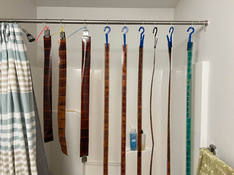
Just completed my first round of developing color film, 8 C-41 and 1 E-6 film cross-processed in C-41.

Mixed results; just really started looking at the negatives. Main problem was one I knew I would have before developing, at least in general. Several of these rolls got wet inside my fridge waiting for their turn to be developed, thanks to a leaky water pitcher. Given that, and my first time with color developing, I think things came out ok.

I would like some advice on how best to pre-treat the film before development; how long of a pre-soak is too long?

Regards,

Erik
 

Attachments

  • 2023-03-04 18.41.40-smalled.jpg
    2023-03-04 18.41.40-smalled.jpg
    134.5 KB · Views: 122
Congrats on getting started :smile:

I would like some advice on how best to pre-treat the film before development; how long of a pre-soak is too long?

Some people don't do a presoak at all. For 35mm I also find it unnecessary. With 120 film in my Jobo 1520 tank I get slightly uneven development along the very edges of the film, so I do a presoak with that, and also with sheet film in a 2500 tank for the same reason. I don't think there's a firm upper limit to the duration of a presoak, but just a few minutes (2-3) is ample. I don't think it hurts if you stretch it to 5 or perhaps even 10 minutes, but why bother going there?
 
Congrats on getting started :smile:


Some people don't do a presoak at all. For 35mm I also find it unnecessary. With 120 film in my Jobo 1520 tank I get slightly uneven development along the very edges of the film, so I do a presoak with that, and also with sheet film in a 2500 tank for the same reason. I don't think there's a firm upper limit to the duration of a presoak, but just a few minutes (2-3) is ample. I don't think it hurts if you stretch it to 5 or perhaps even 10 minutes, but why bother going there?

Thank you! My main idea for doing a longer pre-soak is to make sure the film gets to the temperature of the developer and subsequent fluids. My thinking here is based on developing B&W and the goal to keep the film and fluids all within a couple of degrees of each other so the film emulsion doesn't crack; developing in 20C water and then rinsing in 40C could cause problems from what I have read and might have experienced.

Regards,

Erik
 
My main idea for doing a longer pre-soak is to make sure the film gets to the temperature of the developer and subsequent fluids.

It only takes a couple of minutes to get everything to temperature. 5 minutes or so really does the trick; longer serves no purpose. Saves you time :smile:

developing in 20C water and then rinsing in 40C could cause problems

Yeah, but those kinds of gradients you typically don't see in color processing. Just start at 38C and keep it around there. The developer is critical, subsequent steps can drift a few degrees with no ill effects.
I've never gotten color film to reticulate.
 
Please keep up posted with examples of what you obtained. In your #1 post, view of bathroom, what is that odd film strip on the right, greenish-colored?

The one on the far right that was greenish colored was Velvia 50 cross-processed in E-6. Given the damage that the other films had taken, and that I couldn't remember what was on that Velvia roll, I decided it was best to develop it sooner than later, even if I needed to cross process it.

I will keep folks posted indeed; next up is scanning.
 
Last edited:
It only takes a couple of minutes to get everything to temperature. 5 minutes or so really does the trick; longer serves no purpose. Saves you time :smile:


Yeah, but those kinds of gradients you typically don't see in color processing. Just start at 38C and keep it around there. The developer is critical, subsequent steps can drift a few degrees with no ill effects.
I've never gotten color film to reticulate.

Thank you!

Erik
 
Yeah, I figured the one on the right was the x-processed E6 film.

Are films #1 and #3 from the left (long) expired film? The fourth from the right also looks pretty dense.
 
Yeah, I figured the one on the right was the x-processed E6 film.

Are films #1 and #3 from the left (long) expired film? The fourth from the right also looks pretty dense.

The films all had reasonably current expiration dates, especially given I kept them refrigerated. The problem is that it took some time for me to gear up for color developing, and they sat in my fridge (exposed) for as long as two years. In that time, they suffered water damage in the fridge from the water pitcher. The second one from left was the one most damaged by water.

Probably had exposure problems when taking the photos in those rolls you mentioned. #1 and #3 were in a Pentacon Six without a meter; I used a spot meter but might have erred anyway. #2 was in a Lubitel 166b TLS. The 35mm I don't recall what camera they were in; probably a Nikon F4.
 
I was going mostly by the density of the blank areas on the edges and between the frames :smile: The rolls I mentioned reminded me of long expired Superia and Kodak films I've used myself.
 
I was going mostly by the density of the blank areas on the edges and between the frames :smile: The rolls I mentioned reminded me of long expired Superia and Kodak films I've used myself.

Ah, gotcha. Thanks!
 
Photrio.com contains affiliate links to products. We may receive a commission for purchases made through these links.
To read our full affiliate disclosure statement please click Here.

PHOTRIO PARTNERS EQUALLY FUNDING OUR COMMUNITY:


Ilford ADOX Freestyle Photographic Stearman Press Weldon Color Lab Blue Moon Camera & Machine
Top Bottom
