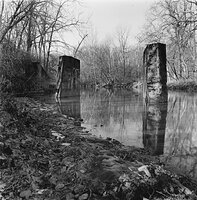
Although both films are the same speed according to the ISO standard, the two differ in some very noticeable ways. First thing you'll notice is a difference in grain structure. TMY (TMax 400) has a very regular grain pattern, while the grain pattern of Tri-X tends to be more random. You will notice this most if you examine the image projected onto the baseboard of your enlarger under a grain focusing microscope. Only when you reach enlargements of 10x or so, and when you compare prints side by side, does it become obvious in the print. The second thing you'll notice is that TMY has more red sensitivity. Contrast between sky and clouds is more pronounced as rendered by TMY. Using yellow, orange, or red contrast filters heightens the effect more. Finally, TMY tends to separate the very low shadow densities out more clearly than Tri-X. Tri-X, on the other hand, renders the mid-tone values with better separation. Of course, none of this matters if you don't wet print the negatives. Scanning either film will probably not show the grain, but rather artifacts of grain aliasing. Contrast curves can be manipulated to whatever you prefer with the editing software of your choice.


 .
. Although I'm using Ilford HP5 in my Rollei.
