• Welcome to Photrio!
    Registration is fast and free. Join today to unlock search, see fewer ads, and access all forum features.
    Click here to sign up

first lith attempt

Forum statistics

Threads
203,279
Messages
2,852,225
Members
101,756
Latest member
rsj1360
Recent bookmarks
0

eddie

Member
Allowing Ads
Joined
Jul 24, 2005
Messages
3,250
Location
Northern Vir
Format
Multi Format
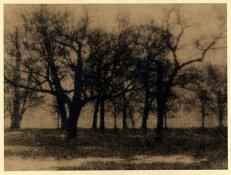
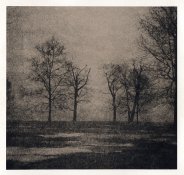
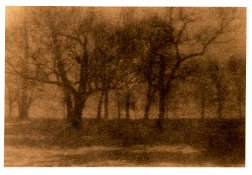
Yesterday, I tried lith printing for the first time. These are from the same negative, but on different papers (the first is Foma Variant, the second an Agfa RC). 30 minute development for each.
In the winter, it's hard to maintain temp. in my darkroom. Since I'm making small (5x7 & 8x10) prints, until I get a better handle on the possibilities, I'm putting the developer into a hot water bath between prints, and floating the small tray in a larger tray filled with hot water. Still, the temperature drops significantly over the 30 minutes.
I'm going to try it again today. I now have "old brown". Any suggestions for it's use? Also, any recommendations on shortening the development times?
Thanks.
 

Attachments

  • lith2.jpg
    lith2.jpg
    86.3 KB · Views: 234
  • lith1.jpg
    lith1.jpg
    172.1 KB · Views: 259
Nice first attempts. Is all that grain on the neg?
 
These are nice.
30 minutes is a pretty long developing time, even by lith standards. Try increasing the developer strengh, and perhaps more exposure.

Some more information will help folks make suggestions,
How much exposure are you using, in comparison to a normal print from these negs?
What lith developer and what dilution are you using?
 
I'm using LD-20. I mixed it as directed, at first (15ml A : 485ml water & 15ml B: 485ml water). After a few prints, I added another 15ml of each to the tray, without more water. The exposures were for 180 seconds. I developed the same negative in Dektol, with a time of 22 seconds, at the same f stop. The straight print was done at 68 degrees. The liths started at 80 degrees, but were at about 71 after half an hour.
Since it's a new process, for me, I didn't want to deviate too much from recommendations. Any suggestions would be appreciated...

The negatives are Acros 100, shot in a JEM JR (6x9cm). It was shot on a very foggy day, with visibility of about 40 yards.
 
What you are doing seems reasonable, but a half hour is a really long time for reasonably warm and fairly low dilutions (I tend to use developer more dilute and warmer). Try keeping the tray in the warm water bath during the development so the temperature doesn't drop so much. Also, Foma Variant is probably the grainiest and difficult paper to work with. You might try something like Fomatone to start with...it is a bit less stark.
To answer the old brown question, I use about 15%-20% old brown. Most people use less, though.
 
When I lith print, I simply use straight old brown as my "water". Out of a 2 L batch, I save 1.8 mL (fits in an empty OJ bottle), and then hit it with 200 mL of fresh developer at the beginning, and every time it poops out during the session. A squeezed (or "squozen", as I like to say) 2 L pop bottle would work just as well with this method.
 
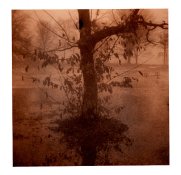
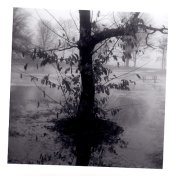
I tried a different negative today. This print is on Forte, and developed for 20 minutes. I mixed fresh LD-20, and added 25% of Old Brown. I don't know what caused the dark spot on it. I also used Selenium 1:15, for 6 minutes. I really didn't see any effect from the toning.
The second print is a quick print on Ilford, developed in Dektol.
 

Attachments

  • lithday2b.jpg
    lithday2b.jpg
    100.4 KB · Views: 189
  • lithilford.jpg
    lithilford.jpg
    78.4 KB · Views: 183
Last edited by a moderator:
eddie: your second session looks like you got a better result. Old Brown does make a difference. I use LD20 as well, but I print on Foma Classic 131 paper. I am using 20ml of A to 20ml of B to 600 ml of water at 30c, and then topping off to 1 liter with old brown. This formula is giving me the nice, bright, salmony tones that I like. I know that this is contrary to what the directions say to mix each concentrate separately with water then mix together, but I did that by accident once after using another brand with a different mixing scheme and it worked, so I stayed with it. Also, unless you have run several prints through the developer it may not be as dead as it should be. After a session I always leave my developer in the tray overnight to oxidize, and if I had not run many prints through the developer I throw an old sheet of paper in the developer to really kill it. Then next day bottle it up and I am good to go.

Unless you like the sort of thick, dense image that you are getting, I would recommend backing off on the exposure a stop or so to brighten the highlights and improve the contrast. Your shadows will develop to the desired density with time. If your highlights don't develop enough you know you backed off too much on the exposure. I fight with a cool darkroom in the winter as well, and find that I can keep my developer warm by covering it with a clear sheet of acrylic. I aim to keep my developer at 30c and usually get a print between 3:30 and 5 or 6 minutes, depending on how old the developer is.
Best of luck,
Dan
 
Last edited by a moderator:
Thanks for the info. I'd like to reduce the development time. I'll try it with hotter developer.
 
Also, experiment with the exposure....maybe a stop over, a stop under, and two stops under. You'll learn a lot about contrast control fast if you do that.
 
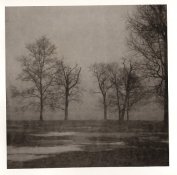
These are yesterday's results. I used the LD-20 at 85 degrees. The first is on Emaks paper. I like the tonality of it, but there's a bit of uneven development. I also think I snatched it a little early. The exposure was 4.5 minutes at f.8, and it was developed for 12 minutes.
The second was on Foma paper. It was exposed for 5.5 minutes at f.8 with a #3 filter. Development was 20 minutes. Too much pepper fogging (I think that's what it is... ) for my taste. Both were selenium toned at 1:15 for 6 minutes.
A few changes to my "routine" for these. First, I swapped my regular timer for a Graylab. The regular timer only goes to 99 seconds. Now, I don't have to keep track of how many times I hit Expose. I also picked up a small flashlight which I covered with Rubylith. I'm hoping it helps determine the snatch point. Obviously, so far, it hasn't... :-}
 

Attachments

  • emaks.jpg
    emaks.jpg
    66.6 KB · Views: 128
  • foma.jpg
    foma.jpg
    120 KB · Views: 135
FYI - that is not pepper fogging....fomatone is really, really grainy. What you have is about what I'd expect. Try Fomatone. Amazing stuff and probably the easiest to work with.
 
FYI - that is not pepper fogging....fomatone is really, really grainy. What you have is about what I'd expect. Try Fomatone. Amazing stuff and probably the easiest to work with.


Lovely image! I'm a big fan of the less intense lithy colours.
I thought that is pepper fogging on the second photograph? At least that's what I thought it looked like. Ive never got that on fomatone paper.

Alex
 
Photrio.com contains affiliate links to products. We may receive a commission for purchases made through these links.
To read our full affiliate disclosure statement please click Here.

PHOTRIO PARTNERS EQUALLY FUNDING OUR COMMUNITY:


Ilford ADOX Freestyle Photographic Stearman Press Weldon Color Lab Blue Moon Camera & Machine
Top Bottom