• Welcome to Photrio!
    Registration is fast and free. Join today to unlock search, see fewer ads, and access all forum features.
    Click here to sign up

Filter transmission curves

Tompkins Square Park

A
Tompkins Square Park

  • 2
  • 0
  • 35
Siesta Time

A
Siesta Time

  • 1
  • 0
  • 30

Recent Classifieds

Forum statistics

Threads
202,858
Messages
2,846,662
Members
101,572
Latest member
apltd
Recent bookmarks
0

Tim Gray

Member
Allowing Ads
Joined
Sep 2, 2006
Messages
1,882
Location
OH
Format
35mm
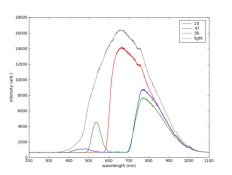
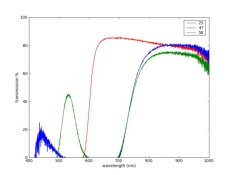
Thought some of you might find this interesting. I was playing around with the new spectrometer in the lab and my 25, 47, and 58 Tiffen filters happened to get delivered today. So I made transmission curves for them. Note the source light was just a crummy flashlight which is pretty light on the blue end of the spectrum, so the curves are a bit skewed (there's only so much the software can compensate for). I did a quick test using window light and the transmission hump in the blue end of the spectrum for the 47 filter was about 30%, compared to the 20% from the flashlight.

The other graphic is the actual output of the spectrometer for each of the three filters and the source flashlight.

Notice the HUGE amount of IR that all three of the filters lets through.
 

Attachments

  • transmission.jpg
    transmission.jpg
    22.9 KB · Views: 485
  • light.jpg
    light.jpg
    24 KB · Views: 349
That is interesting. Can you repeat these test with sunlight? Additional filters?

Steve
 
Sunlight, maybe, maybe not. I'll have to think about how to get a decent amount of sunlight into the spectrometer. But I should be able to rig up a better light source than a flash light. We'll see.

Can't do much more in the way of filters since I don't own that many more. A couple UV filters, an R72, and a B+W dark red one...
 
Many standard filter curves from Wratten and B+W filters that I've seen also show the high transmission in IR. Most films drop off in sensitivity very quickly after 650nm or so, which makes the filters effective within the spectrum of the film. I suspect it would also be much more expensive to produce filters that block IR (unnecessarily in the case of most films) in addition to the visible spectrum.

Lee
 
Last edited by a moderator:
Interesting variation in amplitude for each of the filters. I would have expected them to be a bit closer. Of course, the source contributes to the variability of the curves.

I would be very interested in the UV filter response and matching that response to respective manufacturers. I know some are quite good at blocking UV and some are awful!

Thanks for the information!

-Fred
 
As far as the variability of the source, the transmissions should be calculated relative to the source, negating any contribution of non-uniformity in the source. However, you can see in the blue there is not much signal, and the SNR starts to get a bit bad there.

Any body have standard filter factors for 47 and 58 filters? I'll play around tonight with my light meter to calculate them, but they should point to the differences in overall magnitude amongst the filters.
 
If you have a spectrometer, the kind of thing I'd like to see is processed B&W film transmission spectra. Like we have all seen that certain films are more blue or pink after processing. Interesting to see the magnitude of that film base tint. Also, how about stained negatives...would be interesting to see how the spectra differs for different types of staining developer.
 
If you have a spectrometer, the kind of thing I'd like to see is processed B&W film transmission spectra. Like we have all seen that certain films are more blue or pink after processing. Interesting to see the magnitude of that film base tint. Also, how about stained negatives...would be interesting to see how the spectra differs for different types of staining developer.

Easliy done.

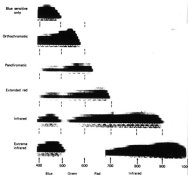
Here are the spectral sensitivities of Ortho, Pan and IR films.

PE
 

Attachments

  • dye types.jpg
    dye types.jpg
    36 KB · Views: 180
As in just hold a piece of fixed (or unfixed) film and see it's transmission properties? I can do that for sure.

I also have access to two UV spectrometers, but I think they are probably less useful...
 
Ron, I don't think ic-racer means the spectral sensitivity. I think the question is motivated by concern about the UV transmission of the film stain and base, which is especially important for alt printing.
 
Keith;

Yeah, I goofed. Sorry. But all of the films have some degree of UV protection except the newest B&W that Kodak designed for alternative printing.

Thanks. I read that one with my brain somewhere else. :sad:

My bad.

PE
 
Just as an addendum to the last post, Keith, a film's transmission spectrum before exposure is equal to its measured spectral sensitivity (absorption) after exposure. This should help when comparing with what I posted above.

PE
 
Oh, I guess that does make sense. Thanks for putting those pieces together for me PE.
 
Just as an addendum to the last post, Keith, a film's transmission spectrum before exposure is equal to its measured spectral sensitivity (absorption) after exposure. This should help when comparing with what I posted above.

PE

What if you use a staining developer?
 
Then you add in the relevant stain. I left that out as I have seen stains that range from yellow through brownish to green. But you are right in that case.

PE
 
Actually I was thinking more along the lines of Blue and Green transmission and MG printing. Kind of to confirm or refute the idea the a different film bases or stained negatives would need a different calibration tables for MG printing.

I currently don't use staining developers because of real or imagined effects on MG printing. Would be interesting to see the magnitude of the mired shift of pyro negatives. Or, more practically, how many CCs of (yellow or whatever) the stain adds to the system.
 
There have been threads on MG printing of stained negatives IIRC. Since I don't use that method, I have pretty much ignored them. You see, the stain is a dye, and that dye like all dyes, will fade eventually. So a stained negative is a moving target over a certain period of time. IDK if anyone has measured it or quantized it.

But, it is not one of my favorite fields.

PE
 
Photrio.com contains affiliate links to products. We may receive a commission for purchases made through these links.
To read our full affiliate disclosure statement please click Here.

PHOTRIO PARTNERS EQUALLY FUNDING OUR COMMUNITY:


Ilford ADOX Freestyle Photographic Stearman Press Weldon Color Lab Blue Moon Camera & Machine
Top Bottom