• Welcome to Photrio!
    Registration is fast and free. Join today to unlock search, see fewer ads, and access all forum features.
    Click here to sign up

Filter exposure guidelines for B&W film.

Forum statistics

Threads
203,441
Messages
2,854,731
Members
101,842
Latest member
Madmac
Recent bookmarks
0
The strange part is, somehow all the times I've "incorrectly" used the yellow and red filters, somehow I still exposed relatively correctly and almost always happy with the image. Hmmm... :-0

Not strange, it's more likely that your guesses are just doing a decent job of getting your shots inside the film's normal latitude range.
 
The dividing the filter factor into the ASA speed and setting the light meter with the resultant offfset seems like a good idea at first blush. Bt what do you do if you're shooting a snow scene, or adding a polarizer, working wih a ND filter, and have to adjust by different stops in addition to the contrast filter? Then for a second shot you take one filter off. Wouldn't it be easier to just leave the meter at box speed and adjust the stops on the camera after adding them all up?
 
Alan just divide the first result by the next filter's # and so on.
 
in photography,everything depends on everything else and the currentorbitalpositions of majorheavenly bodies.

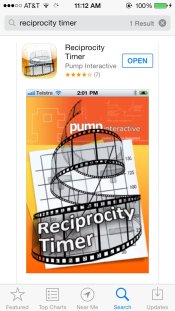
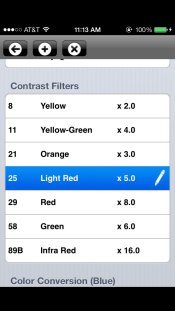
There's an app for that.

Dead Link Removed
 
There's an app for that.

Dead Link Removed

Yup...

ImageUploadedByTapatalk1391184819.812832.jpg
ImageUploadedByTapatalk1391184826.513028.jpg
ImageUploadedByTapatalk1391184831.861791.jpg

Though I never used the filter options before, just did that ahead of time (improperly apparently).

It's a great app though, a LF Forum member made it by request.

The version 2 is coming out any day now! It's worth the price! (I got in early but I know the version 2 is $10 but has zone system capability including taking a snapshot of the scene and then notating the exposure readings you want/zones and also a log book you can later download to Dropbox/excel to keep all your notes, the version 2 is very robust.
 
I think in terms of EV values, that way one can work in either f/stop changes or shutter speed changes, or use them in combination. That's
why many convenient meters, such as the Pentax spotmeters used by many of us as well as the cine industry, give EV values. In the field, I
often don't have time to dig out some silly smart phone and punch a bunch of app buttons reliant on a half-dead battery to tell me what to do.
The old-fashioned way is a hundred times faster and far more reliable.
 
I think in terms of EV values, that way one can work in either f/stop changes or shutter speed changes, or use them in combination. That's
why many convenient meters, such as the Pentax spotmeters used by many of us as well as the cine industry, give EV values. In the field, I
often don't have time to dig out some silly smart phone and punch a bunch of app buttons reliant on a half-dead battery to tell me what to do.
The old-fashioned way is a hundred times faster and far more reliable.

The smartphone tool is just like the spot meter tool, it tells you things, you could do it without the spot meter, but why not use the tools you have.

Also, half dead battery... I think not, my iPhone (with mophie case I'll admit to having) will last 2 days with antenna, if I shut that off to work in the field I could easily go 8 days with it on, if I shut it down when I'm not using it for metering or exposure stuff, I could last longer.

It would take me 20 minutes to work out all the math if I had to figure it out, with the app, I punch in data and it spits out more data, and I use that.

It's no different than a spot meter
 
I use the guidelines outlined by B + W filters which is attached. For Light Red I use + 2.5 stops of compensation. Which would be between Filter Factors of 4 and 8. I have this laminated and keep it in my film camera bags
 

Attachments

  • B + W Filter Factor Chart.JPG
    B + W Filter Factor Chart.JPG
    42.8 KB · Views: 132
I use the guidelines outlined by B + W filters which is attached. For Light Red I use + 2.5 stops of compensation. Which would be between Filter Factors of 4 and 8. I have this laminated and keep it in my film camera bags

Welcome to APUG Photrio!!
 
I shoot 4x5 and use a spot meter. Someone on this site, years ago, told me to meter through the filter. I have done that since and it really helped prevent under exposure in the blacks.

With a RED25 Filter you can really see the blue sky go from white to grey.
 
I shoot 4x5 and use a spot meter. Someone on this site, years ago, told me to meter through the filter. I have done that since and it really helped prevent under exposure in the blacks.

With a RED25 Filter you can really see the blue sky go from white to grey.

The wavelength spectrum seen by the light meter will not product and accurate light reading through denser filters. Always use the manufacturer's filter factor instead. That is what I do even for my Pentax Digital Spot Meter.

Filter-----f/Stops
Red23------2
Red25------3
Red29------4
720---------5
 
While everyone has their pet system of filter exposure I think it’s important to know what you are trying to achieve by a specific filter. For example are bright white clouds and a dark blue sky important or lighter green foliage etc. The desired result will determine what filter. I usually take one frame with and one without especially if that’s the only chance for that particular image. I also tend towards the lighter version of the filter. Years ago I made a couple of graduated filters with Rit dyes to affect the sky but not the rest of the composition. Find the ones that best suit your needs and learn how they work for you.
 
Photrio.com contains affiliate links to products. We may receive a commission for purchases made through these links.
To read our full affiliate disclosure statement please click Here.

PHOTRIO PARTNERS EQUALLY FUNDING OUR COMMUNITY:


Ilford ADOX Freestyle Photographic Stearman Press Weldon Color Lab Blue Moon Camera & Machine
Top Bottom