
I don't know, but from now on, I will refer to all spot meters as "bananas," and just claim that it's one of those colorful terms they use on film sets.
Didn't the Marx Brothers make a movie about spot meters?
or was that Woodie Allen??
I don't know, but from now on, I will refer to all spot meters as "bananas," and just claim that it's one of those colorful terms they use on film sets.
Dear Sandy,Donald Miller used the term SBR to discuss measuring subject brightness range in a very specific way that persons who understand BTZS would immediately understand.

I did a few prints over the weekend and although I can't add anything scientific to this thread, I can say that I greatly prefer the prints I made with HP5+ at EI 160 than those at EI 400. As expected, they show better shadow detail but with no discernable (to me) loss to the highlights.
As for my experiment to determine exposure by finding minimum time for maximum black using a blank piece of the same film - It worked to a point but I found I needed to use a little bit extra exposure to get a pleasing print.
Steve.
As for my experiment to determine exposure by finding minimum time for maximum black using a blank piece of the same film - It worked to a point but I found I needed to use a little bit extra exposure to get a pleasing print.
Steve.

HP5 is probably a little overexposed at 160

We need a new rant here: PREVISUALIZATION, which I saw here a while back. Would someone please tell me what precedes "visualization"? I can visualize the final print when I look at the scene, but before that I'm probably parking the car. I can't find "previsualization" in any of my dictionaries. I got edited by a professional editor for far too long to let such a barbarism as "previsualization" pass, and I don't care if my fave photog Edward Weston used it. Just pass me his girlfriends and hold the ketchup.

The curious thing to me is that the idea of "previsualization" is in tension with AA's other famous dictum--"the negative is the score, and the print is the performance." So the message seems to be: previsualize, but don't be afraid to change your mind.
Ah well, at least this has somewhat resolved my confusion over the "add five" concept, so not all was wasted...
Cheers, Bob.

At the risk of sounding like a cracked record, the use of incident light readings to estimate subject brightness range for the Zone System predated BTZS: Minor White covered it in one concise page of his Zone System Manual.
Best,
Helen
We need a new rant here: PREVISUALIZATION, which I saw here a while back. Would someone please tell me what precedes "visualization"? I can visualize the final print when I look at the scene, but before that I'm probably parking the car. I can't find "previsualization" in any of my dictionaries. I got edited by a professional editor for far too long to let such a barbarism as "previsualization" pass, and I don't care if my fave photog Edward Weston used it. Just pass me his girlfriends and hold the ketchup.
So I don't get the "pre-" and find it an horrendous use of our otherwise equally horrendous language. I don't permit anyone to use it in our workshops, unless it's after dinner over a beer or three and they're trying to tease me.

If you are interested in the math behind BTZS, here is enough to keep you busy for a while. . .
http://www.bobwheeler.com/photo/Surveys/Survey.pdf
. . . look at page #39
Have fun,
B Dalton
If you are interested in the math behind BTZS, here is enough to keep you busy for a while. . .
http://www.bobwheeler.com/photo/Surveys/Survey.pdf
. . . look at page #39
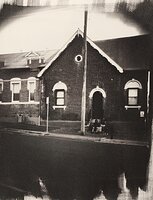
What excapes me is how by using the BTZS you can place a value without a reflective meter. If use we the distant barn in a pasture for an example, you measure yourself as the fully lite side of the barn, your shadow and the open shadow of the shadow the barn casts, but not the shadow of the interior though the door which I want to fall in zone 3 rather than zone 2. With only 2 reading how you know where the values will fall? Do you guess by holding your hand over the meter to minic the deeper shadows?
Nice summation, it's important to note the following:
"If one assumes a range of reflectance for the subject, then one need only measure the illumination to discover the subject luminance range. . . . A five stop range of reflectance is assumed, and Davis argues both that this is normal, but that even if it is not, '. . . camera exposure should generally provide for all the tones, from black to white, whether they are actually present in the subject or not.' "
I concur with Roger on the importance of knowing what assumptions are taken.
It would appear then, to lay it on the line, that subject brightness range cannot be read with an incident meter.
Regards
John
It would appear then, to lay it on the line, that subject brightness range cannot be read with an incident meter.
Regards
John

"A five stop range of reflectance is assumed..."
Why?
| Photrio.com contains affiliate links to products. We may receive a commission for purchases made through these links. To read our full affiliate disclosure statement please click Here. |
PHOTRIO PARTNERS EQUALLY FUNDING OUR COMMUNITY:  |
