- Joined
- Oct 11, 2006
- Messages
- 2,193
- Format
- Multi Format
I have a question about film granularity as a function of density.
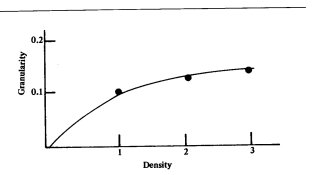
By granularity I mean the standard deviation of the density of a series of measurements using a circular region of film that is 0.048mm in diameter. The film would be uniformly exposed. The results are multiplied by 1000. At a density of 1 a fine grain film like T-Max 400 has a a granularity of 10.
In general, granularity for conventional black and white film increases with density. My question is "how much?" I realize that this would depend on the film type and developer conditions, but there must be some kind of "ball park" figures. For example, if we assume that the granularity is a linear function of density, then would a slope of the log exposure vs. density curve typically be about 0.5? If so then it would mean that film with a granularity of 10 at a density of 1 would have a granularity of 15 at a density of 2. If the slope was 2 then the granularity at a density of 2 would be 2.
I have searched in vain for information that is quantitative for popular film types.
What think ye on the matter?
Note added later: where I said "slope of the log exposure vs. density curve" I should have said "slope of the granularity vs. log exposure curve".
By granularity I mean the standard deviation of the density of a series of measurements using a circular region of film that is 0.048mm in diameter. The film would be uniformly exposed. The results are multiplied by 1000. At a density of 1 a fine grain film like T-Max 400 has a a granularity of 10.
In general, granularity for conventional black and white film increases with density. My question is "how much?" I realize that this would depend on the film type and developer conditions, but there must be some kind of "ball park" figures. For example, if we assume that the granularity is a linear function of density, then would a slope of the log exposure vs. density curve typically be about 0.5? If so then it would mean that film with a granularity of 10 at a density of 1 would have a granularity of 15 at a density of 2. If the slope was 2 then the granularity at a density of 2 would be 2.
I have searched in vain for information that is quantitative for popular film types.
What think ye on the matter?
Note added later: where I said "slope of the log exposure vs. density curve" I should have said "slope of the granularity vs. log exposure curve".
Last edited: