
• Welcome to Photrio!
    Registration is fast and free. Join today to unlock search, see fewer ads, and access all forum features.
    Click here to sign up

Film Dev advice needed

Recent Classifieds

Forum statistics

Threads
202,078
Messages
2,834,734
Members
101,101
Latest member
howlingsun
Recent bookmarks
0

jesterthejedi

Member
Allowing Ads
Joined
Mar 7, 2012
Messages
61
Location
Gilbert, AZ
Format
Medium Format
Okay got a Paterson tank and Ilford ID-11 and mixed it up per the instructions, wondering why my negatives seemed to be too flat (grey) when I processed them. Some variables to consider.

New Developer chemicals but kept at room temp for an hour before testing.
loaded film onto reels in complete dark as suggested, processed in bathroom light
followed the instructions with 1+0 rules and then reused the developer with 10% more time
first roll Neopan Acros 100 120mm @ 7 mins
second roll Neopan 400 135 @ 8:15
I used water as my stop bath and standard fixer for 1 min
approx room temp was 72
when I made contact prints, no enlarger yet, they came out really light.

Guess I need some more darkroom tips as this was my first tank developing and it shows noob all over it!
Some more data on the negs, the 35mm roll was auto exposed and the 120 was old sunny f16 +/-
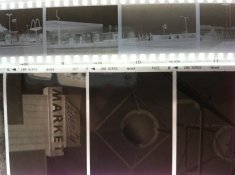
IMG_4769.jpg
 

dehk

Member
Allowing Ads
Joined
Aug 4, 2010
Messages
881
Location
W Michigan
Format
Multi Format
Your 1 minute FIX could be one of the problems.
 

dehk

Member
Allowing Ads
Joined
Aug 4, 2010
Messages
881
Location
W Michigan
Format
Multi Format
I use Kodak Fixers and their recommend times are around 10 minutes or so, read the instruction for your fixer.
Not sure abut the question on the emulsion thickness, they just feel normal to me.
 
OP
OP
jesterthejedi

jesterthejedi

Member
Allowing Ads
Joined
Mar 7, 2012
Messages
61
Location
Gilbert, AZ
Format
Medium Format
Just made a side by side contact print from the 120 and an older lab processed 120, the lab side came out perfect but my own was way too light, It seems I over developed the negatives :sad: Should I be more careful with timing, temperature, agitation, or dilute the ID-11 further?
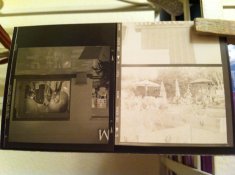
 

dehk

Member
Allowing Ads
Joined
Aug 4, 2010
Messages
881
Location
W Michigan
Format
Multi Format
Should I be more careful with timing, temperature, agitation, or dilute the ID-11 further?

Yes.

But why don't you expose negs to the lights longer during the contact printing, for the ones that came out light?
 

snederhiser

Member
Allowing Ads
Joined
Oct 14, 2010
Messages
161
Format
Medium Format
Hello;
Your fixing time is way too short, 5-10 minutes is the recommended time. I reuse my developer and fixer returning them back to the gallon jugs. I also replenish my developer before returning the used developer back to the jug. Freestyle sells a ID-11, D-76 developer and replenisher under the LegacyPro brand. I use a standard (acid) fixer and change this every two months. When fixing the timer is set to 10minutes, after 2minuted the film is checked to see if the film has cleared (milky white gone). If so double or triple the fixing time. I also process at 68 degrees. Have fun, Steven.
 

AndrewB

Member
Allowing Ads
Joined
Nov 19, 2011
Messages
10
Location
Hampshire, UK
Format
35mm
hi,
Which fixer did you use and which dilution did you do (1+9 or 1+4) and also is the unexposed film completely clear? If it isn't, the film needs more time in the fix. 1 minute seems very short for fixing, i usually do mine for 3 to 5 minutes at 1+4, depending how used the fixer is.
 

George Collier

Subscriber
Allowing Ads
Joined
Feb 23, 2005
Messages
1,374
Location
Richmond, VA
Format
Multi Format
+1 on the fixing time. Also, the top (35mm) section of the scan looks fogged, the rebate (border-sprocket hole area) is not clear, like the lower film. Both show discoloration, which might be underfixed. Also, in the 35mm sample, you can see drag effects (sometime called surge) from excessive agitation motion, where there are dark areas "streaming" up from the holes, giving more agitation than in other areas. We have all had this at one time or another, it doesn't mean too much agitation, just to much movement when agitating.
 

AndrewB

Member
Allowing Ads
Joined
Nov 19, 2011
Messages
10
Location
Hampshire, UK
Format
35mm
The more rolls of film you do, the better you get at it and know what adjustments to make to get better negatives, if they went wrong.
 

Rick A

Subscriber
Allowing Ads
Joined
Mar 31, 2009
Messages
10,038
Location
Laurel Highlands
Format
8x10 Format
If you only fixed the first roll for 1 minute, I recommend you refix for at least 5 minutes or more then rewash. I use TF-4 and fix for 6 minutes, which is slightly longer than specs, but safe. You really need to read the directions supplied with the product you purchased for good results.
 

clayne

Member
Allowing Ads
Joined
Sep 4, 2008
Messages
2,764
Location
San Francisc
Format
Multi Format
You definitely should be fixing longer as many have mentioned. Remember too though that Acros is typically low contrast and aside from Acros you should generally be targeting negatives for moderate contrast and not necessarily deep black looking negatives.
 

phelger

Member
Allowing Ads
Joined
Nov 17, 2006
Messages
110
Location
Luxembourg
Format
Multi Format
as mentioned by Rick (post #15) you can refix a second time. I've done that more than once when it turned out my fixer was worn out and the film was streaked or stained because not enough fixed. But I don't know if there's a time limit beyond which you no longer can refix.
Peter
 

Ed Bray

Member
Allowing Ads
Joined
Nov 23, 2011
Messages
352
Location
Plymouth, UK
Format
Multi Format
When I was at college studying photography I was taught that you used the following formula to decide on your fixing time: 2CT+1 in minutes, where CT is the clearing time.

How do you find the clearing time, use the cut off end of the leader from your 35mm film, stick it in some working strength fixer and time how long it takes to clear (in Ilfords Hypam @ 1:4 it's usually about a minute or so) then double the time and add a minute.

The reason for this is that it is just as bad for the film to be in the fixer too long as it is to not wash for long enough.
 

clayne

Member
Allowing Ads
Joined
Sep 4, 2008
Messages
2,764
Location
San Francisc
Format
Multi Format
When I was at college studying photography I was taught that you used the following formula to decide on your fixing time: 2CT+1 in minutes, where CT is the clearing time.

How do you find the clearing time, use the cut off end of the leader from your 35mm film, stick it in some working strength fixer and time how long it takes to clear (in Ilfords Hypam @ 1:4 it's usually about a minute or so) then double the time and add a minute.

The reason for this is that it is just as bad for the film to be in the fixer too long as it is to not wash for long enough.

Film can sit in fixer for hours without any negative effect. Its a 100 times harder to damage film through underfixing than it is through overfixing.
 

Ed Bray

Member
Allowing Ads
Joined
Nov 23, 2011
Messages
352
Location
Plymouth, UK
Format
Multi Format
Film can sit in fixer for hours without any negative effect. Its a 100 times harder to damage film through underfixing than it is through overfixing.

One of your sentances negates the other.

So you are saying that it is 100 times easier to damage the film by overfixing??

Why would you need to leave the film in the fixer longer than it takes the film to clear? all you are doing is allowing the emulsion to 'soak up' fixer requiring longer washing times to get rid of it all.

Still, I'll happily stick with my way, my negatives from the early 80s are just as good now as they were when processed.
 

clayne

Member
Allowing Ads
Joined
Sep 4, 2008
Messages
2,764
Location
San Francisc
Format
Multi Format
Sorry, indeed it should have read "it's a 100 times harder to damage film through overfixing than through underfixing."

Now with regards to the emulsion, it's not soaking up fixer like fiber paper does. Fixer should wash out of film at pretty near the same rate independent of fix time.
 

pentaxuser

Member
Joined
May 9, 2005
Messages
20,381
Location
Daventry, No
Format
35mm
It is not how the negs look that counts. It is how easy it is to produce good prints from those negs. Negs that look better as negs are often overdeveloped which can make good prints more difficult to do.

Good negs often look flat and grey. Judge the negs from the end product which is the print.

You certainly need to fix for much longer if you want the negs to last as others have said.


pentaxuser
 

ic-racer

Member
Joined
Feb 25, 2007
Messages
16,750
Location
USA
Format
Multi Format
Okay got a Paterson tank and Ilford ID-11 and mixed it up per the instructions, wondering why my negatives seemed to be too flat (grey) when I processed them.

Compared to what?
A 'normal' negative will have about six or seven-tenths the contrast of a print or transparency.
The negatives posted look Ok. I'd print them and see.
 

cliveh

Subscriber
Allowing Ads
Joined
Oct 9, 2010
Messages
7,816
Format
35mm RF
As a guess, I would suggest your development time is about 4 minutes short and you should fix for about 6 minutes.
 
Photrio.com contains affiliate links to products. We may receive a commission for purchases made through these links.
To read our full affiliate disclosure statement please click Here.

PHOTRIO PARTNERS EQUALLY FUNDING OUR COMMUNITY:


Ilford ADOX Freestyle Photographic Stearman Press Weldon Color Lab Blue Moon Camera & Machine
Top Bottom
