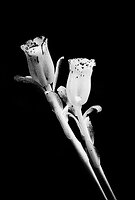
I'm probably operating the only glazing (ferrotyping) operation, such as it is, in Oregon, and I can say, it aint easy. There is a distinct learning curve that will have you second-guessing and tweaking almost every step of your printing process. Mine goes like this:
1)dev, acid stop, hardening fix
The hardening fix I've found to be of great importance. Prints were sticking bad to my dryer until I switched to hardening fix.
2)wash 30 min, cold.
3)Heico PermaWash diluted per bottle, agitated gently for 5 minutes
4)Wash 10 min, cold.
5)Selenium tone 1oz to 1gal of warm (100F) water for 3 minutes
6)Wash 20 min, warm (75F)
The warm second wash is both to speed the washing process by swelling the gelatin topcoat, and to soften it for drying. Also in this bath is a small amount of Kodak Print Flattening Solution (really just a solution of glycerine) that aids in the prints' release from the glazing drum.
After this, prints go into a holding tray of more 75F water. One at a time they are removed, squeegeed once (one single pass, top to bottom), and placed onto the blanket of the print dryer.
I was lucky in that my print dryer has both a clean blanket and an exceptionally clean drum that is free from scratches and rust. Likewise, I've ended up with a good supply of Kodak Ferrotype Plate Polish. Its a mix of parrafin wax and benzene. In order to prevent sticks and crazing, I have to be constantly be polishing the drum with a dab (tiny, tiny, tiny amount) of polish on a lint-free rag (which also keeps down the appearance of lint embossments).
After a couple weeks of banging my head against the thing and very carefully picking ruined, stuck prints from the drum, my success rate stands at about 95%, which from what I hear is pretty good.
I've used the same process on some individual ferrotype plates, with mixed results. The key seems to be applying a great deal of pressure when sticking the paper to the plate, and then leaving it in a place where it can dry as slowly as possible, with the back a little bit damp, so that it will peel off naturally and avoid telltale "oyster shell" lines (concentric lines from the paper drying and peeling the gelatin off the plate a bit at a time, leaving a mark where it couldn't peel any further until it was more dry).
I've got all the formulas for all this junk around, collected over the years, so if you can't find any of them, let me know and I'll do some digging. What I can say, though, is that once you've got it dialed in and pull that first well-glazed print off, you understand what all the fuss was about and be better for it. It's an art I'd rather not see die off.