• Welcome to Photrio!
    Registration is fast and free. Join today to unlock search, see fewer ads, and access all forum features.
    Click here to sign up

Favorite Camera for IR Film ?

Sprung

H
Sprung

  • 0
  • 0
  • 10
Hensol woods

A
Hensol woods

  • 2
  • 0
  • 11

Recent Classifieds

Forum statistics

Threads
202,961
Messages
2,848,148
Members
101,555
Latest member
drzf
Recent bookmarks
0
A standard light meter has no way of telling the IR light on the subject.
That is true, but ...

With experience, one realizes that there is a correlation between the amount of visible light on the subject and the amount of near IR on the subject.

During the middle of the day, I had good success using an R72 filter with Rollei ISO 400 film and metering using an incident meter set to an EI of between 3 and 12.

Bracketing is your friend, and don't meter through the filter.
 
That is true, but ...

With experience, one realizes that there is a correlation between the amount of visible light on the subject and the amount of near IR on the subject.

During the middle of the day, I had good success using an R72 filter with Rollei ISO 400 film and metering using an incident meter set to an EI of between 3 and 12.

Bracketing is your friend, and don't meter through the filter.

I would suggest there is no correlation between visible light and IR in the atmosphere.
 
I would suggest there is no correlation between visible light and IR in the atmosphere.

I don't think that's right. After all, the sun's output is more or less consistent at some relation of visible to IR---the difference in that proportion between different times of day is just down to differences in scattering and absorption. As we all know from absorbing AA's _The Negative_ with our mothers' milk, longer wavelengths scatter less, which is why (1) red filters cut haze and (2) sunsets look reddish.

So at a clear, cloudless midday, the amount of IR is low relative to the visible, because not so much visible light is getting scattered; in hazy golden-hour light, the proportion is high. At a given location, I think it's possible to work out metering and compensation practices for these cases and interpolate between them.

By the way, I've also had some luck metering through an 89B (mainly in sunny conditions and temperate latitudes). The meters in question may just be reading off the little bit of far-visible-red that gets through the filter, or they may be sensitive a bit beyond the visible spectrum---I don't know why it's worked but it has.

-NT
 
My favorite camera for IR is FM3n with cheap Soviet made Universal Turret Viewfinder.
The viewfinder has 35mm frame so Nikkor 35/2 follows when they go out.
 
Favorite Camera for IR Film ?

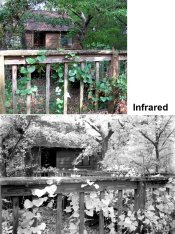
The 4x5 view, 6x9cm rangefinder, 6x7cm rangefinder, 6x6cm TLR, and 35mm rangefinder were my favorite cameras for shooting infrared film.

The 35mm SLR was never a favorite for infrared film because it was too difficult to focus and compose with the filter in place and it was too slow to operate if I had to remove the filter too often to focus and compose.

I used a Hoya R72 infrared filter.

I mounted the camera on a tripod.

I used a handheld light meter to estimate the exposure.

I bracketed the exposure.

I bracketed the focus.


https://flic.kr/p/eDwiuv
 

Attachments

  • Infrared.jpg
    Infrared.jpg
    214.6 KB · Views: 114
Photrio.com contains affiliate links to products. We may receive a commission for purchases made through these links.
To read our full affiliate disclosure statement please click Here.

PHOTRIO PARTNERS EQUALLY FUNDING OUR COMMUNITY:



Ilford ADOX Freestyle Photographic Stearman Press Weldon Color Lab Blue Moon Camera & Machine
Top Bottom