I shoot a lot of Tri-X and a decent amount of T-Max 3200 (TMZ). I've also shot a couple rolls of T-Max 400. In my tests, TMZ does a real 1 to 1 1/3 stop increase over the two 400 speed films. This is right inline with the TMZ spec sheet where its rated at ISO 800-1000.
Tri-X/T-Max 400 look alright at 800. But head to head, the TMZ is going to have a stop (plus a bit) more in the shadows. I don't find a stop missing down there at 800 too annoying. At 1600, TMZ is only running 2/3rds of a stop underexposed, while the 400 speed films are two stops under. This is where TMZ really pulls ahead in my opinion.
Of course, it seems like a lot of people say "Tri-X or T-Max 400 at 1600 looks a lot better!" If you like contrast and dislike grain, then sure. If you'd rather have better shadow tones and don't mind grain as much, then you might prefer TMZ. Also factor in that TMZ is about twice as expensive.
I don't find TMZ *that* grainy. It's certainly grainier than slower films, but I've a couple 11x14's printed from it and they look fine to me.
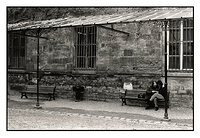
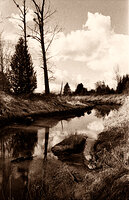
This is an 8x10" print taken out of what would have been a 26"x19" print from a TMZ 35mm negative.
Here is Tri-X version, and lastly, the
TMY version. For reference,
here is a scan of an 8x10" print of the full TMZ frame.
It wasn't the most scientific test, but I shot these three films on the same setup and then scanned and wet printed them to look at how they behaved. The main part of the test was to see how they all pushed, but I never wrote that up.
I'm sure you can substitute the Ilford equivalents in and get more or less the same results. I don't think you can do the same for Fuji. In my opinion, Neopan 1600 is NOT even ISO 800. It does have fine grain, but it gets really contrasty.