• Welcome to Photrio!
    Registration is fast and free. Join today to unlock search, see fewer ads, and access all forum features.
    Click here to sign up

F-Stop Printing Calculators. now I am confused

Recent Classifieds

Forum statistics

Threads
201,268
Messages
2,821,509
Members
100,626
Latest member
davidjames64
Recent bookmarks
1

Bruce Osgood

Membership Council
Member
Allowing Ads
Joined
Sep 9, 2002
Messages
2,642
Location
Brooklyn, N.Y.
Format
Multi Format

Doc W

Member
Allowing Ads
Joined
Nov 7, 2009
Messages
955
Location
Ottawa, Cana
Format
Large Format
it works logaritmically not on a linear time line:laugh:.rather than usingthese calculators you may be better of using an f/stop timing table, printed large enough so you can see it in the darkroom:smile:

This is exactly what I do, stolen right out of Ralph's book, and it has improved my prints. No electronics required other than a timer that works in fractions of a second, and for long exposures that may not even be necessary.
 

baachitraka

Member
Joined
Apr 6, 2011
Messages
3,646
Location
Bremen, Germany.
Format
Multi Format
I have memorized all the values from 4s->32s. Its easy and works beautifully well.
 

StoneNYC

Member
Allowing Ads
Joined
Aug 5, 2012
Messages
8,345
Location
Antarctica
Format
8x10 Format
I'm going to have to pull out my copy of way be on monochrome because I totally am confused here.
 

Bill Burk

Subscriber
Allowing Ads
Joined
Feb 9, 2010
Messages
9,455
Format
4x5 Format
I have memorized all the values from 4s->32s. Its easy and works beautifully well.

It's not extremely hard to memorize the short list of f/stop times.

You can see the simplicity of the concept in Way Beyond Monochrome's cut-out replacement dial for a GraLab 300 Timer.

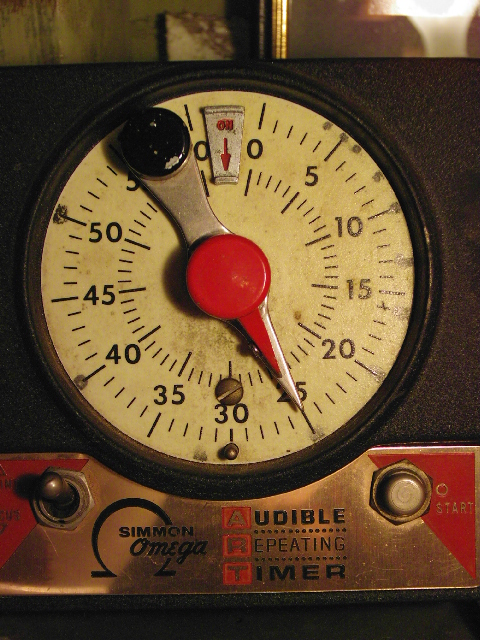
Here's another simple illustration. I marked "third-stop" times with dots on my timer. I haven't even memorized the series. I just look at the dots just before printing and think to myself the steps I am going to use for that print...

PIMG0040.JPG


From 50 you can see the seconds between dots in the count down... 10, 8, 7, 5, 4, 3, 3, 2, 2 (I skip the fractions and just round).
 

MattKing

Moderator
Moderator
Joined
Apr 24, 2005
Messages
54,746
Location
Delta, BC Canada
Format
Medium Format
I'm going to have to pull out my copy of way be on monochrome because I totally am confused here.

Think of it this way Stone:

The paper responds logarithmically, so we set out a progression in logarithmic terms. We end up with nice, even spaces, like notes on a scale.

Then we convert those logarithmic terms back into normal numbers (of seconds). It doesn't matter where you start, and what size steps you use, but to be convenient, 2.8, 4, 5.6, 8, 11, 16, 22, 32, 45 is easy to remember, and steps equal to one half "stop" are both reasonably small, and reasonably large.

Ralph's table takes it all the way down to 1/6 stop - probably about as small a difference as you can reliably perceive.
 
Joined
Sep 10, 2002
Messages
3,653
Location
Eugene, Oregon
Format
4x5 Format
Geez, people,

While I understand and appreciate the concept and the relationships in f-stop timing/printing, (I figured out the half-stop = sq,rt of two and third-stop = cube,rt of two thing decades ago), I still do not understand just why f-stop timing gets so much buzz. I have absolutely no use in my darkroom for fractions of a second while printing. Nor do I want to be multiplying by sq/cube roots or consulting tables just to find a print exposure.

I find working with percentages so much easier, so fundamental and simple that I would have to increase the complexity to go to any other method. 100% more exposure (or burning) is 1 stop. 50% less exposure (or dodging) is one stop. 20% intervals are easy to calculate in your head for test strips; 10% intervals are insanely easy to calculate for small print manipulations/exposure changes.

I don't need a chart, everything is intuitive and I still get proportional exposures, which is what all the hoopla about f-stop timing is in the first place, isn't it.

Sample test strip at 20%: 10 - 12 - 14 (rounded down) - 17 (rounded up) - 20 (rounded down) - 24 - 29 - 35. There, I can figure that out faster than I can type it and when converting it to my metronome-style of printing I just count: 10 +2 +2 +3 +3 +4 +5 +6 and I've got a test strip with 20% intervals. Thirty percent is equally as easy.

I also record all my dodging in burning as percentages as well. When changing paper or size for a reprint, I simply find the new basic exposure time and then use my percentages as a starting point for fine tuning the image on a new paper or at a new size. No having to figure out what one-third stop less than the new exposure is by consulting a chart... or using a fancy (and expensive) timer. Just move the decimal point and multiply by 2, 3, or whatever.

It also seems that many are confused by f-stop timing. For those, I would recommend getting a good handle on the relationships of f-stops with time and aperture and figuring out all those confusing intermediate stops, which end up NOT being where the arithmetical mean or thirds would be. It is indispensable information to a photographer.

However, there is no reason to be dealing with all that when printing. Percentages work just as well and are simpler.

Best,

Doremus
 

Steve Smith

Member
Allowing Ads
Joined
May 3, 2006
Messages
9,110
Location
Ryde, Isle o
Format
Medium Format
O.K. Perhaps exactly was the wrong word. But a percentage is a proportion of the whole rather than a fixed amount, just as a fraction of a stop is.


Steve.
 

Bill Burk

Subscriber
Allowing Ads
Joined
Feb 9, 2010
Messages
9,455
Format
4x5 Format
Doremus Scudder,

We've had this conversation before, and if people are making timers - they can use the split seconds.

But I'm with you... Simpler is better.

Your percentage scale could be improved... Different percents for different Grades... I know 20% is great for Grade 2.

What's great for Grade 4?
 

Bill Burk

Subscriber
Allowing Ads
Joined
Feb 9, 2010
Messages
9,455
Format
4x5 Format
How about 10% for Grade 4? Keeps it simple.
 
Joined
Sep 10, 2002
Messages
3,653
Location
Eugene, Oregon
Format
4x5 Format
Doremus Scudder,

We've had this conversation before, and if people are making timers - they can use the split seconds.

But I'm with you... Simpler is better.

Your percentage scale could be improved... Different percents for different Grades... I know 20% is great for Grade 2.

What's great for Grade 4?

How about 10% for Grade 4? Keeps it simple.

Bill,

Exactly! I was just giving an example, but the actual percentage is variable. Working in 10% multiples is easy. If finer refinements are necessary, they are almost always at the very last stages of making a fine print, and can be done by slight adjustments in exposure time or, as I often prefer, slight adjustments in the developing time. I find the latter more controllable once I have a dodging and burning scheme worked out.

And are actually, exactly the same.


Steve.

as an f/stop evangelist, I say: percentages work just as wellbut are not exactly the samewhen it comes to test strips.howeverpercentages work very well :smile:

Well, the exact units are not the same (inches vs centimeters, for example) but the end result is the same, and without the analogous "fractions-of-an-inch" difficulty in measuring (I still can't figure out why the U.S. has never embraced the metric system. That said, no one I know is better at adding fractions than an American carpenter...). I guess that's the point: why bother with the extra complexity when it's not needed.

Best,

Doremus
 

bdial

Subscriber
Joined
Jan 2, 2005
Messages
7,509
Location
North East U.S.
Format
Multi Format
I got tired of constantly doing even the easy math and bought an f-stop timer and I'm very happy with it, and my printing has improved since it deals with smaller increments than I would do in my head.

On a practical basis, I think a clock-face timer like Bill's is superior to a digital timer if you don't want to deal with charts and math, and don't want to spend the money on a f-stop programed timer.
 

StoneNYC

Member
Allowing Ads
Joined
Aug 5, 2012
Messages
8,345
Location
Antarctica
Format
8x10 Format
why change if inches are good enough to get you to the moon and back?no benefit in sight;no change required

Because when you try to dock with the international space station and their locking clamps are 1 meters long and your docking clamps are 1 yard long... You have a problem...
 

John Koehrer

Member
Allowing Ads
Joined
Apr 3, 2004
Messages
8,277
Location
Aurora, Il
Format
Multi Format
Because when you try to dock with the international space station and their locking clamps are 1 meters long and your docking clamps are 1 yard long... You have a problem...

Yeah, and close only counts in hand grenades and horse shoes.
 
Joined
Jan 21, 2003
Messages
15,715
Location
Switzerland
Format
Multi Format
I don't know if this has been clarified in the thread yet, but here's a quick graph to illustrate the relationship between stops and time.

When I print I use 8, 11, 16, 22, 32, 45, 64, and 90 second exposures for my test strip to lay down my base tone. I alter the enlarging lens aperture as needed.

It's a very simple base line that happens to coincide with what's on the shutters of my lenses, so it's very easy to remember.

I use a metronome and count seconds to keep track of time. Both hands can be used at all times to do stuff relating to printing.
 

Attachments

  • Untitled.png
    Untitled.png
    19.8 KB · Views: 147

MartinP

Member
Allowing Ads
Joined
Jun 23, 2007
Messages
1,569
Location
Netherlands
Format
Medium Format
The only part I thought was odd was the decision that sixth of a stop was a finely enough graduated scale. It is easy to see tenth of a stop in tones slightly darker than a notional 'middle'. I do use the the f-stop idea though, and I do have an electronic timer that works in tenths of a second. Ask yourself if the clockwork timers (which are now pretty ancient) are either accurate or consistent? For burning and dodging I use a metronome too, so that is perhaps more by feel than by precision, oops.
 

TheToadMen

Subscriber
Allowing Ads
Joined
Sep 18, 2012
Messages
3,570
Location
Netherlands, EU
Format
Pinhole
I read and thought about F-stop enlarger timers, but never got to it to get me one and try it.

But reading this thread made me curious again. So I'll look around (again) for a F-stop timer overhere in Europe - preferably second hand. I'm in no hurry, but think I'll have time to study & trey it next spring or so.

Can anyone recommend me a good model f-stop enlarger timer to look for - to use with my Leitz Focomat V35?
 

bdial

Subscriber
Joined
Jan 2, 2005
Messages
7,509
Location
North East U.S.
Format
Multi Format
The RH Designs timer is excellent, made in the U.K.
There is also an Open Source timer discussed in here that you can build if you are up for a DIY project.
 
Joined
Jan 21, 2003
Messages
15,715
Location
Switzerland
Format
Multi Format
The only part I thought was odd was the decision that sixth of a stop was a finely enough graduated scale. It is easy to see tenth of a stop in tones slightly darker than a notional 'middle'. I do use the the f-stop idea though, and I do have an electronic timer that works in tenths of a second. Ask yourself if the clockwork timers (which are now pretty ancient) are either accurate or consistent? For burning and dodging I use a metronome too, so that is perhaps more by feel than by precision, oops.

1/6th stop or 1/10th stop doesn't really matter, actually. It depends on what enlarging lens aperture you are using.

The time that yields 1/6th stop at f/8 yields 1/3rd stop at f/5.6, and 1/12th stop at f/11.

The amount of precision you need is a combination of the lens aperture and the time increments. That's why I prefer longer printing times. It gives much more time for minute adjustments, and the precision of a metronome is more than enough.
 

miha

Member
Allowing Ads
Joined
Feb 15, 2007
Messages
3,016
Location
Slovenia
Format
Multi Format
I read and thought about F-stop enlarger timers, but never got to it to get me one and try it.

But reading this thread made me curious again. So I'll look around (again) for a F-stop timer overhere in Europe - preferably second hand. I'm in no hurry, but think I'll have time to study & trey it next spring or so.

Can anyone recommend me a good model f-stop enlarger timer to look for - to use with my Leitz Focomat V35?

I was in need of new timer as my old Kaiser with a probe (a very useful feature) broke down. I went for a RH Design Stop Clock and learned most of its functions. It works great, also the test strips I find to be more intuitive and easier to judge when made with an f-stop timer. But one can print fine with a metronome too.
 
Joined
Sep 10, 2002
Messages
3,653
Location
Eugene, Oregon
Format
4x5 Format
... The amount of precision you need is a combination of the lens aperture and the time increments. That's why I prefer longer printing times. It gives much more time for minute adjustments, and the precision of a metronome is more than enough.

Amen!

I'll add to that the following: Extending development time for modern fiber-base papers does not increase contrast (a myth), it moves the entire curve of the paper, increasing paper speed a bit. This is effectively the same as increasing print exposure by a small amount.

If I have to make adjustments to my exposure times of less than one second, then I'll either 1) change the f-stop and use a longer exposure time or 2) use the exposure that is slightly too little and extend developing time. This latter is a very effective and often overlooked tool. I find development changes of 10% to be quite visible (e.g., adding 15 seconds to a 2'30" development). Sometimes I'll make two or there identical prints and then snatch them at 2'30", 2'45" and 3', dry them down and compare. The differences are more than subtle.

FWIW, the smallest change I can regularly detect in print exposure amounts to about 3%. Less than that and I'm not really sure. I'll let you f-stop guys figure out how much of a stop that is. (Someone will now certainly make a table with percentages to f-stop equivalents... I see it coming :laugh: )

Best,

Doremus
 
Photrio.com contains affiliate links to products. We may receive a commission for purchases made through these links.
To read our full affiliate disclosure statement please click Here.

PHOTRIO PARTNERS EQUALLY FUNDING OUR COMMUNITY:



Ilford ADOX Freestyle Photographic Stearman Press Weldon Color Lab Blue Moon Camera & Machine
Top Bottom