• Welcome to Photrio!
    Registration is fast and free. Join today to unlock search, see fewer ads, and access all forum features.
    Click here to sign up

F-Stop equivalents for OLD lenses

Georgia

H
Georgia

  • 1
  • 0
  • 25
German_Church.jpg

H
German_Church.jpg

  • 4
  • 0
  • 38

Recent Classifieds

Forum statistics

Threads
202,564
Messages
2,842,419
Members
101,380
Latest member
andi63
Recent bookmarks
0

dbseney

Member
Allowing Ads
Joined
Sep 7, 2002
Messages
39
Some recently posted the F-stop equivalents for old lenses. I thought I had copied it and didn't. And can't find it on the archive. If that person could repost that info I would greatly appreciate it. Reason: I just bought an old brass lens; says C.Francios Paris rectilinear Sere A , no. 2 and measures 6 3/4 inches. It seems to be a triplet with a Baush and Lomb shutter. The cost; $47.

Thanks for the help.

Donald
 
What numbers do you have on your lens? The most common system next to f/stops was the Uniform System:
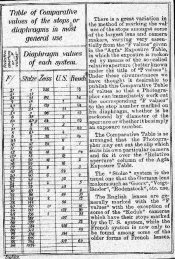
1 = f4 2 = f5.6 4 = f8 8 = f11 16 = f16 32 = f22 64 = f32 128 = f45 256 = f64
This has often led to the statement that Edward Weston took pictures at f256, in fact this was US256 which was f64.

Regards,

David

PS: If you have different numbers, I have a good table showing 6 different systems in use around 1900.
 
There are also the "intermediate stops" where 4, 5.6, 8, 11, 16, 22 etc is replaced by (commonly) 4.5, 6.3, 9, 13, 18, 25, 36, 50 or 3.5, 5, 7, 10, 14, 20, 28, 40 and so on. These are "normal" f-stops; they are just a little offset from what we're used to.

Many older German lenses use these or similar, they are the reason for the "standard" choises of max aperture of 3.5, 4, 6.3 or 7!
 
Anybody also may have an idea on the corresponding f-stops on an old Soho Cadet folder? I have 1,2,3,4 and the guy at the camera repair place told me theycorrespond to f/1, f/2, f/3 and f/4, but that does not make sense to me. My guess is that those 1-4 numbers correspond roughly to a sunny f/whatever rule; my shutter gives about 1/20 (only one speed).
 
I have a lens a bit like that, it's got two scales: One is the aperture in 1/16 inch, the other is "relative exposure". A clear candidate for developing by inspection, possibly with multiple developers.
 
Of course, you can always measure the aperture diameters and calculate the corresponding F numbers. Alternatively, you can measure the actual light transmission at the different apertures.
 
I have found this chart useful. I am sorry to say that I can't remember its source.
 

Attachments

  • fstop.jpg
    fstop.jpg
    78.8 KB · Views: 253
Photrio.com contains affiliate links to products. We may receive a commission for purchases made through these links.
To read our full affiliate disclosure statement please click Here.

PHOTRIO PARTNERS EQUALLY FUNDING OUR COMMUNITY:


Ilford ADOX Freestyle Photographic Stearman Press Weldon Color Lab Blue Moon Camera & Machine
Top Bottom