
-
Welcome to Photrio!Registration is fast and free. Join today to unlock search, see fewer ads, and access all forum features.Click here to sign up
- Home
- Forums
- Analog Workflow Forums (100% Analog/Traditional)
- Analog Equipment
- Medium Format Cameras and Accessories
You are using an out of date browser. It may not display this or other websites correctly.
You should upgrade or use an alternative browser.
You should upgrade or use an alternative browser.
Exposure time
-
A
- Thread starter bdoss2006
- Start date
Recent Classifieds
-
For Sale Cable Release Adapters for Leica, Nikon, Yashica, Rollei
- Started by Jon Shiu
-
Free Stoesser Pin Registration Punch
- Started by Roger Thoms
-
Want to Buy 4 x 5 Back for Agfa Ansco Universal View Camera
- Started by sharpnikkor
-
For Sale Set of 3 glass beakers
- Started by Jon Shiu
Forum statistics
what ISO/ASA for that kind of time?
what ISO/ASA for that kind of time?
The film I’m using is 400 iso. I don’t think the manual specified what type of film it was referring to.
what ISO/ASA for that kind of time?
Here is screenshots from where the manual says this.
Attachments
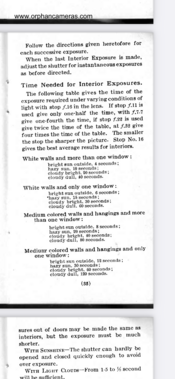
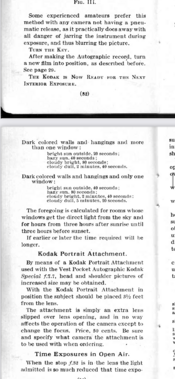

Manuals for cameras like that actually reference the films that were available at the time the camera was new and current.
Films are very different now!
Those sorts of exposure settings are more a matter of historical curiosity now.
What does the manual tell about the shutter speeds and apertures you have available? With that information, and possibly some translation of the aperture, you can use a modern meter to actually measure the light and more reliably calculate exposure.
Films are very different now!
Those sorts of exposure settings are more a matter of historical curiosity now.
What does the manual tell about the shutter speeds and apertures you have available? With that information, and possibly some translation of the aperture, you can use a modern meter to actually measure the light and more reliably calculate exposure.
Manuals for cameras like that actually reference the films that were available at the time the camera was new and current.
Films are very different now!
Those sorts of exposure settings are more a matter of historical curiosity now.
What does the manual tell about the shutter speeds and apertures you have available? With that information, and possibly some translation of the aperture, you can use a modern meter to actually measure the light and more reliably calculate exposure.
Is a light meter something I really need to take quality pictures? Do you know if any guide to go by without a light meter?

Is a light meter something I really need to take quality pictures?
Basically, yes. There are exceptions, but these involve either very constant lighting levels, or a sixth sense for guesstimating exposure accrued through many years of practice. Forget about the exceptions for now, though, and get a light meter or a camera that has one built in.
Is a light meter something I really need to take quality pictures? Do you know if any guide to go by without a light meter?
You either need a light meter or years of experience (and still use a light meter). If your aim is quality pictures it's not a good idea to make shortcuts even before you've started, a meter will help you understand the contrast range, the latitude of your film, and help make the best exposures. Dare I say it but there is a method for estimating exposure called 'Sunny 16', and plenty of people will say 'I've never had a problem using Sunny 16'. But when film is expensive and your time is more expensive, experimenting becomes very, very expensive, so leave it to those who've 'never had a problem' and use a meter.
Depending on which version of the camera you have, it may very well predate the time when readily available meters came into being - essentially 1932 and the Weston 617. Although there were earlier, extinction type meters.
pentaxuser
Member
bdoss2006, looking at the excerpt of the instructions they give everything except film speed. Could a film speed have been mentioned earlier in the manual? Unless all films were of one speed in those days it just seems strange that there is no mention of film speed
If you don't want to get/ borrow a meter then it looks as if you'll have to assume a film speed and then translate that in your 400 speed film. I'd be inclined to assume it was the equivalent of either 25 or 50 so at the same aperture as mentioned i.e. f16 assume that your exposure is 4 or 5 stops less than the time given
Then depending on whose 400 film it is i.e. Ilford, Kodak , Foma etc add in what your film's reciprocity failure is for the time you have selected
Best of luck
pentaxuser
If you don't want to get/ borrow a meter then it looks as if you'll have to assume a film speed and then translate that in your 400 speed film. I'd be inclined to assume it was the equivalent of either 25 or 50 so at the same aperture as mentioned i.e. f16 assume that your exposure is 4 or 5 stops less than the time given
Then depending on whose 400 film it is i.e. Ilford, Kodak , Foma etc add in what your film's reciprocity failure is for the time you have selected
Best of luck
pentaxuser

L Gebhardt
Member
For indoor use you really do need a meter. For outdoor use the Sunny 16 rule is usually adequate. I've had very good luck with light meter apps on recent iphones. They are an easy way to get a decent exposure reading for not much money, assuming you have a smart phone.
Back in those days, first quarter of 20th century, they did not reference film speed. The equivalent speeds were very slow. Besides, whatever the speed was that assumed ortho rather than panchromatic film. Working old cameras with new film but avoiding a light meter could be considered a foolish decision. At least your shutter seems to be f/stops rather than US stops. That’s one less thing to factor in to the eat!
Unless all films were of one speed in those days it just seems strange that there is no mention of film speed
Depending on the version of the camera, it could be 110 years old!
Films were very different. Film "speeds" were very different - not even using the same system or measurements.
Films were very different. Film "speeds" were very different
And the vocabulary used to discuss photographic materials was very different. I recall a reference from a 1905 carbon transfer manual pointing out how the addition of glycerin "greatly adds to the vigor of prints". Now you tell me what a vigorous print looks like (without getting into trouble with Google SafeSearch).
I once made a print from the original negative of this image of Bannister and Landy running the "Miracle Mile". That was pretty "vigorous" 

Of course, the photographer, Charles Warner, was my immediate supervisor at the time.
Of course, the photographer, Charles Warner, was my immediate supervisor at the time
.
pentaxuser
Member
Depending on the version of the camera, it could be 110 years old!
Films were very different. Film "speeds" were very different - not even using the same system or measurements.
Matt, can I not presume that enough literature on 110 years old film remains such that whatever was in use then can be translated into the modern ISO equivalent?
Is it not possible to tell the rough age or age range of the camera from its description and from that move on to the speed range of typical films?
Will finding out all of this not be easier than relying on a meter? I'll answer that one myself. No, not a chance but I was simply trying to give an alternative approach to the OP who said:
"Is a light meter something I really need to take quality pictures? Do you know if any guide to go by without a light meter?"
I got the impression that the OP was sufficiently reluctant to consider moving to a meter to want to hear if there were any immediate alternatives.
pentaxuser
pentaxuser
Member
Film speed was 12 or 20, roughly. So divide the times given in the manual by about 16 and you'll get a more-or-less correct time for iso400. Err on the side of overexposure.
Thanks, Don you answered my question as I was composing it.
pentaxuser
... and since nobody has addressed the shutter speed capability of the specific shutter being contemplated to be used, many shutters of that day were single speed (generally 1/50 or so) and those with shutter speeds weren't either fast or (now) reliably accurate. Exposure seems to have been treated back then as a rough approximation only. Using 400 speed film in old cameras like this can very difficult in outdoor situations because of the shutter speed/aperture limitations of the ancient shutter.
if you have no lightmeter, you might go doing ok with a mobile phone lightmeter app (depending on phone more or less accurate) or a digital camera to get exposure times and aperature for a given ISO. Of course you need to get an idea of what values the camera has first...
Matt, can I not presume that enough literature on 110 years old film remains such that whatever was in use then can be translated into the modern ISO equivalent?
Is it not possible to tell the rough age or age range of the camera from its description and from that move on to the speed range of typical films?
Will finding out all of this not be easier than relying on a meter? I'll answer that one myself. No, not a chance but I was simply trying to give an alternative approach to the OP who said:
"Is a light meter something I really need to take quality pictures? Do you know if any guide to go by without a light meter?"
I got the impression that the OP was sufficiently reluctant to consider moving to a meter to want to hear if there were any immediate alternatives.
pentaxuser
We don't know which camera the OP has - different versions were made between 1912 and 1935.
So we don't know which film was referenced in the manual.
We don't know which camera the OP has - different versions were made between 1912 and 1935.
So we don't know which film was referenced in the manual.
If the scanned instructions are really correct for the camera, it would be this, most likely:
What’s also not so clear is which shutter is on it. It could have a Kodak ball bearing shutter, which offers only T, B, 25, and 50. That shutter isn’t known for its accuracy. If the shutter is a B&L TBI, then it will be even more limiting.The Vest Pocket Autographic Kodak was a version advertised as "Soldier's camera" during WWI. It was manufactured from 1915 to 1926, sold 1,750,000 times. It was of the compact strut folding type and had the meniscus lens or a U.S.-speed 8 Rapid Rectilinear. Its camera back had an area through which notes could be written onto the paper backing of the 127 film, the "autographic" feature - invented by Henry J. Gaisman. Vest Pocket Autographic Special models were equipped with selected f/6.9 and f/7.7 lenses of Kodak, Bausch & Lomb, Zeiss, Ross, Berthiot or Cooke, the rarest is H Duplouich Verax although mainly with the Kodak Anastigmatf/7.7 lens and the Suter Basel Swiss made optics.
Last edited:

There are also exposure calculators available like the Expomat (https://expomat.tripod.com/) or the exposure calc by Squit Photo (http://squit.co.uk/photo/exposurecalc.html).
The later one features a list of suggested EV values for different scenarios, so it's probably a better choice for you.
Then there are exposure charts like this one from Stearman Press (https://shop.stearmanpress.com/pages/exposure-estimation-guide)
They're all free and can get you out of a rut very well.
The later one features a list of suggested EV values for different scenarios, so it's probably a better choice for you.
Then there are exposure charts like this one from Stearman Press (https://shop.stearmanpress.com/pages/exposure-estimation-guide)
They're all free and can get you out of a rut very well.
pentaxuser
Member
We don't know which camera the OP has - different versions were made between 1912 and 1935.
So we don't know which film was referenced in the manual.
Yes I appreciate that, Matt. Hence my questions about whether it is possible to ascertain age range of the camera and from that ascertain what speed or speeds of film were available for it.
pentaxuser
| Photrio.com contains affiliate links to products. We may receive a commission for purchases made through these links. To read our full affiliate disclosure statement please click Here. |
PHOTRIO PARTNERS EQUALLY FUNDING OUR COMMUNITY:  |