
• Welcome to Photrio!
    Registration is fast and free. Join today to unlock search, see fewer ads, and access all forum features.
    Click here to sign up

Exposure and sharpness

Forum statistics

Threads
203,435
Messages
2,854,683
Members
101,841
Latest member
Jannis
Recent bookmarks
0
Just to be clear: I am talking about those photos that bring out peak sharpness in your setup - so I am equating peak sharpness (given accurate focus and high shutter speeds of course) with very good exposure.
So the saying "negative film is very tolerant of bad exposure" would have the addendum "and then get so-so sharpness".
Have you been able to control the effects of aperture on sharpness across the number of negatives you examined?

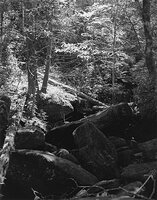
It seems to be a big factor. I often shut down to f45 or f64 when I was starting out with 4x5 -- photographing complex landscapes (middle of the redwood forests) requiring max DoF over any sharpness loss due to optical losses. When I moved out of the redwoods and could use the middle f/stops (f11 or f/16), enlarging these TMax100 negatives to 16x20, the prints were noticably sharper. Caltar IIN 150mm/5.6 lens
 
All very interesting. My question: How do you know if your exposures are "perfect"? I've recently been shooting with Tri-X in the desert, with high contrast subjects, deep shadows and a wide range of grey tones. Using my Hasselblad on a tripod with mirror lock-up and my 150mm CF Sonar, I see that my exposures were difficult at best, usually problematic and not easy to print in the darkroom. Some of them are quite sharp, but some are less so, and few if any resemble the sharpest pictures I've ever seen. I've also been using a yellow-green filter, and wonder how that contributes to sharpness. And. BTW, what would be the sharpest F-stop on the Sonar? F8?

Good point, and let's not forget that development also plays a significant role in sharpness. The best sharpness needs perfect exposure and development as well as a high-contrast subject, and all of that transferred to the print is not easy and most likely not necessary if it is an interesting and well-composed photograph, but still worth aiming for; getting it blurry is easy; getting it critically sharp not so much.
 
If one is enlarging negatives, over exposure is detrimental to overall image quality. Add in over development and things get worse.
over-exposure-jpg.371916
 
Too bad they didn't print the scale on Y axis. We would've finally had the answer whether the print quality goes up to 10 or to 11.
 
Last edited:
I think in underexposed negatives, when you look in the shadow areas, they tend to look grainier (or dye-cloudier for color) - anyway noisier, and this contributes to an impression of lower sharpness. Sometimes this is pictorially fine, like if you're shooting a street scene at night. But if you were (for example) taking photos of a landscape or streetscape, and you examine it in detail for details of say a tree or a distant sign or whatever, the underexposed photo will often look like it resolves less fine detail due to the impression of noise. You can test this by taking the same photo at a few different exposure settings.

If so, you should see the effect more in the shadows, and not so much in the highlights, where the film received more or less enough light even when underexposed by -1 or -2.
 
whether the print quality goes up to 10 or to 11.

LOL!

I think in underexposed negatives, when you look in the shadow areas, they tend to look grainier (or dye-cloudier for color)
You're usually looking at grainier elements of the emulsion, which explains this in part. Another part is that we tend to digitally boost contrast on underexposed negatives, resulting in more emphasis on these non-image artifacts, which can further degrade the impression of sharpness. On the other hand, overexposure can result in halation and light piping effects that can degrade microcontrast. There's a bunch of other effects playing a role as well.
 
Photrio.com contains affiliate links to products. We may receive a commission for purchases made through these links.
To read our full affiliate disclosure statement please click Here.

PHOTRIO PARTNERS EQUALLY FUNDING OUR COMMUNITY:


Ilford ADOX Freestyle Photographic Stearman Press Weldon Color Lab Blue Moon Camera & Machine
Top Bottom
