
• Welcome to Photrio!
    Registration is fast and free. Join today to unlock search, see fewer ads, and access all forum features.
    Click here to sign up

Evaluating scanned negative (for analogue printing)

Forum statistics

Threads
203,265
Messages
2,852,091
Members
101,753
Latest member
Janek201
Recent bookmarks
0

tomalophicon

Member
Allowing Ads
Joined
Feb 7, 2010
Messages
1,568
Location
Canberra, AC
Format
Sub 35mm
Hello.

After playing with T-Max 400 and Ilfosol 3, I think I've come to a point where I'm happy that I've got a standard development time.

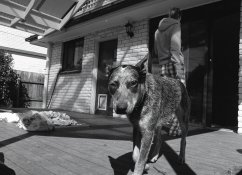
Do you think there is a good range of tones in this negative? I metered on the sunlit part of the deck and overexposed by 1 step Hoping to achieve zone VI.

Just to help me identify tones, do you guys think that the squares on the wooden door (above the dog's head) are on zone V?

Do you think the shadow in the door is around zone II?

Do you think the white wood about the fence on the left of picture is zone VIII?

I know different monitors can be different so maybe it won't look the same. I don't plan to print from computer but I will be printing in the darkroom tonight. to see if I can translate the tones.

Developed for 7 minutes at 20 degrees with agitation at every minute for 10 seconds.

T-Max 400 rated @ 400 on the camera's dial.
f/16 and 1/500th shutter speed.
45mm lens on Mamiya 645 pro.


Is there any reason why Ilfosol 3 is no good for T-Max?
 

Attachments

  • img017.jpg
    img017.jpg
    859.5 KB · Views: 176
I've updated the thread title to keep the discussion on topic.

I don't know that there's a good way to answer this question, since the scanner and software introduce too many variables that may or may not reflect what happens when you print on photographic paper. I'd recommend just proofing the negs traditionally on the paper you plan to print on, minimum time for maximum black in the unexposed film rebate, and judge contrast from there. Look at the shadow areas of the neg directly and see if there is detail, and that will help you judge whether you gave the neg enough exposure.

Scanning, though, might be useful to help visualize what you plan to do in the darkroom, particularly if you don't have your own darkroom and time is limited. Ultimately, though, I think it's more efficient just to look at the contact sheets, mark them up to plan your printing session, and work with the neg in the darkroom.
 
Thanks David, I appreciate your comments. I suspected after I posted that the questions might actually be difficult to answer since I don't plan on printing from the digitised images (not that I necessarily plan on printing this image, either).
Tom.
 
Nothing wrong with Ilfosol 3, I have used it a little and it's a good developer. One usually just has to get to a stage where your exposure in camera, developing in tank and printing in tray, produce what you are after.

Personally, your depiction of the (Blue Healer?) itself is good, but the background parts that are quite bright will be a bit difficult to burn in to an appropriate or pleasing level.

The forehead of the dog (or is it a bitch) is where I would have taken a reading from, this would allow me to ensure that I get the darker hair of it's hind, showing enough detail to allow a print.

Many years ago working with drum scanned negatives in the graphic arts industry, I realised that the detail one sees in a depiction on a monitor bears only a passing likeness to what you can actually print reasonably easily.

I agree with David, you should (if possible) work with a contact sheet or proof of your negative(s). In 35mm land it is possible to see some great tonality in a contact sheet, with 645 you will see a lot more far easily, 6x7 and larger contact sheets are something else.

Your observations/questions as to where the different zones fall, seem about right from what I sit, but the correctness of my observation is open to enormous interpretation due to, as David says, variables.

Mick.
 
Thanks Mick.
The male blue heeler wasn't there when I took the reading so I just based it on the deck and thought it would be OK. To me it is a good representation of what I saw, with the front part of the body in light and the hind in shadow.
The white bricks are extremely bright when the sun hits them.
If I wanted to take a really good shot of the dog I probably wouldn't do it out here.

Thanks for the assistance guys.
 
I haven't done it for B&W but I did it for color negative with good sucess. A lot of calibration work needs to be done ahead of time and the scanner software must allow you to do the exposure control on the scan completely manual. Not automatic with compensation. I had to adjust the tone curves when scanning to make it match that of the paper. I guess in B&W you would need several tone curves for different contrast grades. It may be easier to evaluate tone value by reading off the RGB values via software than trying to judge by eyes.
 
That all sounds too complex for my liking. :smile:
I'll just stick to the darkroom and scan the prints if I want to share them electronically.
 
I am not qualified to give advice on your questions. But I am qualified to say that, if that were my shot, and I was able to make a print that looked just as that appears on my monitor, I would be quite pleased.
 
Photrio.com contains affiliate links to products. We may receive a commission for purchases made through these links.
To read our full affiliate disclosure statement please click Here.

PHOTRIO PARTNERS EQUALLY FUNDING OUR COMMUNITY:


Ilford ADOX Freestyle Photographic Stearman Press Weldon Color Lab Blue Moon Camera & Machine
Top Bottom
