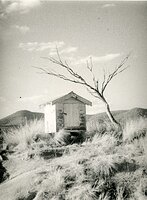
OP
OP

So is my Nikon D2x with its very limited dynamic range in the highlights.
But you probably have a LCD screen with a histogram to help you with highlights…

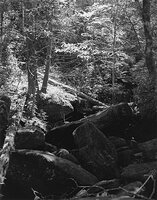
So is my Nikon D2x with its very limited dynamic range in the highlights.

Don’t forget, you’re seeing the JPEG file not the RAW image I’m seeing on my screen…
But that's the point. We see the jpeg.

But at least I’m fortunate enough to see the RAW file…
A RAW file isn't viewable. It has to be converted into some sort of display format to be viewable.
What you see is the results of a RAW file being processed by some sort of converter, with the result most likely then being further converted into something like a jpeg that can be seen on a screen.
Are you saying what I’m seeing is not a RAW image on my screen
 .
.But you probably have a LCD screen with a histogram to help you with highlights…
If you don't recognize the import of this fact, you clearly haven't encountered the heated arguments about which RAW converter should be used

Indeed.
It's a bit like being unable to hear someone else's thoughts. They'll have to be put in words, first. What you see/hear is indirect and interpreted.
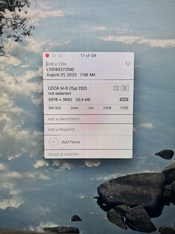
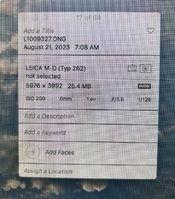
What RAW converter do I need to see the image in RAW…
is it a RAW image maybe compressed
We know it's a compressed RAW image. Why?
I use Darktable.
So I don’t need to get it converted…
So I don’t need to get it converted…

When you're viewing it, it's already converted. That was the point Matt was making.
Yes, it was a thought that needed to be expressed and interpreted in order to be able to grasp it. We can never know what the original thoughts really was.
If it is not converted in some way, it will be impossible for you to see it.
Unless of course, you are an Android, and you were photographing Electric Sheep.
Actually, I think rawdigger will display a raw file, but that’s not really very helpful. Raw files consist of a single filtered colour at each pixel and the colours are out of balance due to the filtration and spectral response.
What you see from raw converters, including Lightroom, are demosaiced images with (interpolated) full colour information at each pixel.
Raw digger can be useful to understand the underlying raw, but for actual photography you will be working in the raw converter. The histogram the should show the rgb channels in the converted image.
Working with digital capture, the general approach to optimising exposure (subject to the need to obtain appropriate depth of field and shutter speed) is to maximise exposure at lowest possible iso without blowing any highlights you wish to keep. This allows (post) processing to take advantage of the full dynamic range of the sensor, and minimises shadow noise to the extent possible.
A short note on the Nikon post earlier re limited highlight headroom - this is a consequence of the metering and is not inherent in the sensor. There is an overall dynamic range available at any iso setting. The camera metering simply sets the exposure level and may be biased towards saturation of pixels (lower noise less highlight headroom) or towards lower exposure (more highlight headroom and less shadow recovery available). For scenes that require very high dynamic range, the exposure really matters and this where ETTR starts to be an important concept.
Mike
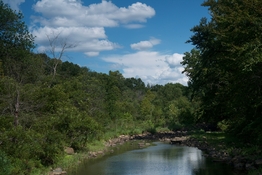
Shot this scene at +1…
Sure, get basics of exposure right. But no technical tricks short of the big hammers of image manipulation will solve the fundamental issues with the scenes you show: foreground in shade, bright sky. If you want vibrant foreground and blue sky, wait until the lighting is right, you probably want a ray of sun on those trees!
| Photrio.com contains affiliate links to products. We may receive a commission for purchases made through these links. To read our full affiliate disclosure statement please click Here. |
PHOTRIO PARTNERS EQUALLY FUNDING OUR COMMUNITY:  |