• Welcome to Photrio!
    Registration is fast and free. Join today to unlock search, see fewer ads, and access all forum features.
    Click here to sign up

Entering a new era - getting stabilized light

Texas

A
Texas

  • 1
  • 0
  • 21

Forum statistics

Threads
203,432
Messages
2,854,525
Members
101,837
Latest member
Chapster
Recent bookmarks
0
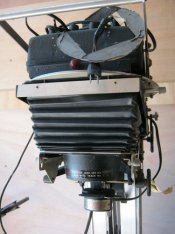
Isn't a coldlight head usually used with a shutter under/on top the enlarger lens? Am I misunderstanding the "leave the lamp on" problem - surely it can't run directly of the timer?

A shutter controlling light from an always-on lamp would solve the problem, but that's not how it's normally done. I think overheating of the tube causes its life to be shortened. In my Aristo VCL4500, admittedly with two tubes, not one, after 10 minutes continuously on, the air in the enclosure was 70degC (158degF) and still rising. Maybe they should be called "not-so-cold-lights."

Just to elaborate on my post above, the Zone VI Compensating timer allows the tube to run at full output (which varies with temperature) and the timer shortens the units of time, "nominal seconds" as the unit gets brighter. An audible tick marks the passing of each "nominal second" and the acceleration in the ticking on the old one-tube ZoneVI unit is very dramatic (the lamp unit bought in the mid 1970s). Interestingly, this does not happen nearly as much in my Aristo VCL4500, where the rising in temperature causes some (not a lot) increase in brightness which levels out and actually can decrease with much higher temperatures (which I don't reach because the unit is bright and exposure times don't need to be inordinately long.) I wonder if it's a deliberate design improvement or just an artefact of different materials etc used. This leads me to wonder if the newer tubes for the one-tube unit made with a wider spectrum for VC might also exhibit less intensity variation with temperature, but that is pure conjecture.
 
So a thermostat and active-cooling of the lamphouse (as used for halogen diffuser heads) would help also, or the led-lightboxes which were being used as an alternate to cold-light heads and to which I had found that d-i-y link previously (Edit. post #20) . . .

I only saw one cold-light head in action decades ago, on a visit to another lab, and that had an electric shutter (from a solenoid timed by the usual sort of timer), but I've no idea if the head was cooled or not. That particular enlarger was an 8x10 De Vere, but the head was from a different manufacturer I think.
 
Larger systems like an 8x10 enlarger could justify an electric solenoid-operated shutter. The process cameras that I used to operate all had them. The lights would come on first, and a brief time later the shutter would open and a sensor - typically near the copyboard pointed at the lights - would feed into an "integrator" like Drew was talking about.

I had a couple ideas kicking around. I tried to make an electric shutter, and a metronome hooked up to a sensor. I put those projects away once I realized that after a brief warmup, the lamp was reasonably consistent and I could work for a session by just keeping an eye on the resistance and using real time seconds. The consistent results between test-strip and print were all I cared about.

I'd figured on getting either a "tik-tok timer" or a stabilizer or a compensating timer. The RH Designs would be great but priced out of my league. Any of these would have helped. So I was happy when Greg Davis had this at a price within reach.
 
Isn't a coldlight head usually used with a shutter under/on top the enlarger lens? Am I misunderstanding the "leave the lamp on" problem - surely it can't run directly of the timer?

You might be thinking of the fluorescent lamp used in the "Omegalight." That could be left on continuously and run with a shutter (also made by Omega). However, in terms of coldlights, the maximum recommended 'on' time for a 14x14" Aristo is about 5 minutes.
OmegaShutter.jpg
 
My stabilizer is set at the L position. With Aristo D2-Hi with V54 tube it immediately switches the green stable light on when turned on. I turn the heater on about an hour before I start printing to make sure the head is at operating temperature.
 
To ic-racer, above.

The enlarger was a De Vere, so probably the head was a Cathomag? Whether that was made by De Vere or was a re-badged head (or tube, at least) I have no idea. :smile:
 
Thanks for the tip ChuckP!

I'm getting only up to "G" with this new rig. I'm actually looking forward to being able to use an "optimum" f/stop... because I'll dial in what it takes to make 32 seconds "typical"... Still haven't printed but it's going to be soon...
 
Photrio.com contains affiliate links to products. We may receive a commission for purchases made through these links.
To read our full affiliate disclosure statement please click Here.

PHOTRIO PARTNERS EQUALLY FUNDING OUR COMMUNITY:


Ilford ADOX Freestyle Photographic Stearman Press Weldon Color Lab Blue Moon Camera & Machine
Top Bottom