• Welcome to Photrio!
    Registration is fast and free. Join today to unlock search, see fewer ads, and access all forum features.
    Click here to sign up

Enlarging small sections to large sizes

Temporary Jewels

H
Temporary Jewels

  • 1
  • 0
  • 49
Horicon Marsh-5

A
Horicon Marsh-5

  • 2
  • 0
  • 107

Recent Classifieds

Forum statistics

Threads
201,259
Messages
2,821,358
Members
100,624
Latest member
ericstoynov
Recent bookmarks
0

Jacob Iverson

Subscriber
Allowing Ads
Joined
Sep 12, 2025
Messages
12
Location
Delaware County, PA
Format
Multi Format
Hi all, I have a rather dumb question fit for my lack of expertise. Still though, I wonder if it's been done before.

I'd like to make a set of prints that focus on SUPER small parts of a negative.

Think cropping into the photo by 200+%, and having that small portion make up the entire print.

Would it be as simple as getting a super sharp enlarger lens + a 4x5 head fit with other compatible carriers, enlarging to the wall, and cropping the paper size? Or is there another way something like this could be done?

For research, is anyone familiar with artists who have done this sort of work before?

I know it's a bit of a silly question, but it's for a concept I'd like to pursue for a body of work.
 
Last edited:

DREW WILEY

Member
Allowing Ads
Joined
Jul 14, 2011
Messages
14,787
Format
8x10 Format
It could hypothetically get as crazy as using microscope lenses on your enlarger. That has been done, but with significant logistical headaches.

But what is the overall FULL size of the negs you plan on starting with? And how short does your bellows go? Do you have a recessed lensboard? All that has to be factored before choosing an appropriate lens.
 

Pieter12

Member
Allowing Ads
Joined
Aug 20, 2017
Messages
8,016
Location
Magrathean's computer
Format
Super8
How large is your negative? How small an area do you want to enlarge? Not sure why you would need a 4x5 enlarger as they usually don't need to scale up as much as smaller negs. I have enlarged maybe 50% of a 2-1/4 negative with nice results. Depending on the look you're after, the original should be nice and sharp to hold up. Certainly, the sharpest lens you can afford with a condenser head will render the sharpest image and a short lens will help get larger prints from a small area. I like negatives processed in Rodinal as the grain is very well defined and looks good blown up big.

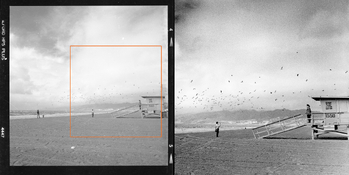
Crop example.jpg
 

loccdor

Member
Joined
Jan 12, 2024
Messages
2,403
Location
USA
Format
Multi Format
Might it be easier to duplicate these tiny sections with a 35mm camera and macro lens and then use normal small format enlarging techniques?
 

ic-racer

Member
Joined
Feb 25, 2007
Messages
16,697
Location
USA
Format
Multi Format
Hi all, I have a rather dumb question fit for my lack of expertise. Still though, I wonder if it's been done before.

I'd like to make a set of prints that focus on SUPER small parts of a negative.

Think cropping into the photo by 200+%, and having that small portion make up the entire print.

Would it be as simple as getting a super sharp enlarger lens + a 4x5 head fit with other compatible carriers, enlarging to the wall, and cropping the paper size? Or is there another way something like this could be done?

For research, is anyone familiar with artists who have done this sort of work before?

I know it's a bit of a silly question, but it's for a concept I'd like to pursue for a body of work.

Prior thread on the topic:


Paul Howell

Subscriber
Allowing Ads
Joined
Dec 23, 2004
Messages
10,030
Location
Scottsdale Az
Format
Multi Format
While in the Air Force we did extreme crops as a last resort. We used Omega D5 XL, set of Schneider lens matched to the AF rails. We had very tall darkroom ceiling so that if needed we could shoot to the floor. The limiting factors in just sheer size are the lengths of the bellows, how tall is the enlarger frame, does it allow to shoot to the floor or turn to shoot to a wall. The quality limitations are in the film stock. Most often the shots were from 34mm and MF taken in the field work, shot on 70s vintage TriX or Plus X, we enlarged until the resolution fell apart. Sometimes we made a copy of a 35mm or MF negative on 4X5 copy film, still only so far we could befor the resloution and grain just fell apart. It was techincal work, Air Intelligence and engineering staff would request that we crop a print to show detail in a small area of a negative, the just wanted to see useful detail, nothing more mattered. So much depends on the formate, are you talking 4X5?
 

GregY

Member
Allowing Ads
Joined
Apr 12, 2005
Messages
3,888
Location
Alberta
Format
Large Format
Hi all, I have a rather dumb question fit for my lack of expertise. Still though, I wonder if it's been done before.

I'd like to make a set of prints that focus on SUPER small parts of a negative.

Think cropping into the photo by 200+%, and having that small portion make up the entire print.

Would it be as simple as getting a super sharp enlarger lens + a 4x5 head fit with other compatible carriers, enlarging to the wall, and cropping the paper size? Or is there another way something like this could be done?

For research, is anyone familiar with artists who have done this sort of work before?

I know it's a bit of a silly question, but it's for a concept I'd like to pursue for a body of work.

You can do this in smaller sizes. Rack your enlarger out to its max height and print a small portion of whatever size negative you're working with.
 
Joined
Sep 10, 2002
Messages
3,653
Location
Eugene, Oregon
Format
4x5 Format
A short lens and lots of lens-to-print distance is what you need.

If you're starting from a larger negative (4x5 or 120), you can easily enlarge a 35mm-film-sized part of that by simply using a 50mm enlarging lens at the height for full-frame 35mm. If your enlarger goes higher, then you can go even smaller (think a cropped print from a 35mm neg).

If you're starting with small film, you need the shortest enlarging lens you can find (maybe one intended for half-frame 35mm or for enlarging 16mm or even 8mm movie film) and you need to be able to get it close enough to the negative by means of a recessed lens board or very short bellows.

There are 28mm and 26mm enlarging lenses out there if you look hard enough.

Doremus
 

cliveh

Subscriber
Allowing Ads
Joined
Oct 9, 2010
Messages
7,715
Format
35mm RF
Here is another dumb question. Why didn't you photograph that small section in the first place?
 

DREW WILEY

Member
Allowing Ads
Joined
Jul 14, 2011
Messages
14,787
Format
8x10 Format
One often can't. And if they do, the perspective changes. Or in this case, maybe he wants extreme magnification grain n' all. He hasn't responded back to any remarks yet, so dunno.
 

wiltw

Subscriber
Allowing Ads
Joined
Oct 4, 2008
Messages
6,622
Location
SF Bay area
Format
Multi Format
Keep in mind that 'enlargement' is not merely the image of the subject in the frame, but the GRAIN. So while what you propose is certainly feasible, whether or not it results in a 'pleasing' and 'acceptable' enlargement is a different matter. I recall, from my youth, discovering that anything above 16X enlargement size (>16x24" print from 135) began to show unexceptably obvious grain for my taste. So making a 8x12 (16X) print from 1/4 of the 135 frame might be OK for you, but an 10x15 (20X) print from the same frame section might not be OK for you.
 

Pieter12

Member
Allowing Ads
Joined
Aug 20, 2017
Messages
8,016
Location
Magrathean's computer
Format
Super8
Keep in mind that 'enlargement' is not merely the image of the subject in the frame, but the GRAIN. So while what you propose is certainly feasible, whether or not it results in a 'pleasing' and 'acceptable' enlargement is a different matter. I recall, from my youth, discovering that anything above 16X enlargement size (>16x24" print from 135) began to show unexceptably obvious grain for my taste. So making a 8x12 (16X) print from 1/4 of the 135 frame might be OK for you, but an 10x15 (20X) print from the same frame section might not be OK for you.
From what is stated in the initial post, it seems like he realizes the consequences of enlarging very small section of a negative. That is what he is after.
 

wiltw

Subscriber
Allowing Ads
Joined
Oct 4, 2008
Messages
6,622
Location
SF Bay area
Format
Multi Format
From what is stated in the initial post, it seems like he realizes the consequences of enlarging very small section of a negative. That is what he is after.

He did state, "fit for my lack of expertise". I recall the revelation I had almost 60 years ago when I made my first 16X enlargement as a young teen making a print for an 11x14 entry in a competition.
 
Last edited:

Pieter12

Member
Allowing Ads
Joined
Aug 20, 2017
Messages
8,016
Location
Magrathean's computer
Format
Super8
He did state, "fit for my lack of expertise". I recall the revelation I had almost 60 years ago when I made my first 16X enlargement as a young teen making a print for an 11x14 entry in a competition.

I interpreted lack of expertise as technical knowledge. He states he is perusing a concept for a body of work, which I take as the grainy, abstract appearance of the enlargement of a very small segment of a negative.
 

Don_ih

Member
Allowing Ads
Joined
Jan 24, 2021
Messages
8,406
Location
Ontario
Format
35mm RF
You could make a reasonable size print and take a close-up photo of part of it and enlarge that.

You could also enlarge 35mm to 4x5, then that 4x5 to another 4x5, then enlarge that one to paper.

There are lots of different ways to do it - not all involve direct huge magnification (and the long distance to paper that comes with it with the accompanying loss of contrast). You need to settle on what kind of quality you're willing to accept, though.
 
OP
OP
Jacob Iverson

Jacob Iverson

Subscriber
Allowing Ads
Joined
Sep 12, 2025
Messages
12
Location
Delaware County, PA
Format
Multi Format
Hi all, sorry for my tardiness in replying, and thanks for your participation! I'll share a bit about the concept.
In the age of AI, I've been thinking about how film acts as a literal record of a moment, in the sense that the original negative was impacted by the actual photons present in the moment of capture. In just that same sense, prints are embodiments of that light, of that instance. I'm sure this is why many of us use the medium!

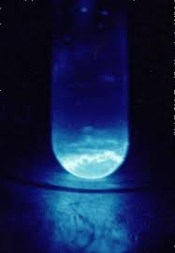
There are several photos I can think of in history where a subject matter is "rare" or can never occur again. from a material perspective, this can even be examined in old scientific photographs, such as this photo of Einsteinium – I'll admit, I'm not actually sure if this is film – but nonetheless, that specific accumulation of light represents something I find fascinating, the beautiful decay of a very rare material. Many photographs, some in libraries, others, floating around in online stores, withhold a phenomena or represent something which can be magnified and appreciated for its character.

I love to work with abstractions of photography, and so this altogether seemed like an interesting project to pursue.

Pieter12 nailed it with post #15. Because this concept would involve negatives of all sizes, but perhaps most commonly 35mm and 120, the question is a bit broad...
The centerpiece for the concept is light, as a medium, passing through the "original negative" to pass on the life of that scene.So... This project might take me some time, considering I don't immediately have access to these "rare" photos. I'll test with my own negatives at first.

The scale I'd have in mind though would certainly be in the range of grain being individually recognizable, and ideally at print sizes of 16x20 or beyond. I think a variety here might benefit the body of work.
 

Attachments

  • download.jpeg
    download.jpeg
    3.6 KB · Views: 20
Last edited:
OP
OP
Jacob Iverson

Jacob Iverson

Subscriber
Allowing Ads
Joined
Sep 12, 2025
Messages
12
Location
Delaware County, PA
Format
Multi Format
While in the Air Force we did extreme crops as a last resort. We used Omega D5 XL, set of Schneider lens matched to the AF rails. We had very tall darkroom ceiling so that if needed we could shoot to the floor. The limiting factors in just sheer size are the lengths of the bellows, how tall is the enlarger frame, does it allow to shoot to the floor or turn to shoot to a wall. The quality limitations are in the film stock. Most often the shots were from 34mm and MF taken in the field work, shot on 70s vintage TriX or Plus X, we enlarged until the resolution fell apart. Sometimes we made a copy of a 35mm or MF negative on 4X5 copy film, still only so far we could befor the resloution and grain just fell apart. It was techincal work, Air Intelligence and engineering staff would request that we crop a print to show detail in a small area of a negative, the just wanted to see useful detail, nothing more mattered. So much depends on the formate, are you talking 4X5?

Thank you for sharing your experiences, Paul. That is a fascinating execution of this. Not sure if those kinds of photographs are "classified" or how that works, but if it wouldn't be trouble, I'd love to see an example if you have one on hand.
 
OP
OP
Jacob Iverson

Jacob Iverson

Subscriber
Allowing Ads
Joined
Sep 12, 2025
Messages
12
Location
Delaware County, PA
Format
Multi Format
I interpreted lack of expertise as technical knowledge. He states he is perusing a concept for a body of work, which I take as the grainy, abstract appearance of the enlargement of a very small segment of a negative.

That's totally right. If anyone is familiar with an artist who has worked this way, I'd love to see their work.
 
OP
OP
Jacob Iverson

Jacob Iverson

Subscriber
Allowing Ads
Joined
Sep 12, 2025
Messages
12
Location
Delaware County, PA
Format
Multi Format
A short lens and lots of lens-to-print distance is what you need.

If you're starting from a larger negative (4x5 or 120), you can easily enlarge a 35mm-film-sized part of that by simply using a 50mm enlarging lens at the height for full-frame 35mm. If your enlarger goes higher, then you can go even smaller (think a cropped print from a 35mm neg).

If you're starting with small film, you need the shortest enlarging lens you can find (maybe one intended for half-frame 35mm or for enlarging 16mm or even 8mm movie film) and you need to be able to get it close enough to the negative by means of a recessed lens board or very short bellows.

There are 28mm and 26mm enlarging lenses out there if you look hard enough.

Doremus

Thanks for the information. I'm still building my enlarger setup. I have an Omega B22 with a 50mm Nikor on hand, but I only purchased that to repurpose the column for DLSR scanning.
When I can get to it, a proper enlarger capable of 4x5 is what I'll be after, just so I have the entire range of printing.

Would 4x5 as a choice of enlarger put a bottleneck on getting the proper equipment for this project? Perhaps it may be better to build a separate, specialized rig?
 
Last edited:

MattKing

Moderator
Moderator
Allowing Ads
Joined
Apr 24, 2005
Messages
54,746
Location
Delta, BC Canada
Format
Medium Format
Most of us have had occasion to print at least a bit larger than the ideal amount from a portion of a negative.
As an example, I just made some 11x14 prints from a moderately cropped (~ 1/2) portion of a 35mm negative.
The film is 400 ISO HP5+ and well past its develop before date - some age related fog is visible, and there is fairly distinct grain.
They were grab shots taken at my niece's wedding with a scale focus Olympus XA2 - thankfully I nailed focus.
I'm very happy with the result, because the aesthetic of the result more than overcomes any strictly technical shortcomings. I think the 11x14, hand made enlargement will stand well alongside the literally thousands of sharp and well exposed digital images that my niece and her new husband have available to them - I certainly am happier with that print than my digital efforts.
I say all this to help illustrate the fact that relatively modern photographic equipment and materials has tremendous technological capabilities. You may have to go to real extremes before any shortcomings in the technology overwhelm the pictorial content.
You may actually find that the biggest challenge will be finding the relatively narrow range where the shortcomings intrude, but only the right amount.
 

koraks

Moderator
Moderator
Joined
Nov 29, 2018
Messages
26,146
Location
Europe
Format
Multi Format
You may actually find that the biggest challenge will be finding the relatively narrow range where the shortcomings intrude, but only the right amount.

I think we need to stop trying to push a 100+ year old tradition of straight photography and the technical dogma it comes with upon OP's project. What you call "shortcomings" are the pearls he's looking for.

@Jacob Iverson I would consider getting a microscope with a camera adapter. That way you can make huge enlargements and capture them on film or digitally, then make prints of those images. If you value an all-film workflow, look for a microscope that can have a 35mm camera fitted to its ocular. These systems were commonplace at a time and should be available (to an extent) on the second hand market. You will have to do some reading/investigation on which microscope-camera-adapter configurations will work.
 
Last edited:

Don_ih

Member
Allowing Ads
Joined
Jan 24, 2021
Messages
8,406
Location
Ontario
Format
35mm RF
A microscope may be the way to go. Adapters are available for lots of different cameras. Some manufacturers even made dedicated microscope cameras. Older high-quality microscopes are fairly inexpensive, too. You could reversal process the film and get something directly enlargeable.

The only "shortcoming" I would see is taking a 35mm negative made using a microscope and enlarging that to 16x20 - mainly because the grain of that film would intrude. But that can be minimized by the film choice and reversal tends to smooth that out (if you went that way) - plus it is all part of the same process you're attempting to realize, anyway. So that may not be a problem.

This all reminds me I wanted to get an adapter for the Zeiss microscope I have. But I need to clean all the dust out of it, first. Just another thing on the list....
 

MattKing

Moderator
Moderator
Allowing Ads
Joined
Apr 24, 2005
Messages
54,746
Location
Delta, BC Canada
Format
Medium Format
What you call "shortcomings" are the pearls he's looking for.

Ah, a dispute about the meaning of words - perfect for Photrio! :smile:
How about "shortcomings" for some purposes, but aesthetic elements for others?
The trick with any of these things is to decide how exactly you want the mix to be between the ability of the materials to present detail of the original subject and the aesthetic potentials of the materials.
 

Paul Howell

Subscriber
Allowing Ads
Joined
Dec 23, 2004
Messages
10,030
Location
Scottsdale Az
Format
Multi Format
Thank you for sharing your experiences, Paul. That is a fascinating execution of this. Not sure if those kinds of photographs are "classified" or how that works, but if it wouldn't be trouble, I'd love to see an example if you have one on hand.
Sorry, classified and property of the U.S Air Force,
 
Photrio.com contains affiliate links to products. We may receive a commission for purchases made through these links.
To read our full affiliate disclosure statement please click Here.

PHOTRIO PARTNERS EQUALLY FUNDING OUR COMMUNITY:


Ilford ADOX Freestyle Photographic Stearman Press Weldon Color Lab Blue Moon Camera & Machine
Top Bottom