• Welcome to Photrio!
    Registration is fast and free. Join today to unlock search, see fewer ads, and access all forum features.
    Click here to sign up

Enlarger bellows to focal length relationship

Forest Light

H
Forest Light

  • 1
  • 0
  • 28
Bacon Fest 2013

A
Bacon Fest 2013

  • 0
  • 5
  • 87

Forum statistics

Threads
203,429
Messages
2,854,454
Members
101,831
Latest member
R-Man
Recent bookmarks
0

pstake

Subscriber
Allowing Ads
Joined
May 5, 2005
Messages
730
Location
Lincoln, Neb.
Format
Multi Format
Can someone smart please explain to me the relationship between the bellows extension of an enlarger and the height needed to bring a negative into focus on the baseboard/easel, based on the focal length of an enlarging lens?

I'm fairly dumb and would prefer layman's terms to mathematical formulae, or at least in addition to formulae.

Please and thank you!
 
Is there one? Guess I'm not one of the smarter guys. I simply adjust the height to get the focus close, then use the bellows to get it dialed in. My preference is to get it as close to focused as I can w/ just the head height to eliminate any sort of misalignment w/ a fully extended bellows. The head height is going to be different w/ 35mm vs 6x6, etc, assuming that you change lenses for each appropriate format, and how much you plan on enlarging the neg.
 
I've done the math before to figure neg to baseboard and bellows extension figures, but can't recite them off the top of my head.

But I did have a figure for you related to our earlier discussion on that. I have an enlarger still set up for an 8x10 print from 4x5 negative with a 150 Componon and measure about 225mm from negative to lens flange.
 
1/focal length = 1/subject distance - 1/image distance, stated as

1/f = 1/u + 1/v
 
Oops

1/focal length = 1/subject distance + 1/image distance, stated as

1/f = 1/u + 1/v
 
It may not be an exact science. Although two similar enlarging lenses, say 50mm, such as my Nikkor EL 50/2.8 and my rather older Durst Neonon 50mm/2.8 (An excellent lens) have different back focus measurements, with the Durst lens needing to be nearer the negative than the Nikon to obtain sharp focus.

Likewise many prime camera lenses of the same focal length are designed to give the correct back focus with specific cameras with some having the mount further away from the focal plane than others.
 
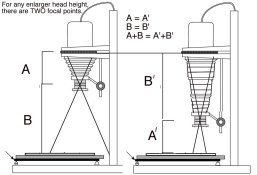
For any enlarger head position there are two focal points for the lens (two bellows positions). One position for enlargements and another for reductions. In one case raising the head and re-focusing causes the projected image to get bigger and in the other case raising the head and re-focusing causes the projected image to get smaller.
enlarger2.jpg
 
Last edited by a moderator:
Thank you to everyone who responded.

Mark, I ended up getting a Rodagon 180 at a decent price, so will let you know how that pans out.
 
Thank you to everyone who responded.

Mark, I ended up getting a Rodagon 180 at a decent price, so will let you know how that pans out.

That is kind of an oddball focal length. Enlarging 5x7?
 
Got it. Even if the falloff is not from the lens, the 180 will 'see' less of your light source. I'm assuming this is a diffusion enlarger. For condenser enlargers, best even illumination is by matching lens focal length to the condensers.
 
Got it. Even if the falloff is not from the lens, the 180 will 'see' less of your light source. I'm assuming this is a diffusion enlarger. For condenser enlargers, best even illumination is by matching lens focal length to the condensers.

It's diffusion type. It's a Federal 450 and I'm considering have a better diffuser glass made for it. I currently have an additional 6" diffusion disk over the original and a small ground glass in the center, above that.

Before I did that, the corner to center light difference was a full stop or more. Now it's the same from each of the right corners, but the left corners are about a half stop apart.

The 180 seeing less, should help, too.
 
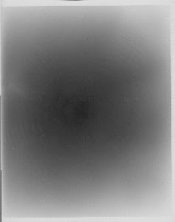
With some trial and error, you can also make your own center filter to place under the diffusion plate by exposing a sheet of negative film under the enlarger's focused beam (with nothing in the negative stage).
Centerfilter.jpg
 
Nice idea. I modified a 4x5 head to 5x7 format a few years back and made prints like you show to see what I needed, but it somehow didn't occur to me to make a film mask.

Still, that was a color mixing chamber which seems easier to work with. For one thing it is fairly cool, at the diffusion plate, which a lot of these old enlargers aren't. I'm all for messing with old gear but wonder if if wouldn't be better to just pick up a 4x5 Beseler or Omega. It is spotty finding them anymore I suppose, but they are usually priced somewhere right around free when one does turn up locally. I've given 2 4x5's away in the last couple years, and turned down another that went to the dump. I just couldn't find anybody local that wanted it.

Hopefully the 180 will do the trick though.
 
Last edited by a moderator:
Photrio.com contains affiliate links to products. We may receive a commission for purchases made through these links.
To read our full affiliate disclosure statement please click Here.

PHOTRIO PARTNERS EQUALLY FUNDING OUR COMMUNITY:


Ilford ADOX Freestyle Photographic Stearman Press Weldon Color Lab Blue Moon Camera & Machine
Top Bottom