



At Kodak, we modeled emulsions, made them and then compared the run-time data with the modeled data for accuracy.
This gave us a feeling for the model, and also told us what took place in the kettle as we made the emulsion.
We had a rich history in mathematics related to emulsion making, and this is reflected in the dozens of patents and publications on this subject. These publications seem to have been generally overlooked.
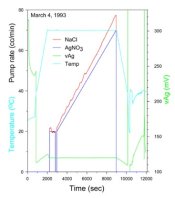
In any event, attached is a run time plot of a pure chloride (Azo type) emulsion made actually for Supra color paper. These too were pure chloride emulsions which were either treated to add epitaxy after the make or which had an Iodide compound added to increase sensitivity. Supra and Endura chloride emulsions could approach ISO 25 in speed.
The data is courtesy of Dr. Bruce Kahn.
Two things of note. The 'bobble' in salt flow at the start of the make is due to an incorrect PID setting, and the general salt flow overall overruns the silver flow due to the increasing ionic strength. This is all seen in the equations applicable to this, for those that are interested.
Afterthought to Simon Galley and the staff at Ilford. This is a freebie from Bruce's course at RIT.
PE
This gave us a feeling for the model, and also told us what took place in the kettle as we made the emulsion.
We had a rich history in mathematics related to emulsion making, and this is reflected in the dozens of patents and publications on this subject. These publications seem to have been generally overlooked.
In any event, attached is a run time plot of a pure chloride (Azo type) emulsion made actually for Supra color paper. These too were pure chloride emulsions which were either treated to add epitaxy after the make or which had an Iodide compound added to increase sensitivity. Supra and Endura chloride emulsions could approach ISO 25 in speed.
The data is courtesy of Dr. Bruce Kahn.
Two things of note. The 'bobble' in salt flow at the start of the make is due to an incorrect PID setting, and the general salt flow overall overruns the silver flow due to the increasing ionic strength. This is all seen in the equations applicable to this, for those that are interested.
Afterthought to Simon Galley and the staff at Ilford. This is a freebie from Bruce's course at RIT.
PE
Attachments
Last edited by a moderator:


