
• Welcome to Photrio!
    Registration is fast and free. Join today to unlock search, see fewer ads, and access all forum features.
    Click here to sign up

Efke IR 820 fogged. Could I have done this?

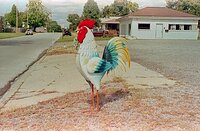
The Chicken

A
The Chicken

  • 2
  • 3
  • 44
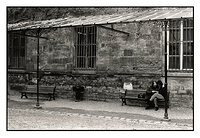
Amour - Paris

A
Amour - Paris

  • 1
  • 0
  • 63

Recent Classifieds

Forum statistics

Threads
203,237
Messages
2,851,885
Members
101,741
Latest member
Bruceluvsfilm
Recent bookmarks
0

GregSalter

Member
Allowing Ads
Joined
Sep 5, 2009
Messages
2
Location
London
Format
35mm
The entire length of the film is fogged to within one step of maximum black (except for the first 6 inches that are completely black having been exposed when the film was loaded). Throughout the film the images are barely visible in the little contrast left. The fogging is uniform, end to end and across the full width of the film - sprocket holes included. There is no visible structure or gradation in the fogging. I could understand some fogging in early frames if loading was careless, or perhaps some directional or repeated patterns if light was leaking into the changing bag or tank. But the uniformity is puzzling. If I'd been set the project of exposing a film completely uniformly to with one stop of max black I'd struggle for a way to do it. Any ideas what might have happened here?

The variables...
Efke IR 820 bought from a well-known specialist in London & came from their fridge.
Film is dated for Jan 2012.
Film was loaded in subdued light (as suggested, but not in total dark).
Camera is an M3 - no previous problem with light leaks.
Bracketed exposures from ASA 3-6 using Heliopan IR715 filter
Processed same day as used.
Loaded into a Paterson tank in a changing bag.
Developed for 7mins in IlfotecLC29 (estimated on the basis of other 100ASA films as Massive Dev chart doesn't have this combination.)
 
Four thoughts come to mind:

1. IR leaking through the felt on the cassette.

From the data sheet: "Complete darkness is required when loading 35-mm cartridges
into cameras..."

...and:

"It is technically impossible to seal the felt trap of a 35-mm cartridge
against IR radiation. Also, the film base will act as an optical waveguide
for IR radiation. It is because of these facts that MACO IR 820c
and MACO AURA 35-mm films must be taken from the storage container
and loaded into the camera in complete darkness (i.e. in a
changing bag or in a darkroom). Films taken from the container under
light (daylight or artificial) can be expected to be fogged up to about
half the film length (frame 12 to 18)."

As you can see, what you stated in your post about loading in subdued light is not even close to being "suggested" by the manufacturer, except in reference to 120 format.

How long did the 35mm cassette see light before it was loaded into the camera?

2. Light leak into the changing bag.

Were room lights on when you loaded the film into the tank?

3. Perhaps the back door of the M3 is leaking IR.

4. It could be heat damage.

How long was the film allowed to sit in room temperature after you purchased it?
 
Last edited by a moderator:
As you can see, what you stated in your post about loading in subdued light is not even close to being "suggested" by the manufacturer, except in reference to 120 format.

But it's hard to see how a light-piping effect would expose the *whole* *roll* uniformly; even if it happened severely enough to affect the roll all the way to the end, surely the sections nearest the tongue would be more exposed than the "inner" ones?

2. Light leak into the changing bag.

Is the changing bag known to be IR-opaque? I don't think they all are.

4. It could be heat damage.

How long was the film allowed to sit in room temperature after you purchased it?

I've kept Maco/Efke IR at room temperature for quite a bit longer than recommended before using it, without seeing any drastic effects. I'm not saying it's impossible, but my experience suggests that this is an unlikely answer unless conditions were really extreme.

The changing bag seems to me like the most likely option.

-NT
 
Sound like the camera might not be usable for IR photography and may not be IR light tight enough. Have you expose efke ir820 in this camera before with problems?

I have shot allot of this film at this stage. You dont need to load it in complete darkness. The only problems I have had with it is with the 120 aura version of the film which can show leak marks along the edges if not put into taken out of the camera quick enough....

Can be lots of things though, also if when you were winding the film onto the real if there was any light at all it could cause this....

Presume also that you have fixed it for long enough

M
 
My experience is with Maco 820c a few years ago, which I understand is very similar. Never had a problem with fogging. Loaded the camera in subdued light -- at worst, the felt trap in the film cassette should result in only a few frames fogged near the start of the roll. That never happened to me (except with Kodak HIE). I used my M2, and I suspect that your M3 is IR tight as long as it is otherwise light tight. I loaded my stainless steel reel and tank in a changing bag (dual black cloth; not rubberized). I understand that 820c was developed originally for traffic surveillance meaning it was designed to be handled by non-photographer law enforcement people and processed rather normally. It's unlikely that there is some exotic or esoteric factor at work here. Is it possible to check the IR specifications of your bag and tank? Was there any chance of anything being mis-connected or improperly closed, e.g. your M3 base plate?

The only other thing I can think of, not being familiar with your developer and the chemistry involved, but did you soak off the anti-halation layer before developing?
 
Greg,

I've had the same thing happen to me, only with a few of my precious remaining rolls of Kodak HIE. For me, nothing has changed after two years of using this film -- the camera used, the loading in and out of changing bag, the developer -- I've done everything the same as I always have, but for some reason, I'm now experiencing this uniform fogging across the entire roll, as you have, although the fogging doesn't appear to be as bad as yours. My initial thought was perhaps the changing bag, but I've unloaded and developed two rolls in one tank and one roll was completely fogged, and the other was not, so I don't think that explains it. I know this doesn't help you much, but I'm very interested in seeing what suggestions come up in this thread.
 
Changing bags rarely stop the penetration of IR. Your problem is loading inti camera and/or loading inti tank, Also be aware that the ring around the top of the Paterson tank may channel IR into the tank. Some of these rings channel visible light.
 
or perhaps some directional or repeated patterns if light was leaking into the changing bag or tank. But the uniformity is puzzling.

I don't have changing bag so I'm loading developing tank covered with a blanket. I loaded my first IR820 120 roll the same way at dusk, couldn't wait for night and had exactly the same problem. Next roll loaded at night, turned off everything around me that can or could emit IR light and processed the roll without any problem.

Pozdrav,
Zvonimir
 
I just processed some 820 Aura, shot in a Canon F1, processed with a Paterson system four tank and D76 1:1. The camera was loaded in subdued light (not dark) and there was no sign of fogging. The all over and even fogging sounds like a film problem to me. If it was a camera leak, or felt leak in the cassette, there would be uneven streaks.
The other suspect, as others have suggested, would be your changing bag, as this would cause a complete fogging because the film is completely out of the cassette. Maybe try loading with your bag, but at night with the lights off.
 
I once had a couple rolls of Kodak 2475 Recording film (extended-red sensitivity) fog and "solarize" chemically in Diafine developer. I never could pinpoint the exact cause, but thought perhaps some E-6 Reversal Bath had made its way into the developer (--> contaminated graduate perhaps ???). The developer continued to fog a few rolls and then, no more. Whatever it was apparently exhausted itself after a few rolls.

Any chance it could be chemical fogging? Are you storing the film near sensitizers, thiocyanates, etc.,?

It doesn't sound like anything you've done would cause uniform fogging. Perhaps it is bad film. Can you check the batch number with manufacturer?
 
An update...

Thanks everyone for insights & suggestions. Even thought I start with the assumption that I've messed up, I'm heading to the conclusion that this time it must be a film problem. The same combination of equipment, process & chemistry has worked fine for a roll of Rollei IR 400 so I don't think it can be the changing bag that's leaking IR (and if it was, the even fogging would be hard to explain.) There's an emulsion number on the pack so I might try an e-mail to efke.
 
Photrio.com contains affiliate links to products. We may receive a commission for purchases made through these links.
To read our full affiliate disclosure statement please click Here.

PHOTRIO PARTNERS EQUALLY FUNDING OUR COMMUNITY:


Ilford ADOX Freestyle Photographic Stearman Press Weldon Color Lab Blue Moon Camera & Machine
Top Bottom
