
• Welcome to Photrio!
    Registration is fast and free. Join today to unlock search, see fewer ads, and access all forum features.
    Click here to sign up

Eastman Portrait Panchromatic Film - develop before 1933

Recent Classifieds

Forum statistics

Threads
202,879
Messages
2,846,980
Members
101,527
Latest member
Grumps
Recent bookmarks
1

blee1996

Subscriber
Joined
Jul 25, 2008
Messages
1,558
Location
SF Bay Area, California
Format
Multi Format
I got some really really old 9x12 sheet film: Eastman Portrait Panchromatic Film. Still in its original sealed packaging. .
Its stamps says "develop before 1933". Haha, that was a while ago.
So my questions are:

- Do you think it is still worth taking photos and develop it? Or just keep it as museum display?
- If it is worth using, what kind of ISO would it be to expose the film? And which developer would you recommend to start with?
- And is Nitrate film easily inflammable? Any precaution in handling this?

old_film Large.jpeg
 
Cellulose nitrate is extremely flammable, like gun powder. Even static can ignite. It's no use as film.
 
It's flammable but it's really not that bad. My dad has a set of knives with cellulose nitrate handles that have been in use in the kitchen for 30+ years, just don't forget and leave one in the oven when you turn it on. Other than maybe not smoking around the film just shoot them as you would anything else.

At a guess start at ISO 25 and work down from there. I'd try progressively exposing one and using a dark slide to do a test strip across the exposure and seeing which, if any, gives you a non-fogged result. Probably try something like rodinal 1:100 stand developing and good luck!
 
I got some really really old 9x12 sheet film: Eastman Portrait Panchromatic Film. Still in its original sealed packaging. .
Its stamps says "develop before 1933". Haha, that was a while ago.
So my questions are:

- Do you think it is still worth taking photos and develop it? Or just keep it as museum display?
- If it is worth using, what kind of ISO would it be to expose the film? And which developer would you recommend to start with?
- And is Nitrate film easily inflammable? Any precaution in handling this?

View attachment 383914

I wouldn't be able to resist trying it. Try at 1/2 the recommended ISO and develop in D76 1+1 for 10 minutes. Nitrate film is flammable but is OK until it has a moderate vinegar smell. If so, keep in a closed container in the freezer.
 
If it was me, I would keep it as a museum piece. I have no idea what you will actually do.
 
I had a box of 4X5 Trix from the 50s and later a partial box of a othro trix maybe from the late 60s. I developed a sheet of each in D76 and fixed them to see how much fog. Both were almost black and the TriX emulsion was peeling off the base. Do you have a 6X9 sheet film holder?
 
Thanks for all the suggestions so far. Indeed I have 9x12 sheet film holders and camera to test this film on, if I wish to do so.

I will weight and pros and cons and decide what to do next.
 
Hi.

Recently I could develope some vintage nitro films.
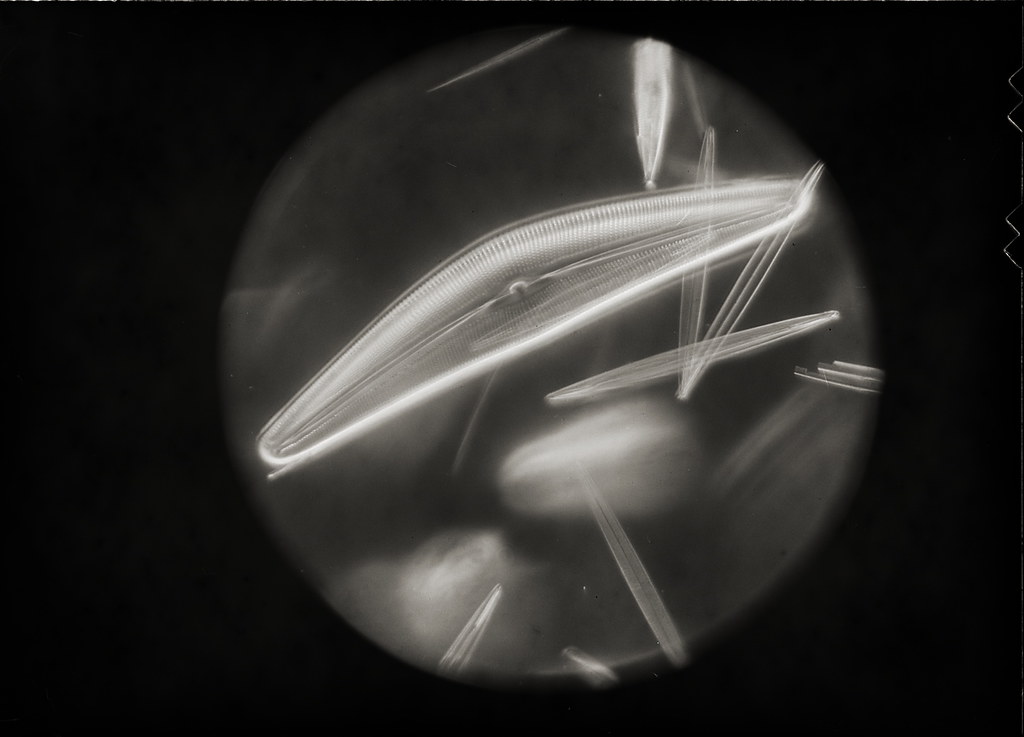
Best results came from Kodak Panatomic (german made edition by Kodak Berlin) expired in 1943. It's a 6.5 cm x 9 cm sheet film:

MGBM_142_Cymbella by Jens H, auf Flickr

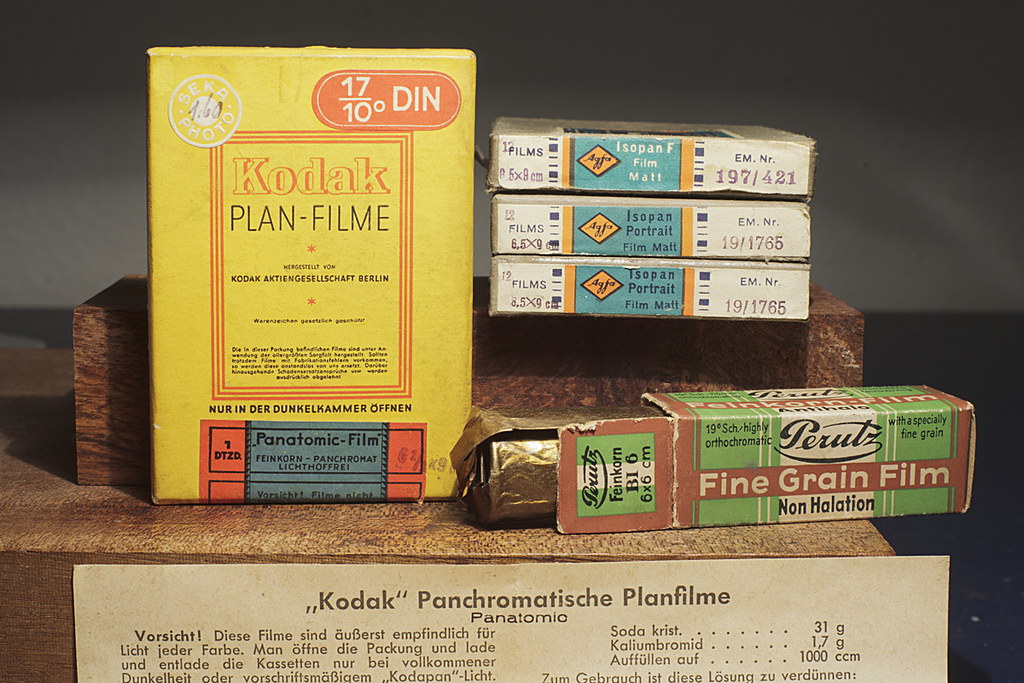
Here all the nitro films I have used so far:

Panatomic_et_al_nitrofilms by Jens H, auf Flickr

All these sheets are well usable, only the 120 roll Perutz fine grain film came out completely black.

For that old film Rodinal, HC110 or other developer's without carbonate prevent emulsion lift off... Pyrocat with NaOH works great, too.

Best
Jens
 
Last edited:
For that old film Rodinal, HC110 or other developer's without carbonate prevent emulsion lift off... Pyrocat with NaOH works great, too.

I guess my mistake was using D76, should have used HC 110, seems to be recommended by most for expired films.
 
For that old film Rodinal, HC110 or other developer's without carbonate prevent emulsion lift off... Pyrocat with NaOH works great, too.

I guess my mistake was using D76, should have used HC 110, seems to be recommended by most for expired films.
Yes, made this mistake, too. Using the usual acidic stop bath made things worse... ;-)
 
Last edited:
Hi.

Recently I could develope some vintage nitro films.
Best results came from Kodak Panatomic (german made edition by Kodak Berlin) expired in 1943. It's a 6.5 cm x 9 cm sheet film:

MGBM_142_Cymbella by Jens H, auf Flickr

Here all the nitro films I have used so far:

Panatomic_et_al_nitrofilms by Jens H, auf Flickr

All these sheets are well usable, only the 120 roll Perutz fine grain film came out completely black.

For that old film Rodinal, HC110 or other developer's without carbonate prevent emulsion lift off... Pyrocat with NaOH works great, too.

Best
Jens

Great film boxes!
 
The reason to expose more than 'normal' with old film is to get the shadows past whatever fog is there, and hope that your high values don't compress way up on the shoulder. I'd start with three stops above 'normal' and see what happens. It's a total crapshoot, but let us know your results... and remember that nitrate film is still flammable after it's been processed.
 
nitrate film is still flammable after it's been processed.

The good news is, that card stock box isn't airtight, to it's unlikely the base has deteriorated in the 90+ years since it was packaged the way old cine film does in sealed film cans.

Yes, cellulose nitrate is flammable, but not (IMO) dangerously so. I've burned a sample once, it was easy to ignite, but not as easy as, say, flash paper. Once burning, it went pretty fast, but the gelatin slows it down some and being a solid material rather than fibrous like flash paper also moderates the burn rate. In film form, at least, it will not ignite from a casual static spark or the like; it takes an actual flame.

Handle it like you would single sheets of thin paper and you'll be safe.
 
The good news is, that card stock box isn't airtight, to it's unlikely the base has deteriorated in the 90+ years since it was packaged the way old cine film does in sealed film cans.

Yes, cellulose nitrate is flammable, but not (IMO) dangerously so. I've burned a sample once, it was easy to ignite, but not as easy as, say, flash paper. Once burning, it went pretty fast, but the gelatin slows it down some and being a solid material rather than fibrous like flash paper also moderates the burn rate. In film form, at least, it will not ignite from a casual static spark or the like; it takes an actual flame.

Handle it like you would single sheets of thin paper and you'll be safe.

Thanks for sharing your own experience. Your and other's feedbacks give me more comfort to try out this film and see how it goes.

And I will preserve the box for museum.
 
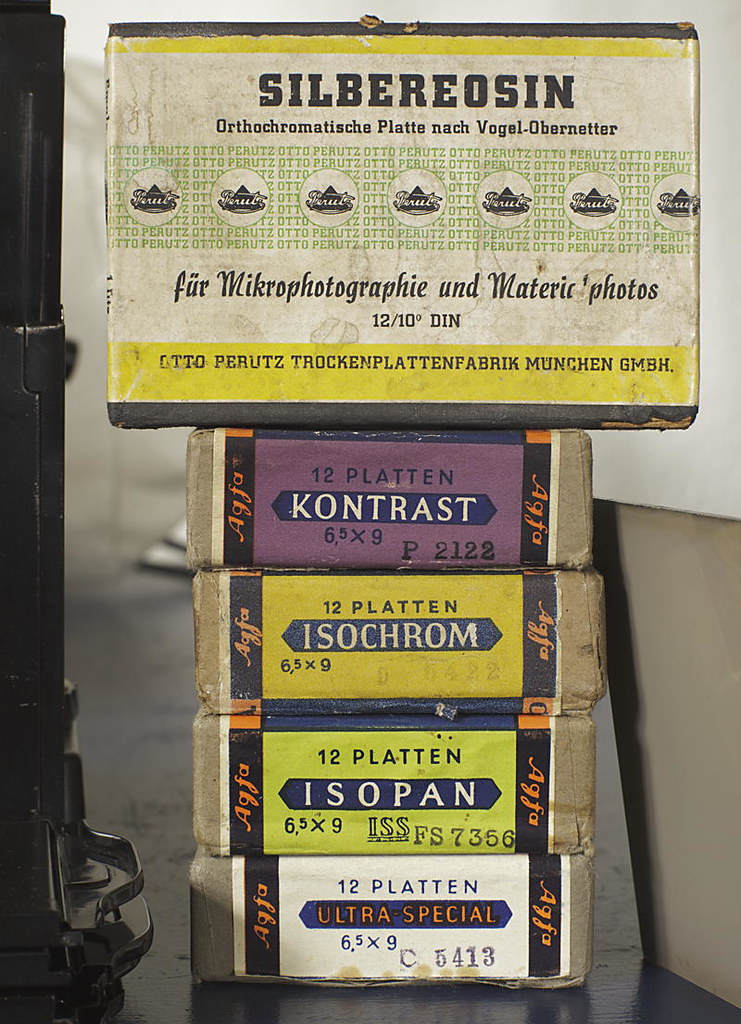
Question, if these are glass plates and not film stock is there any cellulose nitrate? Or does Platten mean film not glass?
 
Question, if these are glass plates and not film stock is there any cellulose nitrate? Or does Platten mean film not glass?

Correct, Platten are on glass. Usually no cellulose nitrat on them, exept they are collodion plates...
Sheet film can be cellulose nitrate (Celluloid) or (later, "Safety Film") cellulose acetate or polyester.
 
nice article on the plates and the company.

Indeed a very good summery.
The Silbereosin plates showed even after 85 years, what a fantastic film this was. Like an ortho version of Kodak's Panatomic, maybe with thicker layers...
If I ever will try to make my own plates, something like this would be the goal.
 
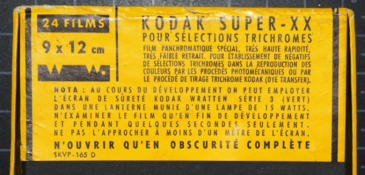
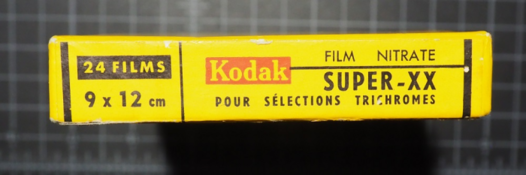
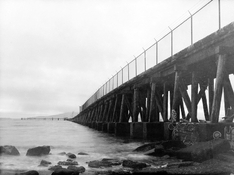
I have some Kodak Super XX nitrate 9X12 sheets. Not as old as the others posted here. These were made in France. I know they stopped making it for consumer use in the U.S. in the early 1950's, not sure when they stopped in France. Heck, I didn't even know Kodak made film in France until I got this box. This film was for Tri-Color Photography. I developed it in Kodak HC-110 Dilution B for 5 minutes with some Benzotriazole to help reduce fog. Next time I may try Rodinal.
 

Attachments

  • Super XX 1.png
    Super XX 1.png
    453.9 KB · Views: 64
  • Super XX 2.png
    Super XX 2.png
    464.3 KB · Views: 63
  • Super XX 3.png
    Super XX 3.png
    216.3 KB · Views: 65
  • 51910801568_c2d2562238_c.jpg
    51910801568_c2d2562238_c.jpg
    104.6 KB · Views: 64
exept they are collodion plates...

There actually were dry collodion glass plates for a time -- they were replaced by gelatin emulsion because it was both much faster (even in the 1880s) and much safer to make. You're unlikely to find a dry collodion plate made after 1900, if even that late.
 
Photrio.com contains affiliate links to products. We may receive a commission for purchases made through these links.
To read our full affiliate disclosure statement please click Here.

PHOTRIO PARTNERS EQUALLY FUNDING OUR COMMUNITY:


Ilford ADOX Freestyle Photographic Stearman Press Weldon Color Lab Blue Moon Camera & Machine
Top Bottom