• Welcome to Photrio!
    Registration is fast and free. Join today to unlock search, see fewer ads, and access all forum features.
    Click here to sign up

Easiest way to make a simple viewfinder?

man arguing 1972

A
man arguing 1972

  • 5
  • 0
  • 50
Got milk

H
Got milk

  • 2
  • 0
  • 34

Recent Classifieds

Forum statistics

Threads
203,016
Messages
2,848,668
Members
101,601
Latest member
instantcrow
Recent bookmarks
0

aterimagery

Member
Allowing Ads
Joined
Jun 30, 2012
Messages
31
Location
Delete me
Format
Multi Format
As part of my pinhole camera making, I want to make one of those simple lensless "wire" viewfinders like the ones you see on the old press cameras. Basically, the ones that are just a little frame in the front with another one in the back that you look through and line up sort of like the iron sights on some sort of gun.

I realize that I probably just need to do some trigonometry to match the size and distance of the "sights" to the angle of view of the camera, and I know I won't easily be able to come up with any sort of parallax correction scheme (if pinholes have that problem), but anything better than guessing would be helpful for aligning a pinhole camera.

Does anyone have recommendations on how to make one of these?
 
Go somewhere with obvious landmarks, set the camera up on a tripod with the back off and note which landmarks hit the corners of the frame.

With those landmarks in mind, make a wire frame, or paint an outline on a piece of acetate...
 
I think the trig is as follows:

width_of_big_rectangle = width_of_little_rectangle + 2 x distance_between_rectangles x tan (horizontal_angle_of_view / 2)
eye_relief = distance_between_rectangles * width_of_little_rectangle / (width_of_big_rectangle - width_of_little_rectangle)

The aspect ratio of both rectangles should be the same as the aspect ratio of your film.

You can use any unit for the distances, provided you use the same unit throughout. The angle unit should be as required by your calculator (or trig tables) - probably degrees.

Parallax is an issue for any camera where the viewfinder does not see from the same point as the lens (i.e. not in LF cameras and SLRs but pretty much everything else). If you mount the viewfinder directly above the pinhole (i.e. not to the left or right of it) then ant least you won;t have to worry about parallax in the horizontal direction. If necessary you could use multiple horizontal wires in the big rectangle to demarcate the close and far focus frames.

Bill's suggestion is probably easier though :smile:
 
Last edited by a moderator:
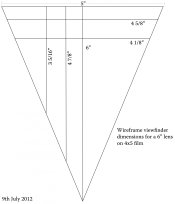
It's not trig, just simple geometry and you can avoid the math. Easier to draw than explain, but let me try. Lets say you have a 4x5 pinhole camera (landscape orientation) with a 6 inch focal length. Get out your paper, protractor and ruler. Put a point on the paper and draw a 6 inch line. At the terminus of your 6 inch line, draw a 5 inch line (width of your film in landscape orientation) that is at a right angle to your 6 inch line and bisected by your terminus. Now make a triangle by drawing 2 lines from your original point through the termini of your 5 inch line. Now you have a nice isoceles triangle. Draw two lines parallel (anywhere) to your 5 inch line. The distance between your 2 lines is the distance between your wire frames. The length at which they bisect the sides of the triangle is the distance between the edges of your wire frame (sideways, in landscape orientation). Do the same for the vertical dimension preserving the distance between the frames.
Having said all that, one of the pleasures of pinhole is that it's down and dirty in a fun way. If you are sweating framing, angle of view, etc, you might be better served by just pointing the box in whatever direction suits you and pushing the little button. If you are going to worry about something, worry about exposure and reciprocity.
 
It's not trig, just simple geometry and you can avoid the math. Easier to draw than explain, but let me try. Lets say you have a 4x5 pinhole camera (landscape orientation) with a 6 inch focal length. Get out your paper, protractor and ruler. Put a point on the paper and draw a 6 inch line. At the terminus of your 6 inch line, draw a 5 inch line (width of your film in landscape orientation) that is at a right angle to your 6 inch line and bisected by your terminus. Now make a triangle by drawing 2 lines from your original point through the termini of your 5 inch line. Now you have a nice isoceles triangle. Draw two lines parallel (anywhere) to your 5 inch line. The distance between your 2 lines is the distance between your wire frames. The length at which they bisect the sides of the triangle is the distance between the edges of your wire frame (sideways, in landscape orientation). Do the same for the vertical dimension preserving the distance between the frames.
Having said all that, one of the pleasures of pinhole is that it's down and dirty in a fun way. If you are sweating framing, angle of view, etc, you might be better served by just pointing the box in whatever direction suits you and pushing the little button. If you are going to worry about something, worry about exposure and reciprocity.

Took me a while but I think I got it right…
Wireframe VF calculations for 6" lens on 4x5 film 9th July 2012 computer.jpg
 
I took a slightly different approach from Matthew. Knowing the angle of acceptance of my Ilford Titan, I printed a similar triangle on a transparent sheet. I placed the apex at the pinhole to get an idea of what the field would be. It oddly enough worked quite well. I then went to a hardware store and bought some metal rods and a thin metal sheet. I soldered the rods to the sheet using the plastic as a template and made a clamping device so I could attach and remove my viewfinder for either a vertical or horizontal format. I painted it black so it looks official. And although it may not be completely mathematically correct it works pretty well. After using it for a few shots I can eyeball rather closely and whatever it is off so be it -- that's part of the lure of pinhole any way.

The materials cost under $10USD and it took about an hour to make.

http://www.jeffreyglasser.com/
 
Photrio.com contains affiliate links to products. We may receive a commission for purchases made through these links.
To read our full affiliate disclosure statement please click Here.

PHOTRIO PARTNERS EQUALLY FUNDING OUR COMMUNITY:


Ilford ADOX Freestyle Photographic Stearman Press Weldon Color Lab Blue Moon Camera & Machine
Top Bottom