

-
Welcome to Photrio!Registration is fast and free. Join today to unlock search, see fewer ads, and access all forum features.Click here to sign up
You are using an out of date browser. It may not display this or other websites correctly.
You should upgrade or use an alternative browser.
You should upgrade or use an alternative browser.
easier negative proofing
-
A
- Thread starter BetterSense
- Start date
Recent Classifieds
-
Want to Buy Intellifaucet D250 K250 etc
- Started by Rafal Lukawiecki
-
For Sale RB67 and Graflex odds & ends
- Started by OrientPoint
-
For Sale New Old Stock Case for 120/220 Rolleflex 3.5F
- Started by binglebugbob
Forum statistics
-

- Barry S
- Deleted

I use to use a pro-lab that could proof a whole roll enlarged to a large sheet, 16x20 or 20x24 ( don't remember which). They must of used an 8x10 enlarger.

- Joined
- Dec 10, 2009
- Messages
- 6,295
- Format
- Multi Format
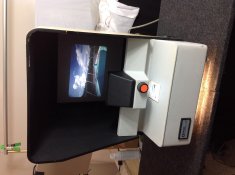
Vaguely reminds me of
The old Kodak PVAC I used at a job I had when I printed color.
The old Kodak PVAC I used at a job I had when I printed color.
OP
OP

Cool! Does that have a way to use strips of film in addition to slides?

Cool! Does that have a way to use strips of film in addition to slides?
The slide is just sitting over the light source, you could just as easily put down a strip of slides. I don't think a strip of negatives would get scratched, but you could put down a thin strip of mylar or something else as Bill suggested. The knob adjusts the focus.

> How has that saved any work versus just looking at the negatives?
It gives a better impression how the real print would look like. If you are well trained you may see this from the negative too. Perhaps.
It gives a better impression how the real print would look like. If you are well trained you may see this from the negative too. Perhaps.
I use traditional contact prints on 8x10 paper, and doing so has revealed something: I get about one good image per 80 sq inches exposed - so one roll of 35mm film will generally result in one good image. One roll of 120 film - one image, four sheets of 4x5 - one image.
For roll film I always make the contacts with the same exposure and contrast settings. With sheet film, where I am making the contacts one image at a time, I always use the same contrast, but will tweak exposure neg by neg.
Someone mentioned that traditional contacts are too time consuming and costly - the cost is minimal, and once the darkroom is set up, it doesn't take much time to crank out the contacts. If I was less concerned with the image and more concerned with time, I'd shift to an all digital process.
For roll film I always make the contacts with the same exposure and contrast settings. With sheet film, where I am making the contacts one image at a time, I always use the same contrast, but will tweak exposure neg by neg.
Someone mentioned that traditional contacts are too time consuming and costly - the cost is minimal, and once the darkroom is set up, it doesn't take much time to crank out the contacts. If I was less concerned with the image and more concerned with time, I'd shift to an all digital process.

random thought: if you did have an 8x10 contact print, you could scan it in like 15 seconds, then enlarge it on the screen.
random thought: if you did have an 8x10 contact print, you could scan it in like 15 seconds, then enlarge it on the screen.
I can scan 8x10 print through files just as easily and invert to positives but my workstation takes rather longer than 15 seconds... closer to 15 aeons, there is no delay with a loupe.

Film strip projector?

bdial
Subscriber
Or perhaps, a Microfilm viewer.

GRHazelton
Subscriber
A little hybrid work flow here. I scan the negatives with an Epson V700 scanner, and then import them into Lightroom. The negatives go into Negafile pages, marked with the date and inclusive frame numbers as scanned.
In Lightroom I can then assign key words, so they are catalogued, along with gasp! digital images from my Pentax K 5. The scanned negatives give me a reasonable idea of their sharpness, along with how they MIGHT look if printed in the dark room. I do very little if any post processing in Lightroom.
In Lightroom I can then assign key words, so they are catalogued, along with gasp! digital images from my Pentax K 5.
The scanned negatives give me a reasonable idea of their sharpness, along with how they MIGHT look if printed in the dark room. I do very little if any post processing in Lightroom.
There are light boxes made for viewing 35mm slides. They hold the slides at a 45o angle allowing the user to sit comfortably at a table for viewing. They typically hold 3 or 4 rows of 10 slides each and so can easily hold 6 exposure strips. They collapse for compact storage. Much more comfortable than leaning over.

jvo
Subscriber
try as i might....
i'm still not good at "reading" a negative... try as i might, after 30 years, i really never get it right... the best way i found is to for me has been to study the neg or contact sheet, then make a print... work it.
jvo
i'm still not good at "reading" a negative... try as i might, after 30 years, i really never get it right... the best way i found is to for me has been to study the neg or contact sheet, then make a print... work it.
jvo

Well thanks folks! As a result of this thread and the other one a couple weeks ago, I decided to try making proof sheets. First of all, it's pretty fun to put on my reading glasses and sit in a comfortable chair and look at them. Second of all, there were several frames in my "might print" notes that I could decide not to print. And the best of all, I just now made a print I'm quite happy with and it wasn't in my "might print" notes... I'd missed it and only realized it was worth printing when I saw the contact sheet. I think I'm going to do this from now on.
| Photrio.com contains affiliate links to products. We may receive a commission for purchases made through these links. To read our full affiliate disclosure statement please click Here. |
PHOTRIO PARTNERS EQUALLY FUNDING OUR COMMUNITY:  |