
• Welcome to Photrio!
    Registration is fast and free. Join today to unlock search, see fewer ads, and access all forum features.
    Click here to sign up

Early Brownie "Film"

Recent Classifieds

Forum statistics

Threads
202,279
Messages
2,837,566
Members
101,188
Latest member
HeyItsMeDusty
Recent bookmarks
0

bewilson

Member
Joined
Sep 7, 2002
Messages
155
Location
Utah
Format
4x5 Format
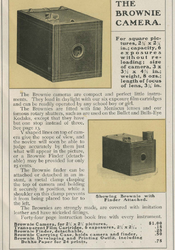
Back in the early days of the Brownie you returned the camera to Kodak for processing. The film was actually emulsion on paper, and during processing the emulsion was floated off the paper and put onto glass for contact printing. I've never seen a sample of that paper. How was it made so that the emulsion wasn't permanently stuck as modern papers seem to be?

In short, can I float my paper emulsion off to a glass plate?

Bruce
 

Kino

Subscriber
Allowing Ads
Joined
Jan 20, 2006
Messages
8,015
Location
Orange, Virginia
Format
Multi Format
A special "stripping" paper was used, as you probably know. The subbing layer for the emulsion was probably a much softer bloom gelatin than the emulsion holding the silver and could be dissolved with mild heat and or additional chemicals.

I have often wondered how they managed to float off the emulsion and keep it from wrinkling on glass on an industrial scale.

Since the business model of Kodak was firmly grounded in patented processes, there might be a clue in searching the US Patent Office records for that time period. There might be a clue in some device used to strip the emulsion from the paper; the trick is to possibly find it!

I would think by the time a modern emulsion floated off a modern photographic paper, it would be essentially destroyed and unfit to print, but I could be wrong.
 

Hunter_Compton

Subscriber
Joined
Nov 20, 2019
Messages
275
Location
Oxford, MI
Format
Analog
You're conflating the 1888 Kodak and the 1900 Kodak Brownie.

The 1888 Kodak was the one that utilized stripping film. The alternative was paper base film which was treated with castor oil to make it more translucent, but the stripping film was superior in image quality.

The stripping film consisted of the silver-gelatin emulsion applied over a water-soluble gelatin layer, in turn applied to a paper base strip offering 100 exposure frames. When the exposed film was returned to the Eastman factory for processing, the film was first steamed to dissolve the soluble layer, and the emulsion layer was then transferred to a clear gelatin or glass base for further development and processing.

By 1890, stripping film had been supplanted by transparent nitrocellulose film.

By the time the Brownie was in production, only transparent film was available.

Screenshot 2026-02-10 152807.png

@laser Robert Shanebrook's Making Kodak Film Second Edition has details on the paper, stripping and transparent film types.
 

Kino

Subscriber
Allowing Ads
Joined
Jan 20, 2006
Messages
8,015
Location
Orange, Virginia
Format
Multi Format
Thanks, Hunter.

Not that up on very early Brownie facts; appreciated.
 
OP
OP
bewilson

bewilson

Member
Joined
Sep 7, 2002
Messages
155
Location
Utah
Format
4x5 Format
What I remember from a documentary I saw decades ago was a 100-photo paper strip being developed, I think cut into frames, then by hand underwater the emulsion placed on a glass plate for a contact print to be made, then washed and recycled. I thought the camera was a Brownie, because it was a simple box. I thought the 100-frame load was generous, but destroying the negative wasn't.
 
Photrio.com contains affiliate links to products. We may receive a commission for purchases made through these links.
To read our full affiliate disclosure statement please click Here.

PHOTRIO PARTNERS EQUALLY FUNDING OUR COMMUNITY:


Ilford ADOX Freestyle Photographic Stearman Press Weldon Color Lab Blue Moon Camera & Machine
Top Bottom