• Welcome to Photrio!
    Registration is fast and free. Join today to unlock search, see fewer ads, and access all forum features.
    Click here to sign up

Durst M601 CLS 66 Lamp Intensity

Recent Classifieds

Forum statistics

Threads
203,402
Messages
2,854,138
Members
101,819
Latest member
Mark J Tudyk
Recent bookmarks
0

Richard Jepsen

Member
Allowing Ads
Joined
Jul 1, 2006
Messages
877
Location
Oklahoma, US
Format
Multi Format
I tested a new to me Durst 601 CLS. The lamp intensity is 3 stops or more dimmer than my LPL 670 dichro.

The lamp has a 1 sec delay when activated through a timer. The lamp has a slow start when turning on; you can see light intensity build over the sec it takes to fully turn on lamp.

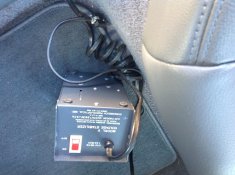
The Durst lamp is 12 volts, 100 watts, the recommended values. The domestic manufactured voltage stabilizer is 117v, 60 HZ, 1.3 A max.

The lamp is in the proper position in the head. What is wrong?
 
Last edited by a moderator:
I wonder if the lamp is fading due to age and needs to be replaced. Do you have the 6X6 light mixing box or the 35mm? If you have the 35mm it will be darker and will not cover 6X6. Although a long shot has anyone added an addtional layer of material for diffusion? My color head come to full intensity almost immediately and is in the same ball park as the condenser head in in terms of brightness with the 6X6 box and condenser set.
 
I have both mixing boxes. My test was with the 35mm box. The carrier is for 35mm slides. The previous owner mentioned buying a new lamp even though he used the enlarger for less than 50 hours. The lamp is not one of the named brands in the booklet but the specs match recommendation. Interesting my lamp is not instant on and yours is.
 
Richard, based on what you have indicated, I would suspect the voltage regulator is defective. A voltage regulator is designed to maintain a constant voltage through circuitry that smooths out variations in line (AC) voltage so lamp color doesn't shift during exposure. If you can physically see the lamp intensity changing on 'turn on,' I would suspect the regulator is not functioning properly. Check the output of the regulator with a voltmeter to see that the ouput is, I would guess 12 volts. It should instantly (within a few milliseconds) reach proper voltage and maintain that without varying. From what you are saying I would expect that the voltmeter would see something like 10 or so volts finally stabilizing at 12 volts.

Sure sounds to me like the regulator is bad. I have a voltage regulator on a Vivitar VI and will try and get some possible data today.

Edit: I just checked the Vivitar and mine is voltage stabilizer. It puts out 19.8 VAC to the lamphead. I was thinking an AC to DC voltage regulator in the previous discussion.

Is the stabilizer a Durst 'matched' unit (EST 305 (N)) or is it an aftermarket generic unit?
 
Last edited by a moderator:
Sounds like the voltage stabiliser, but check the contacts in the lamp holder. I have had issues with my De Vere where the contacts get a film of oxidation. It's an old enlarger I bought mine in 1975, so check the holder it's like having a resistor inline when the contacts aren't clean.

Is it the Durst stabiliser, these are designed to give a fast response but I have other 12v power sources for similar bulbs and they are slower.

Ian
 
Good point, Ian, any series resistance would also demonstrate similar symptoms.
 
I visited our local electric fixture store and determined the lamp was bad. The booklet identifies several recommended lamps rated at 12v and 100w. There are different values for the US and Canada. The booklet identified one bulb rated at 30v 80w for the USA. I bought an available 24v 50w lamp, UV glass covered. Tested in the store it was blinding brilliant. The light can be slightly under rated as I work in B&W. I typically dial in magenta to change contrast without using yellow or neutral density.

The voltage stabilizer is a domestic brand seen with other M601 CLS 66 sold on online.
 

Attachments

  • image.jpg
    image.jpg
    558.3 KB · Views: 252
  • image.jpg
    image.jpg
    556 KB · Views: 300
Last edited by a moderator:
I visited our local electric fixture store and determined the lamp was bad. The booklet identifies several recommended lamps rated at 12v and 100w. There are different values for the US and Canada. The booklet identified one bulb rated at 30v 80w for the USA. I bought an available 24v 50w lamp, UV glass covered. Tested in the store it was blinding brilliant. The light can be slightly under rated as I work in B&W. I typically dial in magenta to change contrast without using yellow or neutral density.

The voltage stabilizer is a domestic brand seen with other M601 CLS 66 sold on online.

A forum member helped with parts allowing me to print. I discovered the light intensity too dim to use color filtration. The correct mix box is installed with a 30v 50w lamp. The power supply is pictured in the previous post. 1. Is the CLS color head naturally dim?
 
Last edited by a moderator:
Richard I have a 605 which may be quite different but I have a 75W bulb. I got this because ironically I was getting too short an exposure time for colour prints with 100W which is what Durst recommends for the 605. Certainly with dichroic head filtration a 100W wasn't too powerful for B&W printing. I am no electrical expert and we have 240V here in the U.K. but I am sure I'd struggle with 50W. This seems too low a wattage assuming my 605 is comparable with your 601

pentaxuser
 
Hi Richard, if you have a mulitmeter you can check to see the voltage, should be 120V at the bulb base. It's too bad I already put my unit in the recycle bin which was picked up so I cant pull the power supply.
 
Richard,
Your power supply is rated at 29.3v at 2.7A. If you do the arithmetic, you get 79.11 watts. The recommended lamp is 30v80w. Underrun slightly, you will be within the capacity of the power supply. The 24v bulb was brilliant, but would have a short life with much bluer light. Your output voltage must be dead on with the lamp spec, or your colour temp will be way off. If the voltage takes a detectable interval to reach spec, the unit requires repair.
 
I'm going to meter the illumination output between condenser and color head tonight. If similar, maybe it's just the lower wattage of the bulb. I'm not printing color so I don't need stabilized power, just the correct voltage to the lamp. PDH provided another 100w bulb so I'm back to the local lamp shop to see if they have a lamp converter which would work.

I printed before daybreak with a member provided 601M condenser set and glass inserts. I'm very appreciative of the assistance from Apug members. Used the recommended 75w bulb, 645 neg, enlargement factor 5x (6x8 in centered on 8x10 in). Ilford PQ developer, 20c, EMAKS G3, exposure 30s at f8, 80mm clean Schneider optic. The same neg would have printed less than than 20s on a LPL or Beseler B23c. Is this typical and why Durst mentions a 150w bulb.
 
Last edited by a moderator:
Pentaxuser, modern diffuser boxes are lined with white styrofoam. Your more recently designed 605 may have styrofoam to reflect light vs the 601s aluminum mix box. I assume white styrofoam is more efficient.
 
I metered light intensity between my LPL 670 CXL and the Durst M601 condenser. Using the same 80mm lens/f stop, head height and projected illumination diameter on the baseboard the 601 with 75w bulb was 2 1/4 stops dimmer than the LPL 75w bulb. Replacing the Durst 75w bulb with a PH212 150w bulb increases the 601 illumination to match the LPL CXL 75w light intensity. Logically the 601 reflex system is not as light efficient as enlargers with the light source directly above the condensers.

The 601 head temp was noticeably higher with the PH212 but not excessive. The glass negative carrier will keep the negative flat.

My color head issues are not worked out but it appears I need the highest light intensity available with recommended halogen lamps. The Durst compact head bounces light 45 degrees to the baseboard resulting in less illumination.
 
Last edited by a moderator:
It turns out I will need to get a 30v 80w halogen lamp as my transformer will not support the 100w lamp.
image.jpg

When I look for the right lamp you run into a bunch of variations. I'm guessing one needs this from elightbulbs.com

80 watt 30 volt MR16 EPK Projector / Stage / Studio Incandescent Light Bulb

Or

80 watt 30 volt MR16 Bi-Pin (GX5.3) Base 3,400K Clear EKP Reflector Projector / Stage / Studio Halogen Incandescent Ushio Light Bulb

Does anyone know the right lamp.
 
EKP/ENA. These are narrow angle lamps, there are several available with wider angle beams, they will not beam the light through the filter aperture, and you will lose a lot of light. Unfortunately, most of the integrated reflector lamps are 'floods' rather than narrow 'spots'.
 
Great info. Hope this helps others who run into similar problems. Makes you appreciate a sole condenser enlarger.
 
I can't print with the color head yet as I do not have the proper halogen bulb; 30v 85w. This is not a common lamp at your local big box store.

I experiemented with the condenser head by replacing the tungsten 75w bulb with a 100w Compact Florescent. Did not work. The light was very dim. It may be easier to place a diffuser under the last condenser. That would avoid having a voltage stabilizer on the counter. One can switch from a condenser to more diffused light from a single head. Very simple. In the past I used two light sources for contrast control with graded paper. I have limited, unvented space so I try to avoid two developing trays.
 
Last edited by a moderator:
hmmm
Durst are not dim enlargers. At least my M600 isn't.
On my old Durst M600 I had to drop down from 150w to a 75w bulb, because the 150w bulb was giving me too short an exposure time. I think it was less than 5 sec with the 150w bulb. And at one time I was considering going down to something less than 75w to give me more time to dodge and burn, but I could not find a 25w enlarger blub.
This was printing 35mm film to about 8x10 or 11x14 with a 50mm lens.
If I printed smaller than 8x10, I used a 75mm lens, to keep the head further from the paper than with a 50mm lens.
 
Photrio.com contains affiliate links to products. We may receive a commission for purchases made through these links.
To read our full affiliate disclosure statement please click Here.

PHOTRIO PARTNERS EQUALLY FUNDING OUR COMMUNITY:


Ilford ADOX Freestyle Photographic Stearman Press Weldon Color Lab Blue Moon Camera & Machine
Top Bottom