• Welcome to Photrio!
    Registration is fast and free. Join today to unlock search, see fewer ads, and access all forum features.
    Click here to sign up

dry tintype success

Somewhere...

D
Somewhere...

  • 2
  • 1
  • 59
Iriana

H
Iriana

  • 6
  • 1
  • 119

Recent Classifieds

Forum statistics

Threads
202,739
Messages
2,844,922
Members
101,493
Latest member
aekatz
Recent bookmarks
0

kevin klein

Member
Allowing Ads
Joined
Mar 20, 2006
Messages
194
Format
Large Format
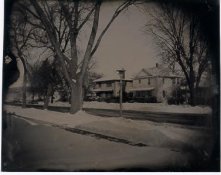
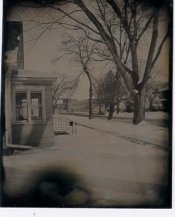
Here are a couple of examples of the dry tintype I have been working on.

The exposure is 1/2 sec,f:16. sun
 

Attachments

  • kevin dry2.jpg
    kevin dry2.jpg
    27.7 KB · Views: 496
  • kev2.jpg
    kev2.jpg
    26.2 KB · Views: 382
Very nice Kevin!

Looks like some coating problems on the edge, but its still really good.

Details on the process please!
 
Details

Well,here it is.
The emulsion is a basic simple emulsion as described in the Kodak AJ-12 instructions or on the unblinking eye site. I used hard photo gel and added the silver all at once.

The plates used are Black aluminum trophy plates given a spray coat of gloss poly urithane and allowed to dry at least Three days. Japaned steel plate was tried and found the emulsion to pull the japan from the surface when drying, must not have been clean enugh when japanning.

Development, Two minutes in Dektol 1:1 with Potassium Thyocyanate added 1gm per oz. of working developer. Ammonium Thyocyanate,used at the same ratio, works a little better and gives a warmer tone to the image but produces an ammonia odor when the plate is placed in the developer(use a glass cover on tray if you want to keep the fumes down). Add the thyocyanate to developer just before use, my past experience with pre mixed developer (a day or so old) caused the emulsion to disolve.

Rinse,fix as usual (any fixer), Ambrotypes can be made with using only half the exposure.

The image will darken a bit when dry but not bad, the images posted look darker than they actualy are.

The plates are easly reclamed by simply puting some tape on the edge and pulling of the urithane, what ever is left behind can be pulled off with more tape. I am going to try reusing some plates that had been just washed off with hot water.

The emulsion coating shuld not be too thin or the highlights may not be as bright, experiment.

Tests with Rockland emulsion seemd to show the exposure was a lot shorter for some reason using the same developer mix. Experiment on small plates and see what you get. I usualy make about eight or twelve at a time to start, more won't hurt.

 
How are you holding the plates? Are you using modern film holders or plate holders? I'm about to modify a modern sheet film holder to accomodate these plates, but if theres an easier way I'd like to hear!

Josh
 
I've been eying AJ-12 for awhile, and it looks like a good starter emulsion to make. Did you have any issues making it?

Also, about how many plates are we talking about 1 batch of this making?
 
I know very little about the tin type process, but what I see of your results is excellent. Thank you for posting and the sharing of the information.

Charlie.....................................
 
dry tintype

What I used for these exposures was a 4x5 plate box camera, the holders are for glass dry plates so the metal plates wil fit with the sprung bottom in the holder keeping them in place nicley. I cheked the fit of an aluminum plate(.020 thick) and it was able to slide under the guides of a cut film holder, check first to see.

A wet plate holder can be used as long as there is a piece of glass on the back of the metal plate to keep it from being pushed out of the focal plane by the tension spring on the door.

The number of plates that can be coated depends on the amount of emulsion you make. I usualy make about 8oz. or less than that if trying a different formula. 8oz will probably make 12 or so 8x10? depending on how much emulsion is used wich is determined by trial and error., not too thin, not too thick. but it will go a fairley long way.

Making the emulsion is not that difficult but it takes about two hours no matter how much you make . I most often have broken the process into two parts. 1-mxing,emulsifying,digesting etc. then refrigerating untill the next night. 2-shreading and washing, remelting,digesting,adding finals.

I am by no means an expert on the subject but this is what I have been doing so far.
 
I am assuming the advantage here in making Dry Tintypes is that it is more convenient to shoot on-location? There is certainly nothing wrong with the quality one can obtain from the wet-collodion process for tintypes or ambrotypes, other than the need for a portable darkroom if you are going to do location work.
 
re.tintype

Yes you are right, the collodion does make for a better image but this is more of a simpler substitute that makes tintyping more easy to do with a minimum of materials and equipment and less fuss. The big advantage is not having to drag all that darkroom stuff out into the field and put it all back later that evening. Compaired to wetplate this is a toy.

I have no intention of abandoning the wetplate but some times I wonder.

The dry collodion plate is a captol variation for field work(negatives only).
 
I have tried to put the plates in modern film holders. They have fit, but have been very hard to get out. I am thinking of modifying(just cutting off the guides of a cut film holder) one of my many junky holders, and putting some sort of adhesive on the back to hold the plate in. Anybody tried this?
 
I have tried to put the plates in modern film holders. They have fit, but have been very hard to get out. I am thinking of modifying(just cutting off the guides of a cut film holder) one of my many junky holders, and putting some sort of adhesive on the back to hold the plate in. Anybody tried this?

Different film holders are constructed differently. If you have a holder that has little metal lips that the film slides under, it would be possible to take a small flat putty-knife, or possibly screw driver, and pry up the lips somewhat to give more clearance under them, they would be too loose for sheet film, but should then have enough clearance for tintype plate. I wouldn't try this with the plastic-lip type holders.
 
Photrio.com contains affiliate links to products. We may receive a commission for purchases made through these links.
To read our full affiliate disclosure statement please click Here.

PHOTRIO PARTNERS EQUALLY FUNDING OUR COMMUNITY:


Ilford ADOX Freestyle Photographic Stearman Press Weldon Color Lab Blue Moon Camera & Machine
Top Bottom