
• Welcome to Photrio!
    Registration is fast and free. Join today to unlock search, see fewer ads, and access all forum features.
    Click here to sign up

Drag artifacts on negatives

Street portraits

A
Street portraits

  • 0
  • 2
  • 28
Street portraits

A
Street portraits

  • 0
  • 2
  • 25

Recent Classifieds

Forum statistics

Threads
201,685
Messages
2,828,522
Members
100,888
Latest member
aLLinSE
Recent bookmarks
0

mau

Member
Joined
Jan 4, 2024
Messages
26
Location
France
Format
Medium Format
Hello all,
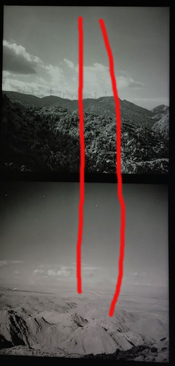
Some of my negatives display some sort of drag artifact, and I was wondering if you may be able to help me identify the culprit.

I'm attaching an example, both positive and negative.
I have reason to believe that the streaks sometimes run along more than one frame (see the attached image with the red markings).

In the example attached:
Film FP4+ @125
Tank Jobo 1000
Presoaked in water for 2 minutes
Developed in HC-110, dilution 1:31 for 8 minutes. 30 sec initial agitation, and then 5 sec agitation every 30 sec.
Stop bath 15 sec continuous agitation in water.
Fix in Rapid Fixer, dilution 1:4 for 4 minutes. Same agitation as development.
Final wash in running water for 2 minutes and then a final pass in distilled water with Ilford method.

I saw a similar post from 2023 on this forum, but I don't think they ever reached a conclusion, and in any case I think they're missing a piece of info.

I'm pretty sure it's not an issue occurring during the development, but rather I think it happens after, when the negatives are hanging to dry.
The reason is the direction of the streaks. They always run along the length of the negative, which is sitting horizontally during the process.
While it hangs, however, it hangs vertically. And the streaks themselves kinda look like water paths.

I'm thinking perhaps stop in water is not sufficient?
I have stopped using commercial stops because I had some issues with pinholes on the negatives, and apparently stop baths can cause that.
I might try some very diluted acetic acid.

What do you think? Do you agree with my suspicion?

Thanks
 

Attachments

  • streaks.jpg
    streaks.jpg
    341.4 KB · Views: 115
  • streaks_marked.jpg
    streaks_marked.jpg
    351.3 KB · Views: 108
  • streaks_negative.jpg
    streaks_negative.jpg
    319.4 KB · Views: 115

MARTIE

Member
Allowing Ads
Joined
Oct 31, 2004
Messages
315
Format
Multi Format
Hello,
I don't think your suspicions. And it might not even be chemical.

Could you tell more about, purchase, expiration, storage before and after exposure and possible x-ray exposure?
 
OP
OP
mau

mau

Member
Joined
Jan 4, 2024
Messages
26
Location
France
Format
Medium Format
Purchase was sometime last year.
Not sure about expiration, but I do remember I had some rolls very close to it. There's a chance this might have been one of them.
Storage in fridge.
It was indeed exposed to x-rays at the airport, several times. I'd say 4 in total. Good catch.
Edit: however, I do have them on another roll that, as far as I remember, didn't go through x-rays.
 
Last edited:

loccdor

Member
Joined
Jan 12, 2024
Messages
2,548
Location
USA
Format
Multi Format
I don't see any mention of wetting agent. It looks like drying marks from minerals in the water.

I've tried skipping wetting agent and using a distilled water final wash instead. It didn't work well, I guess there were enough minerals stuck to the film that marks could still be created.

Wetting agent is the way to go.
 

koraks

Moderator
Moderator
Joined
Nov 29, 2018
Messages
26,689
Location
Europe
Format
Multi Format
It looks like drying marks from minerals in the water.

This could indeed be the cause.

This kind of pattern I would only expect to result from development if the film was rotary-processed ('wagon rut' unevenness), and that doesn't seem to be the case.

Stop bath 15 sec continuous agitation in water.
That's not really a stop bath. I don't think it's the cause of your problem, though. A stop bath would have to be acidic or at least otherwise act to instantly arrest development. Water works differently; it dilutes the developer so it becomes virtually ineffective. There's a very long thread about whether or not one should use an actual stop bath. I wouldn't worry about it though.

Fix in Rapid Fixer, dilution 1:4 for 4 minutes.
Should be OK for fresh fixer; re-used fixer might be less active and could require a longer fixing time. But again, I don't think this would be the cause of the defect you're seeing.

You could try re-washing the affected film in a dilute acetic acid bath, followed by a wash in preferably demineralized or distilled water. You can add a little surfactant to the final rinse to help the water sheet off of the negatives evenly.
 

Rick A

Subscriber
Allowing Ads
Joined
Mar 31, 2009
Messages
10,028
Location
Laurel Highlands
Format
8x10 Format
The use of a surfactant mixed with distilled water for final rinse should eliminate the issue. Let your negative soak in the final solution for at least one minute before hanging to dry. I like to shake the excess water from my film while it's still on the reel then hang, do not squeegee.
 
Last edited:

loccdor

Member
Joined
Jan 12, 2024
Messages
2,548
Location
USA
Format
Multi Format
It doesn't look the way bromide drag does, and I don't think it would be possible with the high level of agitation anyways.

From my tests, wetting agent is always needed.

You can add a little surfactant to the final rinse to help the water sheet off of the negatives evenly.

I bet this fixes it. Good thing is a problem like this does not have any permanent impact on the pictures.
 
OP
OP
mau

mau

Member
Joined
Jan 4, 2024
Messages
26
Location
France
Format
Medium Format
Thanks everybody for the answers, I guess I'll try Photo Flo then 🤷‍♀️

I'll rewash those frames and report back
 

brian steinberger

Subscriber
Allowing Ads
Joined
Jan 5, 2007
Messages
3,044
Location
Pennsylvania
Format
Med. Format RF
Good thing is a problem like this does not have any permanent impact on the pictures.

If these are differential drying marks, which I suspect they are, they are permanent and you cannot simply “wash” them out.

If they are marks from using too much photo flo they can be removed with acid stop bath and re wash.
 

MARTIE

Member
Allowing Ads
Joined
Oct 31, 2004
Messages
315
Format
Multi Format
It was indeed exposed to x-rays at the airport, several times. I'd say 4 in total. Good catch.
Edit: however, I do have them on another roll that, as far as I remember, didn't go through x-rays.

Then I'm going with X-ray.
And certainly if there's no physical evidence of residue marks on the negatives.
 

Elmarc

Member
Allowing Ads
Joined
Feb 23, 2022
Messages
215
Location
Eu
Format
Analog
It looks like bromide drag to me.
I had a similar experience some time ago.


MARTIE

Member
Allowing Ads
Joined
Oct 31, 2004
Messages
315
Format
Multi Format
Could it still be bromide drag if it was inverted tank agitation and not rotary processed?
 

Elmarc

Member
Allowing Ads
Joined
Feb 23, 2022
Messages
215
Location
Eu
Format
Analog
Could it still be bromide drag if it was inverted tank agitation and not rotary
Depends on the effectiveness of the agitation. Those who invert should know more.
 

loccdor

Member
Joined
Jan 12, 2024
Messages
2,548
Location
USA
Format
Multi Format
It looks like bromide drag to me.
I had a similar experience some time ago.


In the thread you quoted, you can tell it's bromide drag because the marks on the negative align with the contents of the picture: the spaces between the trees. In the thread we are currently in, the marks do not align with the contents of the negatives.
 

Elmarc

Member
Allowing Ads
Joined
Feb 23, 2022
Messages
215
Location
Eu
Format
Analog
In the thread you quoted, you can tell it's bromide drag because the marks on the negative align with the contents of the picture: the spaces between the trees. In the thread we are currently in, the marks do not align with the contents of the negatives.

Granted, but I have also experienced the same streaking with negatives similar to the OP's examples. ie: when two quite distinct densities sit side by side.
 

koraks

Moderator
Moderator
Joined
Nov 29, 2018
Messages
26,689
Location
Europe
Format
Multi Format
If these are differential drying marks, which I suspect they are, they are permanent and you cannot simply “wash” them out.
Yes, that's a concern. Re-washing (in a weakly acidic solution!) will only help if the marks are calcium scale marks. It's worth a shot, but success is not guaranteed.

Granted, but I have also experienced the same streaking with negatives similar to the OP's examples. ie: when two quite distinct densities sit side by side.
No doubt, but in this case, it's very clearly not bromide drag.
 

MARTIE

Member
Allowing Ads
Joined
Oct 31, 2004
Messages
315
Format
Multi Format
No mention of a camera in the OP.

Could it be mechanical, in camera, reflections, pinholes in a shutter curtain?
A fault camera back?

Let's hope he gets back with camera make and model.
 

Elmarc

Member
Allowing Ads
Joined
Feb 23, 2022
Messages
215
Location
Eu
Format
Analog
Yes, that's a concern. Re-washing (in a weakly acidic solution!) will only help if the marks are calcium scale marks. It's worth a shot, but success is not guaranteed.


No doubt, but in this case, it's very clearly not bromide drag.

Agreed. just re-read the OP's post re orientation of the film during processing..
So it must be something that occurs during the time that the film is in a vertical orientation..
I personally would rule out x-ray damage. The streaks are too uniform in my experience.
 

MARTIE

Member
Allowing Ads
Joined
Oct 31, 2004
Messages
315
Format
Multi Format
Another question surrounds circumstances while loading the film on to the reel for processing.
 

logan2z

Subscriber
Allowing Ads
Joined
Jan 11, 2019
Messages
3,980
Location
SF Bay Area, USA
Format
Multi Format
Well, this brings back (bad) memories. I struggled with a very similar issue for a while before making changes to my workflow that finally eliminated it.

I believe my issue was caused by some combination of differential drying/minerals in my water. I eliminated the problem by using the following wash/dry workflow:

After a 5 minute fix in Ilford Rapid Fixer (mixed film strength):

1) Wash film in tap water using the Ilford method.

2) Insert film reel into 32 oz of distilled water and let soak for 5 minutes.

3) Remove reel from distilled water, add 2 drops of LFN and mix.

4) Open film reel and dump film strip into water/LFN mixture. Agitate continuously for 1 minute.

5) Remove film strip and hang to dry vertically using film clips.

6) I know the "never squeegee" folks are going to squirm at this step, but I think it was instrumental in solving my problem:

Use two strips of a Pec Pad (one held on each side of the film strip) to squeegee the water from the film strip. I do this twice on both sides of the film. This eliminates nearly all of the water from the film strip and
has never scratched my film.

Then leave the film strip to dry.

I have never had a 'streaking' problem since using this procedure. It's possible that there are some steps that could be eliminated, but if it ain't broke...
 

koraks

Moderator
Moderator
Joined
Nov 29, 2018
Messages
26,689
Location
Europe
Format
Multi Format
Use two strips of a Pec Pad (one held on each side of the film strip) to squeegee the water from the film strip. I do this twice on both sides of the film.
Just to check, you do this on 120 film? I find 120 'wipes' quite different from 135. I do wipe the shiny side of 135 film, but never 120 which has gelatin on both sides.
 

logan2z

Subscriber
Allowing Ads
Joined
Jan 11, 2019
Messages
3,980
Location
SF Bay Area, USA
Format
Multi Format
Just to check, you do this on 120 film? I find 120 'wipes' quite different from 135. I do wipe the shiny side of 135 film, but never 120 which has gelatin on both sides.

I do it on both 120 and 35mm film. It sometimes takes an additional wipe to eliminate the water from 120 film.
 
Last edited:
Photrio.com contains affiliate links to products. We may receive a commission for purchases made through these links.
To read our full affiliate disclosure statement please click Here.

PHOTRIO PARTNERS EQUALLY FUNDING OUR COMMUNITY:


Ilford ADOX Freestyle Photographic Stearman Press Weldon Color Lab Blue Moon Camera & Machine
Top Bottom