
• Welcome to Photrio!
    Registration is fast and free. Join today to unlock search, see fewer ads, and access all forum features.
    Click here to sign up

Does the orange mask in C-41 films help to control highlights?

Filling In

H
Filling In

  • 1
  • 2
  • 49
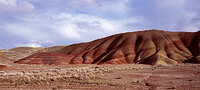
Painted Hills # 3.jpg

H
Painted Hills # 3.jpg

  • 4
  • 0
  • 92

Recent Classifieds

Forum statistics

Threads
203,211
Messages
2,851,503
Members
101,728
Latest member
BrickSandwich
Recent bookmarks
0
...an E6 product can only reach a dmax of about 3.0 while a print film can reach 4.0 or higher. This gives a huge tonal range advantage to the print film.

The essence of a mask is that it NOT be decolorizable. It must be present to do its job or there is no effect.
PE

Thanks for the researchers names... I recognize them, esp. Vittum, but I was not aware he had worked on masking.
--
Ron, is the above mentioned density difference one that can be visually differentiated?
(Under ordinary room lighting, can one see a difference
between density 3.0 and density 4.0 ?)
--
In the neg-pos system, the mask is only "present" during the exposure...
Once the light ceases to illuminate the paper underneath the negative, the presence of the mask is no longer an issue.
 
One question, does anyone make a printing film for printing from C41? ...
is it possible today to make a 35mm slide from a negative?

Good question... I do not know about "Today", but "Yesterday" I did used the film I mentioned earlier... Color Print Film 4109 I think it was called.
 
PE: Can you name some textbooks that I might be able to find at the library?

And why is it that when printing color, you apply strong magenta and yellow filtration resulting in a red image hitting the easel?
 
One question, does anyone make a printing film for printing from C41? I know that they exist for the motion picture industry, and printing motion picture film which IIRC is a different process, but do they exist for personal darkroom use. In other words, is it possible today to make a 35mm slide from a negative?

Yes, and no.
There is no longer a specialized print film (to be processed in C-41) for making transparencies from C-41 films.

As you said there are those cine-print films. These are designed for that lower contrast of cine camera-films. The spectral response of the dyes of all camera films (cine or still) should be the same, so that should not be an issue when chosing print-films. Furthermore the cine-print films have their own process. (One can deduce from Agfa publications that cine-print films can be processed in C-41, however with some alterations and still some limitations.)

But there is one film left (stated to be) designed for making transparencies from C-41 camera films.
Made by Agfa. But with a medium Dmax, to be processed in RA-4, coated on 175μ PET.
The actual problem with this film is that is only available in 10" aero long-rolls.

Edit:
Concerning PE's post below. I totally forgot about those display films. That film above seems to be the same as the late "Agfaclear" used for display transparencies.
 
Last edited by a moderator:
Kodak and Fuji also make a "print" material for RA4 processing that can be used to make "slides" from negatives.

As for textbooks how about "Principles of Color Photography" by Evans, Hanson and Brewer, "Theory of the Photographic Process" by Mees and James (just one chapter on color and masking) and "An introuction to Color" by Evans. I believe that there are others such as works by Hunt at Kodak Harrow. BTW, Bob Hunt was just here for the Anniversary of the Munsell facility at RIT. Our GEH group had him as our guest for lunch.

As for the strong filtration when printing, if you look at the speeds of color paper, the paper has a blue speed of nearly ISO 100 or higher. When filtered back, it has an ISO of about 25 (on easel). This is done for added color purity. The blue layer of color Neg-Pos paper is on the bottom for reasons of sharpness and dye stability. For this reason, the paper cannot have a yellow dye filter layer to cut back the sensitivities of the other two layers, and so you must filter them back to isolate the Red / Green / Blue from each other or you get crosstalk.

PE
 
Kodak and Fuji also make a "print" material for RA4 processing that can be used to make "slides" from negatives.
PE

Maybe I should have stated that as being in home user quantities. I think those display materials come in the kind of quantities that where one package would do every colour negative I have ever made, in over 30 years of shooting.

It's a moot point though, I think most people these days making slide shows use a digital projection process, which is why there are not so many slide projectors made anymore. :rolleyes:
 
We used to say that Kodachrome was built to overdo the color so that it could make a garbage dump look beautiful.


And that it does do! Of course, if the colors here are not the most accurate, it is probably more the result of my scanning than the Kodachrome itself.
 
Photrio.com contains affiliate links to products. We may receive a commission for purchases made through these links.
To read our full affiliate disclosure statement please click Here.

PHOTRIO PARTNERS EQUALLY FUNDING OUR COMMUNITY:


Ilford ADOX Freestyle Photographic Stearman Press Weldon Color Lab Blue Moon Camera & Machine
Top Bottom
