I suspect if you had Log D, Y and C values you had it set to colour (neg) settings. Do you have the manual? It is useful to explain what the buttoms do. The web addess with Frances's review is a better description at how to fly the thing. There are multiple negatives supplied; one for B&W film, one for C-41, and one for E-6. Which one did you use?
Also which process did you get blue greys? If RA-4 that can someties be a function of the film and paper pairing
For B&W you hold down the * button (I think - no manual at and right now where I am at) on power up , and then use the arrows to flip between pos, neg and bw, with pressing 'done' to lock in the setting. In B&W mode you meter with no filters in the light path.
We can discuss more once I have a few more answers.
If there is anyone with a colourstar 3000 that they no longer use, PM me a quote on what you want for it, and what is included.
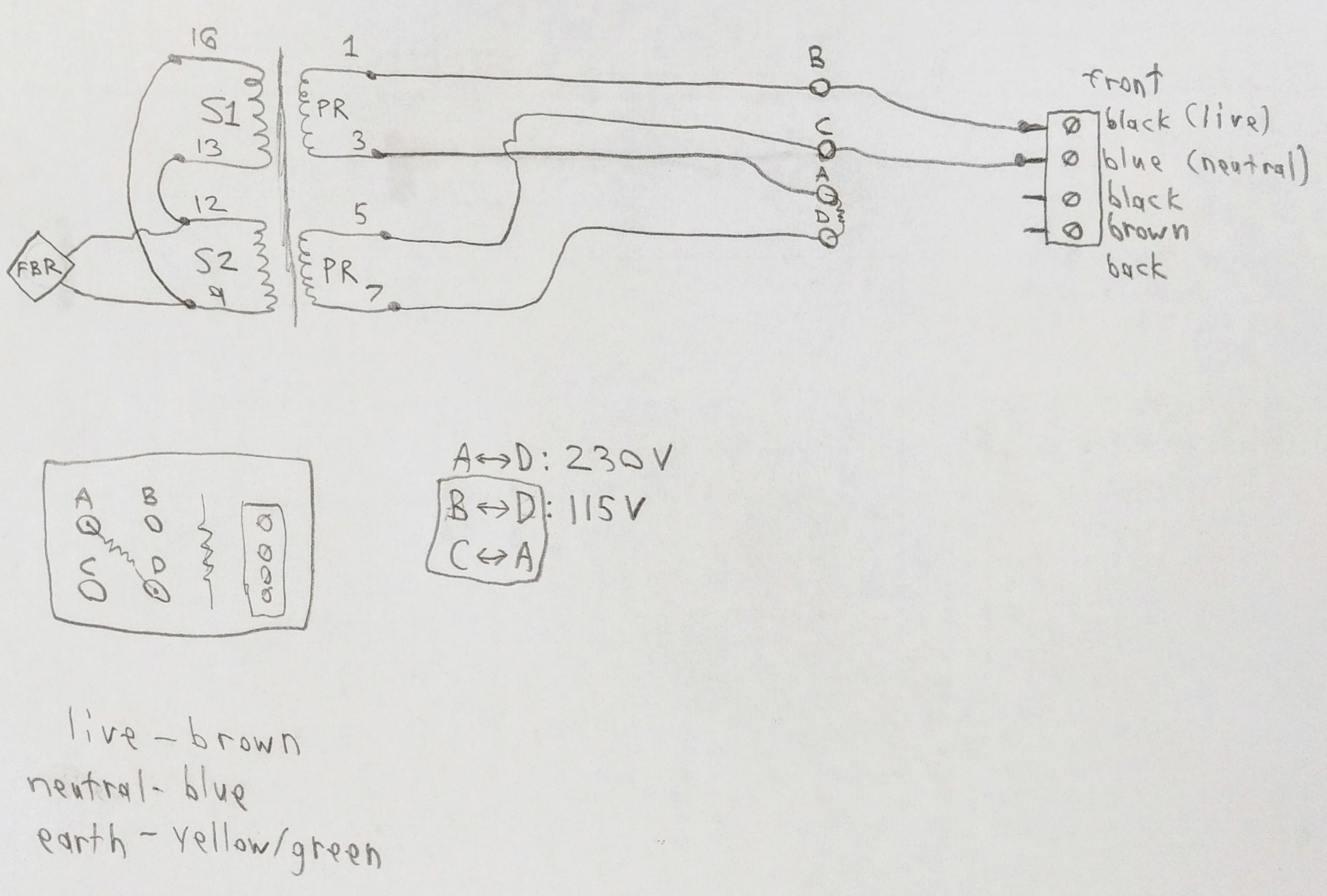
They are able to be adapted to work on 220/240 or 110/120 by changing the jumper connections (soldering required). Then it is a matter of changing the plug and socket to suit where you are living. Mine was bought as NOS from Portugal on the *bay a few years ago, and this is what I did to it to make it work on 120. I print RA-4, and I shudder to think of doing it without the thing now. So I am in the market for a backup.
If you are in the market for a 120V B&W anaysler (might be adaptable to 220; I have not been inside it to figure out) that is also an integrating timer I have an underused working tube powered Melico analyser from the mid sixties that could be a candiate for a swap.
Using the Melico, you set the sensitivity to match the paper characteristics from prior calibration, then spot meter with no contrast filter in the light path, and adjust the aperture and or time adjusting dial until the glow tube indicator hits its minimum spread. ( if you ahd an old radio from the 50's and 60's you know what I mean here)
I usually calibrate it to balance on the first dense part of the neg that I want to have as a light grey tone in the print. Then pop in the contrast filter, and press the start button and you get a perfectly exposed time; but it does not read in seconds.
It can also be used to measure the contrast ratio in a negative between lightest tone and darkest tone in the print where detail is required, and thus give good staring point for an iniatl use of VC filters with MG paper.
Come to think about ti, the Colorstar also does this in B&W mode, but not as elegantly.