

• Welcome to Photrio!
    Registration is fast and free. Join today to unlock search, see fewer ads, and access all forum features.
    Click here to sign up

Does extreme developer dilution beget more fog on old, expired film?

Recent Classifieds

Forum statistics

Threads
202,069
Messages
2,834,588
Members
101,094
Latest member
not_cal
Recent bookmarks
0

David Lyga

Member
Allowing Ads
Joined
Nov 25, 2007
Messages
3,445
Location
Philadelphia
Format
35mm
Interesting to ponder: does extreme developer dilution encourage fog?

I say this because I think that there might be somewhat of a compensating effect with such extreme dilutions (say D-76 1 + 5 or more with carbonate added to make up for the reduced energy). And 'compensation' means 'go lightly on the highlights and bring up the shadows' in order to create lower contrast index overall without sacrificing speed. Fog is a type of 'shadow' in that it represents the lowest density value of the image. It is a threshold value. Even though it is not a density specifically exposed to light, it acts like it was on stale, very expired film. And, for example, a film like Kodak TMZ 3200 does not have to be so old for this fog to manifest, so beware.

Or, perhaps, is the extra carbonate added (sometimes) to highly diluted developers (in order to make the development time less onerous) to blame for any increased fog. But, I think that the inability of the weakened developer to attack the dense highlights is really the culprit here.

Would strong developer, with very little accelerator, do the job better? We like to save money and get more consistent results by using 'one shot' developers, but I wonder if the old way of doing things, back in the forties and fifties when stock developers reigned with constant additions of replenisher, actually do the developing better. We do not notice this difference if we use fresh film, perhaps, but with older film I wonder if anyone has noticed a difference. - David Lyga
 
Last edited by a moderator:

pstake

Subscriber
Allowing Ads
Joined
May 5, 2005
Messages
728
Format
Multi Format
I'm going to be using some old Tri-X soon and was planning to stand dev with Rodinal. Maybe that's not a good idea?
 

Rick A

Subscriber
Allowing Ads
Joined
Mar 31, 2009
Messages
10,038
Location
Laurel Highlands
Format
8x10 Format
In my experience, long development times in very dilute solution helps prevent fog, especially when you keep the temps lower than normal. This is my preferred method for very old film. Using Rodinal 1+100 and 60f for one hour stand development, one min initial agitation then three mins agitation every 15 mins until completion, has rendered decent results.
 
Joined
Jan 21, 2003
Messages
15,715
Location
Switzerland
Format
Multi Format
I have the exact opposite experience to Rick. HC-110 Dil B, with overexposed old film and short dev times got me the least amounts of fog, and Rodinal or Pyrocat at high dilution by far the most.
 

pstake

Subscriber
Allowing Ads
Joined
May 5, 2005
Messages
728
Format
Multi Format
I have the exact opposite experience to Rick. HC-110 Dil B, with overexposed old film and short dev times got me the least amounts of fog, and Rodinal or Pyrocat at high dilution by far the most.

In my experience, long development times in very dilute solution helps prevent fog, especially when you keep the temps lower than normal. This is my preferred method for very old film. Using Rodinal 1+100 and 60f for one hour stand development, one min initial agitation then three mins agitation every 15 mins until completion, has rendered decent results.

Gee ... thanks for clearing things up! I'll just have to see how it goes.

Hardly anything I shoot is really important. I'm not a pro and rarely pose anything or anyone, even for fun. It's just that I die a little inside when my anticipated negatives are ruined. :sad:
 

albada

Member
Allowing Ads
Joined
Apr 10, 2008
Messages
2,177
Location
Escondido, C
Format
35mm RF
Interesting to ponder: does extreme developer dilution encourage fog?

I say this because I think that there might be somewhat of a compensating effect with such extreme dilutions (say D-76 1 + 5 or more with carbonate added to make up for the reduced energy). And 'compensation' means 'go lightly on the highlights and bring up the shadows' in order to create lower contrast index overall without sacrificing speed. <snip>

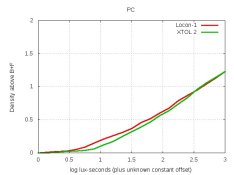
David, I suspect the carbonate is what's reducing contrast. It raises the pH, making the developer more active. But due to the high dilution, the buffering is poor, so pH drops more in the highlights than shadows, creating compensation and lower contrast. I mixed a home-brew PC developer that behaved similarly. Below are the HD curves for it and XTOL, with equal densities on the right side. The low contrast dev obviously has a higher toe, and thus higher speed, and a lower CI. Poor buffering is my theory for this.

t.jpg

Finally, the dev is overdeveloping the shadows and underdeveloping the highlights, so expect to see more grain in the shadows. And more fog for the same reason.

Mark Overton
 

Rich Ullsmith

Member
Allowing Ads
Joined
Jan 26, 2007
Messages
1,159
Format
Medium Format
I've learned more in the last fifteen minutes than I have all year. Keep talking, please.
 
Joined
Jan 21, 2003
Messages
15,715
Location
Switzerland
Format
Multi Format
Gee ... thanks for clearing things up! I'll just have to see how it goes.

Hardly anything I shoot is really important. I'm not a pro and rarely pose anything or anyone, even for fun. It's just that I die a little inside when my anticipated negatives are ruined. :sad:

Somehow you made it look as though I made both those quote.
 

pstake

Subscriber
Allowing Ads
Joined
May 5, 2005
Messages
728
Format
Multi Format
Somehow you made it look as though I made both those quote.

My bad ... I didn't even notice that ... was trying to show the seemingly contradictory experience.

Sorry, Thomas and Rick ... hopefully people following this thread will see my error.
 
OP
OP
David Lyga

David Lyga

Member
Allowing Ads
Joined
Nov 25, 2007
Messages
3,445
Location
Philadelphia
Format
35mm
I think that this was a very relevant topic: one discussed too infrequently. I like albada's warning that carbonate attempting to speed things up only fails the highlights because the diluted developer runs out of steam. I tried, for experimental purposes, to develop paper in Dektol diluted 1 + 11 and was met with weak blacks NO MATTER HOW LONG I DEVELOPED! No matter how much carbonate you add the contrast is truly restricted at these sensational dilutions.

Worry not, most. Most will dilute, say, D-76 only 1 + 1 or 1 + 2. That modest dilution will have no deleterious effect. I am talking about EXTREME dilutions and I do not know if Rodinal 1 + 100 is really all that extreme, given the concentrated nature of that developer.

Pstake, do it both ways to determine what is what. It is interesting to note that there seems to be a conflict here (Rick A finds just the opposite to occur!). But he warns about high temperatures. Do high temps (with reduced development time) really contribute to the fog level of these expired films (assuming development time is reduced accordingly)? - David Lyga
 
Last edited by a moderator:

David A. Goldfarb

Moderator
Moderator
Allowing Ads
Joined
Sep 7, 2002
Messages
20,023
Location
Honolulu, HI
Format
Large Format
With old paper you generally want more exposure and short development time, and you may add a restrainer like benzotriazole, to reduce fog.

With past date E-6 film, too, increase exposure, reduce development time to compensate for age fog (contrast, however, will decrease).

I'd think you would want to do the same with B&W neg film.

Another factor with long development times, depending on the agitation method, would be aerial fog, which could be a problem when compounded with age fog.
 
OP
OP
David Lyga

David Lyga

Member
Allowing Ads
Joined
Nov 25, 2007
Messages
3,445
Location
Philadelphia
Format
35mm
I will add to what David Goldfarb said about paper: ALSO, with very fogged paper you will need a dip in Farmers reducer afterward. BOTH the developer additive (restrainer) and the 'after fixation' reducer might be necessary in order to achieve good whites. NOTE: with Farmers reducer (one combined solution) the blacks lower their density a lot slower than the lighter tones. This adds a slight bit of needed contrast. - David Lyga
 
Last edited by a moderator:

pstake

Subscriber
Allowing Ads
Joined
May 5, 2005
Messages
728
Format
Multi Format
Well ... this thread is of interest to me because I recently came into some old stock Tri-X ... I got a 36-exp roll from 1988 that had been cold stored, and also a 50 foot bulk roll from around the same time.

I shot the 36 exp. roll at 1600, and then processed it based on what I read at the Massive Dev. for 800 exposure in Rodinal 1:100. MassDev recommended ~18 minutes at 24 degrees C. I processed at 20 degrees C for 30 minutes

My ordinary setup for pushing Tri-X at 1600 is Rodinal 1:200 for 2 hours ... but, in part because of what I've been reading in this thread, I decided to use less dilute (1:100 instead of 1:200) ... and therefore less development time.

Well the negatives came out hardly useable at all ... there may be five useable frames. Looks horribly underexposed / underdeveloped. But there doesn't look to be in any fog.
 
OP
OP
David Lyga

David Lyga

Member
Allowing Ads
Joined
Nov 25, 2007
Messages
3,445
Location
Philadelphia
Format
35mm
PSTAKE: Why would you rate old Tri-X at 1600? Try about 100 (not faster). You see, with film that has lost speed you need to expose more in order to get enough detail. A few years ago I bought TWO 100 ft bulk rolls of Tri-X at a used camera show in NYC and it 'expired' in 1958! I am able to use it at about EI 25 and the fog level is surprisingly manageable.

Instead of wasting roll after roll testing it do a clip test of only about one inch of film. Tape that unexposed piece carefully into the back of your camera (on the film gate) and expose it as I said and at an image that holds both shadow detail and highlights. (I use a bookcase in my room under a standard ceiling light arrangement. This is repeatable and from experience I know how much to expose for a given speed.)

Then use a plastic 35mm film canister filled halfway (about 15ml) with developer and, under darkness (I do not trust the light-tightness) and continuous gentle agitation in a water bath, process it. Use small cups of stop and fixer. That is how I find out what is what. - David Lyga
 
Last edited by a moderator:

pstake

Subscriber
Allowing Ads
Joined
May 5, 2005
Messages
728
Format
Multi Format
Thanks David ... I have several other old bulk rolls to try out, too ... and this is a good, economical method. Appreciate the suggestion and I will reply here with what I find out.

Cheers,
Phil
 
OP
OP
David Lyga

David Lyga

Member
Allowing Ads
Joined
Nov 25, 2007
Messages
3,445
Location
Philadelphia
Format
35mm
Just understand why I said 'in a water bath'. Holding a small, plastic 35mm film canister in your hand will generate heat if there was no water bath. You would find that your 75F starting temp would grow to over 80F by the end of the development. The water bath assures that the inside temp of the developer will be retained. - David Lyga
 
Last edited by a moderator:
Photrio.com contains affiliate links to products. We may receive a commission for purchases made through these links.
To read our full affiliate disclosure statement please click Here.

PHOTRIO PARTNERS EQUALLY FUNDING OUR COMMUNITY:


Ilford ADOX Freestyle Photographic Stearman Press Weldon Color Lab Blue Moon Camera & Machine
Top Bottom
