
• Welcome to Photrio!
    Registration is fast and free. Join today to unlock search, see fewer ads, and access all forum features.
    Click here to sign up

Dodging & Burning In

Forum statistics

Threads
203,139
Messages
2,850,454
Members
101,692
Latest member
eviosl
Recent bookmarks
1
As long as you get the print that you want , who cares how you achieve it. Your visualization of the scene is far more important.
We can argue whether it should be achieved in camera, in the darkroom or the computer all day, but in the the end, what does it matter.
A good print is a good print, no matter how it is created.
 
I'm not saying that dodging and burning are wrong, but often unnecessary and done because some printers are saying that this is what a photographer should do to produce a good print. I would say the same about cropping, not wrong, but if you have considered original composure, why crop? Does a painter go out and make a painting and then when he/she returns to their studio, take a pair of scissors and cut a bit off one edge?

The painter always has a complete set of lenses with him...his eyes... and he can always make a perfect composition in his brain and create the painting he wanted to capture. However for someone like me who only has one lens, I have to compose the scene to include the specific portion of the landscape that I visualize in the print and then when I get back into the darkroom, crop in order to achieve that vision. Cropping for artistic control is one thing....cropping to correct a mistake is another.
 
I don't know why everyone continues to say things are OK for artistic reasons and not to correct mistakes.
They must be perfect practitioners of the art or science.
I for one make mistakes with almost all of the pictures I make and have to employ certain tools to correct them in varying degrees.
I hope one day to be as good as all of you.
 
I just find the whole of this debate depressing. So many problems in this world are caused by people creating self imposed rules of their own thinking and then trying to force others to comply by any means possible, criticism, coercion, ridicule etc. Surely we should all be allowed to use the techniques that work for us without being ostracized. Crop, burn, dodge, tone, two bath, hot finger, bleach, warmtone, cool tone, lith, water bath etc, are these all banned in our totalitarian state?
Tony
 
I have never made a print in my entire career that was not dodged or burned , it is a necessity IMO.

Same here. When you look at the print you feel that dodging or burning is necessary, it most likely is. The Both it are not a rescue operations but part of the creative process of the human in the thedarkroom.
 
I do agree in principle that it is possible to produce very good images without dodging and burning at all. That's what we all do if we use slide film for example (I realise that the original post refers to making a print, however).

I think very few of my B&W prints have ever required no dodging and burning to produce a satisfying image, perhaps because D&B is part of the fun (for me) and something that I enjoy doing. On the other hand, most of my shots are taken impulsively in whatever light is available - I spend all day doing "head work" so photography is a way for me to unwind and let my hair down, whilst I still have any.

The views/opinions/experiences of other people may of course be completely different. C'est la vie.
 
Last edited by a moderator:
Really this is all about personal pride, not photography. The thing that was repeatedly hammered into me in my first three photography jobs was that no one else cares how you got the picture; they only care if you didn't. As soon as you decide where to stand to take a picture, you're messing with the image. Get over it.

Technology is not the same as art, though it can help contribute to it. It's interesting to geeks, but not really relevant to the audience's enjoyment.
 
I'm not saying that dodging and burning are wrong, but often unnecessary and done because some printers are saying that this is what a photographer should do to produce a good print. I would say the same about cropping, not wrong, but if you have considered original composure, why crop? Does a painter go out and make a painting and then when he/she returns to their studio, take a pair of scissors and cut a bit off one edge?

Yes, painters do often crop paintings afterward. They may re-wrap the canvas with more of it folded over, or even cut it right off. I have a friend who paints landscape ''en plein air'' on wood panels so he can saw it down afterward. No representation of reality in any medium is ''pure'' IMHO.
 
I've never really understood this need to 'straight-jacket' oneself during the creative process. Not only do most of my prints require or lend themself to D&B, I will frequently take a photo in full knowledge that it will need manipulation; indeed, the dodging and burning are visualised at the taking stage.
 
Very good point.
Dodging and Burning is a natural part of the process for some of us.
I've never really understood this need to 'straight-jacket' oneself during the creative process. Not only do most of my prints require or lend themself to D&B, I will frequently take a photo in full knowledge that it will need manipulation; indeed, the dodging and burning are visualised at the taking stage.
 
cliveh perhaps you could post one or two of your photgraphs which are straight prints from the neg with no dodging or burning.

Tony
 
I am not very adventurous with dodging and burning. Most of mine consists of burning in the sky (or is it dodging the rest of the scene?!).

Most of the time I think that I should have done it with a graduated filter on the lens.


Steve.
 
Most of the time I think that I should have done it with a graduated filter on the lens.

Which leads to a question. Do people that oppose dodging and burning consider
things like polarizers, color filters and GND filters kosher?
 
Unless we are talking about journalistic, forensic, scientific, or some specific fields where fidelity is the most important thing, photography is an art. It's all about personal expression. How can there be right and wrong? I do my best to capture the image the best way I can but if it requires cropping, dodging and burning, or any other dark room manipulations to express my vision, that's my vision and expression.

I think, the very premise of this proposal is wrong.
 
Which leads to a question. Do people that oppose dodging and burning consider
things like polarizers, color filters and GND filters kosher?

Just my opinion of course, but I think GNDs are absolutely necessary for some scenes. At the same time, just as is the case with d&b, there are plenty of examples of misused / overused GNDs.

If you can look at an image and tell right away that there's been heavy d&b or GND, then chances are that it wasn't done properly. Its a question of what you want the viewer to notice first: the image for itself... or the tools and effects that were used to create it. That's all I'm saying.

And again, I am being semi-serious when I say that if a photogram is acceptable then d&b must be too :smile: I don't think this is about what is acceptable or kosher or the highest art. It's about how well it's done. I personally favor doing as much in camera as possible and will typically not take a shot if I don't see pretty much exactly what I am after. That's just me.
 
I have obviously upset a few people with this thread and I do apologise. I should consider other viewpoints more carefully before I type. I also understand the points made by master printers and others about personal creative printing. I was asked to post some prints that I have not dodged or burned, but that would probably be 90% or more of my output. I very seldom dodge or burn and if I do it is usually quite minimal, but then I am not a master printer or artistic creator in the darkroom. I know this sounds strange to some, but even if I am creating a Van Dyke or Salt print, or something in the darkroom that may require a personal approach to process chemistry and application, I am not precious about the print. If it doesn’t work to my satisfaction, I can always destroy it and make another one.
 
Clive I am in the process of matting and framing a gorgeous print from you, it's a gem. Worth every penny and then some! I wouldn't dodge or burn a thing :wink: But thanks for what you just said.
 
Clive I am in the process of matting and framing a gorgeous print from you, it's a gem. Worth every penny and then some! I wouldn't dodge or burn a thing :wink: But thanks for what you just said.

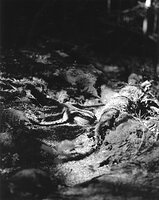
Keith, thanks for that and the picture you have was definitely not dodged or burned. It was taken using a Leica M2 with a 1.4 Summilux at about 1/125 on f8. I took about 7 shots with no changes in exposure, just slight changes in composition. The one you have was the best of the bunch. For what it’s worth I am such a purist nutcase, I don’t even like to use a UV filter on the lens, even though it has virtually no effect on light transmission.
 
I have never made a print in my entire career that was not dodged or burned , it is a necessity IMO.

I agree with Bob. In fact one can start at the basics by looking at the light falloff of almost any enlarging lens and go from there. Those who indicate they never dodge or burn are printing the corners lighter than they are supposed to be. So you are the ones altering the image.:wink:

Componon-S150LightFalloff.jpg
 
I have obviously upset a few people with this thread and I do apologise. I should consider other viewpoints more carefully before I type. I also understand the points made by master printers and others about personal creative printing. I was asked to post some prints that I have not dodged or burned, but that would probably be 90% or more of my output. I very seldom dodge or burn and if I do it is usually quite minimal, but then I am not a master printer or artistic creator in the darkroom. I know this sounds strange to some, but even if I am creating a Van Dyke or Salt print, or something in the darkroom that may require a personal approach to process chemistry and application, I am not precious about the print. If it doesn’t work to my satisfaction, I can always destroy it and make another one.

Cliveh,

It is good to have a well defined way of doing things, as you seem to.

I think the point that most of us we're trying to make is simply that there isn't "one right way": we each have different tools and needs; we each have different personalities and preferences and skills.
 
In fact one can start at the basics by looking at the light falloff of almost any enlarging lens and go from there. Those who indicate they never dodge or burn are printing the corners lighter than they are supposed to be. So you are the ones altering the image.:wink:[/IMG]

I have no problem starting with the basics. But if we're going to do that, then let's go all the way! Your [taking] lens also has falloff, which leads to underexposure toward the periphery of the film :wink:
 
I keep track of exposure and development so my negatives should fit paper.

But I always expect to have to dodge and burn. It does not bother me. I make one or two drawings showing where and how much.

What shocks me is when a print doesn't need seem to need it.

I question my sensitivity at the moment.

cliveh, I've been enjoying your strong, geometric style. I am not surprised you can print with a minimum of pictorial adjustments.
 

Attachments

  • Dodger wall 649.jpg
    Dodger wall 649.jpg
    155.4 KB · Views: 125
Photrio.com contains affiliate links to products. We may receive a commission for purchases made through these links.
To read our full affiliate disclosure statement please click Here.

PHOTRIO PARTNERS EQUALLY FUNDING OUR COMMUNITY:


Ilford ADOX Freestyle Photographic Stearman Press Weldon Color Lab Blue Moon Camera & Machine
Top Bottom