• Welcome to Photrio!
    Registration is fast and free. Join today to unlock search, see fewer ads, and access all forum features.
    Click here to sign up

dodging a complicated horizon

Forum statistics

Threads
203,134
Messages
2,850,377
Members
101,691
Latest member
Kajo
Recent bookmarks
0
Ralph, do you have some tips for cutting the mask?
I always admire the precision of your masking :smile:

Best,

I use an overexposed test print, glue it to a scrap piece of mounting board, cut the shape I need out with a exacto knife and paint the edges with a red or black marker. Any tell-tale signs on the final print are spotted.
 
So are you using the mounting board along with the print, as the mask?

Do you use RC paper? I don't use FB paper much, but I always wondered if the dimensions changed too much from processing for this technique to work.
 
So are you using the mounting board along with the print, as the mask? ...

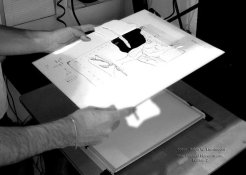
Yes, unless I can use a sketched-on mounting board alone. (see attached)

... Do you use RC paper? I don't use FB paper much, but I always wondered if the dimensions changed too much from processing for this technique to work.

I use RC when using a test print as a mask.
 

Attachments

  • PrintMask.jpg
    PrintMask.jpg
    33.1 KB · Views: 167
When I got my first job in a studio, my primary job was printing the commercial jobs and that required a lot of learning. I was fortunate to have a master printer for my mentor and the following was one of the tricks he taught me. Years later when I went out on my own, aside from photographing and to supplement my income, I used to print for a few pro's and if I had to print multiple prints of the same problem neg, I used a jiggle frame and a sheet of 11x14 clear glass, mounted on four springs. A piece of tissue was temporarily taped to the bottom of the glass and all the dodging masking was done on the top of the glass with croesine or ink, then the tissue was removed and the frame was started in motion with a flick on the right bottom corner of the frame and the exposure started leaving both hands free for burning and additional wand dodging of larger areas. The finer the detail the closer to the print the jiggle frame was placed. With this method you can print many nearly identical prints where very complex dodging and burning was required. This technique along with perspective correction easel mounts was used in many labs that specialized in printing commercial work for advertising and architecture.
Denise Libby

 
very good tip, I use to have a glass setup to put in the light path it was adjustable for different heights.
this was a old photocomp trick for complex masking as well.

When I got my first job in a studio, my primary job was printing the commercial jobs and that required a lot of learning. I was fortunate to have a master printer for my mentor and the following was one of the tricks he taught me. Years later when I went out on my own, aside from photographing and to supplement my income, I used to print for a few pro's and if I had to print multiple prints of the same problem neg, I used a jiggle frame and a sheet of 11x14 clear glass, mounted on four springs. A piece of tissue was temporarily taped to the bottom of the glass and all the dodging masking was done on the top of the glass with croesine or ink, then the tissue was removed and the frame was started in motion with a flick on the right bottom corner of the frame and the exposure started leaving both hands free for burning and additional wand dodging of larger areas. The finer the detail the closer to the print the jiggle frame was placed. With this method you can print many nearly identical prints where very complex dodging and burning was required. This technique along with perspective correction easel mounts was used in many labs that specialized in printing commercial work for advertising and architecture.
Denise Libby
 
Wow...

Better Sense

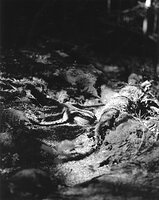
Flashing helps but doesn't solve most cases. A mask will do the trick, but you need patience and a bit of time. The reward is worth it. Look at the attached example:

1. straight print (awful)
2. final print (yes, that's what I wanted)
3. mask (lots of work but worth it)

First, print for the foreground, then use the mask to burn in the sky. The mask was made from a test print for the sky for which the foreground was way too dark. Good luck!

This was one masterful piece of dodging and burning :D
 
I can see why

Thanks. At the time, it was my best-selling print.

Hey Ralph, I'm sure the this is what digital HDR is trying to imitate. The cool thing is that is shot on one piece of film and it required craftsmanship and artistry to pull it off. I do shoot digital, but I appreciate hard-earned skills through years of practicing a craft. Keep up the good work!
 
You might also try "hard" and "soft" developers such as Dektol and Selectol. I think there's more info in "The Print" by Ansel Adams.

Cheers
Morry Katz - Lethbridge, Canada
 
If you burn in the sky with a soft grade (0 or 00) then the pale sky will darken but it will have little effect on the darker trees etc. overlapping the skyline. Overlapping the soft burn with the darker area below the skyline can avoid the pale/dark edging from an inaccurate mask. Keeping the mask high up away from the print seems to work best. Combining this with flashing often solves the problem. Burning the sky away from the skyline with a harder grade can improve the contrast.

Tony
 
Photrio.com contains affiliate links to products. We may receive a commission for purchases made through these links.
To read our full affiliate disclosure statement please click Here.

PHOTRIO PARTNERS EQUALLY FUNDING OUR COMMUNITY:


Ilford ADOX Freestyle Photographic Stearman Press Weldon Color Lab Blue Moon Camera & Machine
Top Bottom