• Welcome to Photrio!
    Registration is fast and free. Join today to unlock search, see fewer ads, and access all forum features.
    Click here to sign up

Do You Use A Polarizer When Shooting Color Print Film?

Bacon Fest 2013

A
Bacon Fest 2013

  • 0
  • 2
  • 36
Other side

H
Other side

  • 0
  • 0
  • 30

Recent Classifieds

Forum statistics

Threads
203,413
Messages
2,854,328
Members
101,825
Latest member
strangefamilia
Recent bookmarks
1

DF

Member
Allowing Ads
Joined
Nov 10, 2012
Messages
649
'Never been much of a CPF shooter, but with the $$ price of currently available E-6 films, It's probably time to delve in.
I'll sometimes use it with B&W, but more often it's better to simply burn-in the sky portion when printing, foregoing the polarizer.
No - I am not yet at the level of doing my own color printing so for the time being it will be up to the lab.
 
I use a polarizer a lot - not just darkening skies but also for increasing saturation by removing the reflective sheen from foliage and rocks and controlling reflection off water ripples.

My most used filter. Also use it a lot in combination with a 25a or deep orange filter for B&W - ask me if I like dramatic clouds.

When shooting vacation snaps on CN film I'll just put a polarizer on every lens and leave them there. My memories of the vacation are all viewed through polaroid sunglasses - my pics should match my memories, natch.
 
Personally, I don't use a polarising filter very often with colour film (Ektar 100 typically). My 35mm Canon is generally fitted with a 24mm lens and the polariser can do weird things to the sky as it's a wide angle; the Mamiya 6MF seems to do fine without it and the 4x5 is mainly used for church interior shots, so rarely used there either!
 
When a polarizer is used to 'darken sky', it does so relative to the brightness of objects...the object stays a brightness level, and the sky itseif is darkened.

IMG_4777-4.jpg

IMG_4776-3.jpg


...burning in the sky in the darkroom does NOT accomplish this.
(Note: I acknowledge that I did not keep the tree at the same brightness level for both shots...in the second shot the tree is brighter while the sky is darkened, relative to first shot.)

As already pointed out, a 24mm lens sees too much expanse of sky, so part of the sky benefits from a polarizer, while 90 degrees away in direction the benefit is small, so a polarizer results in unnatural brightness of he sky in different parts of the photo.
 
Last edited:
It depends on if you mask the other objects and/or the gray level of those objects if burning in split-grade printing. Also, a polarizer will darken or intensify other colors, so it does not just affect the sky. And, of course, a polarizer works best when the sun or light source is at 90º to the lens axis.
 
It depends on if you mask the other objects and/or the gray level of those objects if burning in split-grade printing. Also, a polarizer will darken or intensify other colors, so it does not just affect the sky. And, of course, a polarizer works best when the sun or light source is at 90º to the lens axis.

What you say is true, but it becomes much more challenging if sky is visible between the branches and foliage, trying to keep darkening of the sky consistent with the open sky.
As for affecting other colors, that depends upon whether or not there is surface sheen, as the polarizer can remove much of the surface sheen and reveal the underlying color and texture.
leafcontrast.jpg
 
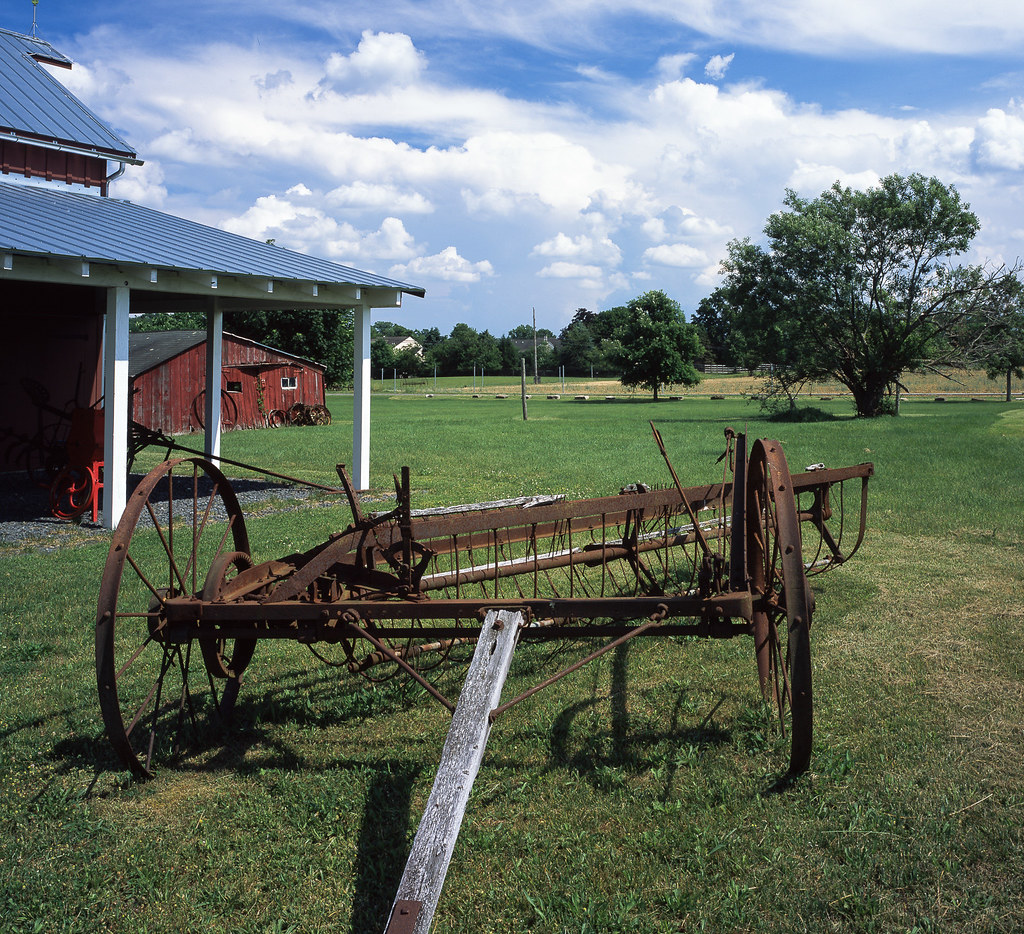
This is on Provia E-6 slide film. Helps make the sky more dramatic even with print film and saturates the colors.
Dey Farm by Alan Klein, on Flickr
 
Nice image, Alan.
I sometimes use a pola, regardless of the type of film. So yes, also with color negative. My main gripe with the old play's I use is that they also act as a weak cyan filter, shifting hues a bit. Not a concern with b&w, but it sometimes bugs me with color.
 
My main gripe with the old polas I use is that they also act as a weak cyan filter, shifting hues a bit. Not a concern with b&w, but it sometimes bugs me with color.

Try a "warming polarizer," or just stack a slight warming filter like an 81a/b.
 
Nice image, Alan.
I sometimes use a pola, regardless of the type of film. So yes, also with color negative. My main gripe with the old play's I use is that they also act as a weak cyan filter, shifting hues a bit. Not a concern with b&w, but it sometimes bugs me with color.

Some polarizers are better than others, with regard to preserving color neutrality and not imparting a tint.
 
NEVER, except when needing cross-polarized light on the copystand in the lab when photographing something shiny, like a Cibachrome print. Polarizers inherently affect hues. But regardless, I like the sparkles and reflections in real-world landscapes just as they are, and based a lot of my early color work upon it. I once displayed a big Ciba print of partially-melted glacial pond water that had multiple layers of reflections, one over another. The curator loved the image and selected it for the show, but an attendee unaccustomed to authentic layered imagery (in distinction from digital applications of that terminology) outright cussed me out at the opening because he felt disoriented. I wasn't offended at all, and in fact was fascinated by his psychological reaction.
 
I have used polarizers with color negative film to bring out the clouds on occasion, but unlike one of my friends never for every or even most photographs.
 
Yes, I will use a polarizer filter when the situation calls for it - regardless of what film is in the camera. For color film, the pola and UV filters are pretty much the only filters I use.

Here are some of the situations where I tend to think about using a polarizer fiter:
- blue skies
- critters in tide pools
- shiny, non-metalic surfaces
- green foliage
- poor man's (quasi-variable?) ND filter
 
  • wiltw
  • wiltw
  • Deleted
  • Reason: cuz
Yes, I will use a polarizer filter when the situation calls for it - regardless of what film is in the camera. For color film, the pola and UV filters are pretty much the only filters I use.

Here are some of the situations where I tend to think about using a polarizer fiter:
- blue skies
- critters in tide pools
- shiny, non-metalic surfaces
- green foliage
- poor man's (quasi-variable?) ND filter

Me, too. I can't think there was ever a time where I used one to ehance the clouds against a less bright sky, probably because the FL was too wide for consistency across the sky.
 
Photrio.com contains affiliate links to products. We may receive a commission for purchases made through these links.
To read our full affiliate disclosure statement please click Here.

PHOTRIO PARTNERS EQUALLY FUNDING OUR COMMUNITY:


Ilford ADOX Freestyle Photographic Stearman Press Weldon Color Lab Blue Moon Camera & Machine
Top Bottom