• Welcome to Photrio!
    Registration is fast and free. Join today to unlock search, see fewer ads, and access all forum features.
    Click here to sign up

Do you always tone your prints for the sake of consistency in your work?

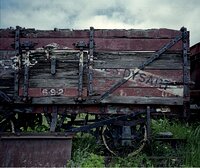
A coal wagon

A
A coal wagon

  • 1
  • 0
  • 21
Morning Birdie

D
Morning Birdie

  • 0
  • 2
  • 24

Forum statistics

Threads
203,142
Messages
2,850,471
Members
101,692
Latest member
eviosl
Recent bookmarks
0
Here you go, Roger. The scan probably doesn't 100% represent what the print looks like, but I tried my best.
 

Attachments

  • Jeanah A.jpg
    Jeanah A.jpg
    219.9 KB · Views: 125
There are experts here that know much more about toning than I do. However, several points might be raised:

1. Some papers do not respond to toning very well if at all. For example, Lodima ( Azo type of paper ) does not change DMax very much, nor does Iford FA MG paper...at least as carefully tested and read on my Heiland.

2. A question that was asked earlier on this thread: Of importance is the question of how much toning, and at what dilution of toner, is necessary to obtain "permanence"? Indeed, is it necessary to obain a color change in order to believe that the image is toned for permanence? Sistain might be an alternative to Selenium in that Sistain, I believe, causes no change in color or Dmax.

3. Some have referenced Herr Moersch who certainly supplies a variety of wonderfully made developers and toners. I have used his Sepia developer with which Herr Moersch advocates a very "light" toning for a very short period of time in very dilute selenium. One might suspect that some here would consider such toning recommendation to be inadequate for permanence, but I suspect that Herr Moersch might feel otherwise.

To my mind, with reference to Selenium toning, the question of "how long and at what dilution" is necessary for permance is still a question. When in doubt....use Gold!!!

Ed
 
There are experts here that know much more about toning than I do. However, several points might be raised:

1. Some papers do not respond to toning very well if at all. For example, Lodima ( Azo type of paper ) does not change DMax very much, nor does Iford FA MG paper...at least as carefully tested and read on my Heiland.

2. A question that was asked earlier on this thread: Of importance is the question of how much toning, and at what dilution of toner, is necessary to obtain "permanence"? Indeed, is it necessary to obain a color change in order to believe that the image is toned for permanence? Sistain might be an alternative to Selenium in that Sistain, I believe, causes no change in color or Dmax.

3. Some have referenced Herr Moersch who certainly supplies a variety of wonderfully made developers and toners. I have used his Sepia developer with which Herr Moersch advocates a very "light" toning for a very short period of time in very dilute selenium. One might suspect that some here would consider such toning recommendation to be inadequate for permanence, but I suspect that Herr Moersch might feel otherwise.

To my mind, with reference to Selenium toning, the question of "how long and at what dilution" is necessary for permance is still a question. When in doubt....use Gold!!!

Ed

Big difference between regular Ilford Multigrade IV and Ilford Multigrade IV Warmtone. Regular MGIV doesn't tone much or increase Dmax, as you've noted, but the MGWT paper is a different story all together.
Just thought I'd point that out as it isn't obvious.

Good points otherwise!
 
Thanks for the clarification Tom...appreciated. I have not yet used the warm tone Ilford FB VC paper...I can get just enough pleasant warm tone with the Moersch Sepia developer.

Your prints continue to be an inspiration for all of us Tom.

Ed
 
To my mind, with reference to Selenium toning, the question of "how long and at what dilution" is necessary for permance is still a question. When in doubt....use Gold!!!

Ed

In Tim Rudman's Book he states 3 minutes at 1:9 dilution a minimum for archival benefits. On both MGIV and MGWT this will produce a color change, though not unpleasant. And with MGIV I usually tone twice this amount of time anyway. MGWT will do amazing splits with selenium at the 1:9 dilution after about 6-8 minutes the shadows are plummy brown and the highlights a coolish silver. There is a moment in time depending on the photograph where the shadow tones begin to creep into the midtones. Pulled at this point it is just beautiful!!.. for the right image of course.
 
... if you are going to frame behind glass, do you see a need to use fiber over rc paper? I made some 11x14 prints last night in RC and toned them this morning ... could never have done this so quickly with fiber paper. Will I notice a difference once they are framed and behind glass anyway? I have a set of 8x10's on the wall of my kids - 1/2 RC and 1/2 Fiber, and I swear I cannot tell the difference!

When I look at the prints in my hall behind glass, which are tipped in, not drymounted, I see the uneven reflection of light from the fact the print is not perfectly flat. I see the sparkling irregular surface of the FB print. When looking at the "image" it is hard to tell the difference. But can you tell the difference from an oblique view where the light skates over the surface?

If this is also satisfying, then great. But I imagine you might be able to see a difference.
 
I have tremendous regard for Dr. Rudman. However, I wonder how he has reached the conclusion that he seems so certain about. Indeed, what experimental model CAN be used to ascertain "how much and for how long" ( sic ) is necessary. Until such model is verified and subject to study, all of the information that represent opions might be just that: Opinions without a firm basis in fact. I am NOT trying to be critical or dismissive, but once more, only posing questions that appear to have no answer that is based upon scientically verifiable facts.

Ed
 
I seldom tone my prints, since I seldom need either the color change or the archival properties toning gives. Color change and archival qualities are really the only reasons for toning. It does not make prints more consistent. In fact, it adds another variable.
 
I think the vast majority of papers have a more pleasing color cast (or lack of unpleasing cast) when given light toning than when completely untoned. YMMV of course.
 
Agreed.

Even just 30-60 seconds in KRST 1+20 is enough to reduce any funky cast left by the development process.

Selenium toner itself has the notion of a snatch point - it'll keep cycling in and out the longer the toning process goes on, where the "cycles" will reduce in intensity as the overall tint approaches colder magenta as the ultimate cast. Grabbing it at somewhere around 90-180 seconds usually works well, but it can also be used longer as a utilitarian to lock in shadows and bottom mids such that a successive toner (brown for instance) has less silver to affect. This doesn't necessarily need to be for a crazy split-tone goal, but instead to help control polysulfide or sepia toners.

Remember too that KRST can also be used the same way but instead followed by bleach to punch up mids/highlights without affecting the shadows - a form of chemical expansion.
 
Hi Katie,
I prefer working with fibre paper. I like the tonal range, the quality and the feel of the paper. It is much, more work than RC when one's protocol involves processing for optimun permanence which is what I endeavour to do according to Ilford.
I tone with selenium to a) remove the olive green cast; and b) to bring the print to optimum permanence.
I like both Ilford MG4 fibre glossy and their new MG Art 300. But I am beginning to think that each paper is best suited to certain types of images.
I recently also printed some 16x20 prints ... boy do I like this size. However, I used RC paper as it was much easier to work with at this size and also the cost is another consideration.
I have found that 11x14 is now my workable (but not limited to), print size.
One paper that I am really hoping to work with in the near future is ILFOBROM GALERIE FB
So because of the way I work, and the materials I prefer to work with, yes, selenium toning is an important part of my practice.
 
I've found that aside from the longer wash time, which I don't necessarily need to be around for, and the post-dry pressing that fiber is not a huge amount of work more. Sure, development and washing take physically more time with fiber and RC is a bit easier to work with overall, but if you break it all down FB only ends up being about 25-50% more work from easel to archival box.
 
Photrio.com contains affiliate links to products. We may receive a commission for purchases made through these links.
To read our full affiliate disclosure statement please click Here.

PHOTRIO PARTNERS EQUALLY FUNDING OUR COMMUNITY:



Ilford ADOX Freestyle Photographic Stearman Press Weldon Color Lab Blue Moon Camera & Machine
Top Bottom