• Welcome to Photrio!
    Registration is fast and free. Join today to unlock search, see fewer ads, and access all forum features.
    Click here to sign up

DIY LED UV Printer

Tied to the dock

D
Tied to the dock

  • 4
  • 0
  • 72
Running in the Snow

H
Running in the Snow

  • 1
  • 2
  • 87

Recent Classifieds

Forum statistics

Threads
203,085
Messages
2,849,646
Members
101,652
Latest member
Mayorbeez
Recent bookmarks
0

kier

Member
Allowing Ads
Joined
Jan 26, 2007
Messages
246
Format
Medium Format
I've been googling without much success and am hoping you fine folks can lend me a hand with a few questions:
  • Are there any resources that show how to build a UV printer with LEDs? All I see are links for PCB printing and I'm not sure if those are going to work for alt photo
  • If not, is there any reason that UV LEDs couldn't be used?
  • Any ideas on how many LEDs would be needed?
  • What would be the best way to test the exposure times? Just some test/step prints? Any better way?


Thanks!!
 
Ask Polyglot, I think he just said something about building one of those.
It's not too hard to get UV LEDs, element14 and digikey and whatnot have a huge selection, both surface-mount and through-hole, everything from 280nm to 1300nm...
 
If you use the forum search and look for UV LED it'll throw up a few threads on the subject.

Here a recent one with some good info (there was a url link here which no longer exists)
 
hmm... I guess I thought by going the LED route I'd be making it easier on myself, but it appears to be more complicated than fluorescent tubes. Trying to do this on the cheap and easy... guess I'll have to rethink things... thanks for the help!

For me, the cheap easy way happened by accident. I found 24 inch fluorescent black lights at Wally world--fixtures with bulbs- for $10 buckeroos each. I bought all they had, four of them, and mounted them under a wide piece of plywood and make 8x10 carbon transfer prints with it. I plan on checking back to see if they got any more in so I can add them to my exposure unit to make larger prints. I have them plugged into a strip plug and that plugged into a timer.
 
For me, the cheap easy way happened by accident. I found 24 inch fluorescent black lights at Wally world--fixtures with bulbs- for $10 buckeroos each. I bought all they had, four of them, and mounted them under a wide piece of plywood and make 8x10 carbon transfer prints with it. I plan on checking back to see if they got any more in so I can add them to my exposure unit to make larger prints. I have them plugged into a strip plug and that plugged into a timer.

I don't see those around anymore. I think I'm just gonna go with BLB CFL's - probably 6 or 8 for a 11x14 lightbox
 
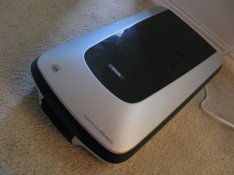
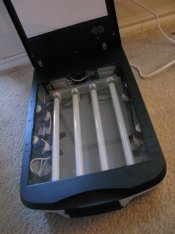
I picked up a cheap face tanning unit for 30 bucks and disassembled the ballasts and the the timer and installed it into a busted scanner I had... Works really well!

ImageUploadedByTapatalk1425237553.424440.jpg

ImageUploadedByTapatalk1425237601.463663.jpg


Sent from my iPhone using Tapatalk
 
I picked up a cheap face tanning unit for 30 bucks and disassembled the ballasts and the the timer and installed it into a busted scanner I had... Works really well!

Love it!

Rick, I found a bank of fluorescent bulbs (BL and BLB) gave me a slightly less sharp carbon print than a single UV light source like my 750W self-ballasted merc vapor lamps...and slightly less contrast. So I tend to use the BL's for platinum printing. But the difference in sharpness is small and not as noticeable at normal viewing distances.

Not $10 each, but similar: http://www.homedepot.com/p/Aspects-1-15-Watt-T8-21-in-Black-Light-Lamp-Included-SLE15-BL/202938507
 
Love it!

Rick, I found a bank of fluorescent bulbs (BL and BLB) gave me a slightly less sharp carbon print than a single UV light source like my 750W self-ballasted merc vapor lamps...and slightly less contrast. So I tend to use the BL's for platinum printing. But the difference in sharpness is small and not as noticeable at normal viewing distances.

Not $10 each, but similar: http://www.homedepot.com/p/Aspects-1-15-Watt-T8-21-in-Black-Light-Lamp-Included-SLE15-BL/202938507

Yeah I think I noticed that too.. My contact print from the same lens and lighting were sharper than the cyanotypes I made with this uv setup... The. I remembered I was cyanotypping so it didn't matter as much


Sent from my iPhone using Tapatalk
 
I tried a cluster of BLB CFL's and considered it a failure. At least I am getting repeatable results. I did notice my prints are a bit soft, but I still like them. I don't have the budget for a different light source for now, I just acquired an 11x14 camera and need some accessories.
 
Yeah I think I noticed that too.. My contact print from the same lens and lighting were sharper than the cyanotypes I made with this uv setup... The. I remembered I was cyanotypping so it didn't matter as much

With cyanotypes (as well as platinums, etc) the image is trapped in the fibers of the paper, rather than sitting on top in an emulsion. This in itself will result in images that are not quite as sharp-looking as the same negative contacted onto silver gelatin papers (everything else being equal). This is not dependent on the light-source used.

What I have found with carbon printing (especially with thicker gelatin layers and going for raised relief) that a very diffuse light source allows the light to spread out into the gelatin layer under the negative to the point of losing critical (for me, anyway) sharpness. It is the same reason I do not like x-ray film that is double sided. Having part of the image on the top of the negative during exposure softens the image, too.
 
With cyanotypes (as well as platinums, etc) the image is trapped in the fibers of the paper, rather than sitting on top in an emulsion. This in itself will result in images that are not quite as sharp-looking as the same negative contacted onto silver gelatin papers (everything else being equal). This is not dependent on the light-source used.

What I have found with carbon printing (especially with thicker gelatin layers and going for raised relief) that a very diffuse light source allows the light to spread out into the gelatin layer under the negative to the point of losing critical (for me, anyway) sharpness. It is the same reason I do not like x-ray film that is double sided. Having part of the image on the top of the negative during exposure softens the image, too.

Ahh nice explanation... Mystery solved


Sent from my iPhone using Tapatalk
 
With all due respect to Vaughn's long time experience I have found that the secret to getting very sharp prints with my home made UV bank is a very tight connection between the negative and the coated paper.
That is the reason I don't use a standard printing frame. I use two pieces of slightly over sized plate glass and multiple industrial clamps on all four sides and slide that under my light bank with about 2 inches of space over top. If you don't have that very tight sandwich certainly the light will bleed around the edges of the grain and a single light source would give you sharper prints. Anyway that is my experience. I used to think that sun prints were sharper and had more brilliant contrast. However I changed my mind after some side by side tests.
Dennis
 
I agree with you 100%, however the loss of sharpness I am referring to is not related to good negative-material contact.

My platinum prints are sharp -- just not as sharp as my carbon prints. This is due to the image being in the paper and just slightly broken up by the fibers in the paper. I have noticed no difference in sharpness in platinum prints between using a bank of BL tubes or a single merc vapor lamp...my frame makes good contact. The smoother the paper (such as hot press vs cold press watercolor papers) the sharper the image tends to appear.

My guess is that those who can make platinum prints on coated glossy silver gelatin papers can get even more sharpness out of their prints -- but I have yet to see one. And again, viewing the prints at 'normal' viewing distances, one may not even notice the differences in sharpness.

But with carbon prints (the way I make them, that is) it is a whole different story. With the very thick emulsion of my carbon tissue (and exposing deep into it) I notice a loss of sharpness when using a diffuse light source. Not as bad as accidently printing the negative upside down, though (even when using a single light source)! The few times I have done that, the prints are mushy-looking...unpleasantly soft...even at normal viewing distances.

My carbon emulsions are much much thicker than film -- including both the silver gelatin emulsions and the 0.004" thick film base.

Edited to add: Thinking about it, I do not the actual thickness of my carbon/gelatin layer. So that last statement could be wrong.
 
Last edited by a moderator:
I'm so glad that I went the LED route a few months ago...and it was so simple to construct, too. My exposure times have been reduced significantly. I've nailed my exposures for carbon, Kallitype, and last night, cyanotype. I've gone from a 25 minute exposure (with BLB tubes) to 6:30. Next it's gum. Gone are the days of going to watch the telly, while making the exposure! :D
 
Photrio.com contains affiliate links to products. We may receive a commission for purchases made through these links.
To read our full affiliate disclosure statement please click Here.

PHOTRIO PARTNERS EQUALLY FUNDING OUR COMMUNITY:


Ilford ADOX Freestyle Photographic Stearman Press Weldon Color Lab Blue Moon Camera & Machine
Top Bottom