
• Welcome to Photrio!
    Registration is fast and free. Join today to unlock search, see fewer ads, and access all forum features.
    Click here to sign up

DIY film dryer

Recent Classifieds

Forum statistics

Threads
201,665
Messages
2,828,217
Members
100,880
Latest member
YNOT REGNIRTS
Recent bookmarks
2

Thorsten

Member
Allowing Ads
Joined
May 20, 2015
Messages
48
Format
Medium Format
Hello everyone.

I have read quite often here and on other photo groups of the problems, people have with drying their film without spots and dust.

I had this problem, too, but solved it a few years ago when I built a little film dryer.

First of all, I wash my film in regular tap water but use demineralized water from the supermarket for the last two washing steps, then I put the development spools (I use the Jobo 1500 system) into a salad spinner to get rid of excess water. After that I used to place the spools into the dryer and let the film dry on the spool. This never caused any issues, it actually helped because the film could not develop a curl while drying - one of the reasons I never liked to use Tri-X and use HP5 instead.

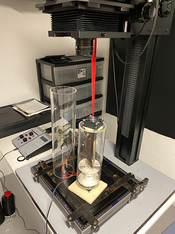
You can also put some 4x5 sheet films into the dryer. I have to tubes of different lengths, the long tube is ok for up to six sheets of 4x5, the short tube for several Jobo spools.

It of course takes a few hours for the film to dry completely on the spool. But who cares.

I do not use it anymore, because I have built a drying cabinet that I can also use for papers, I‘ll probably post some images of the cabinet in the future, too. This dryer still is a functional, easy and small solution. You can get everything needed for less than 50 EUR / USD.


Dryer with short and long tube:
IMG_2023-12-26-223817.jpeg#

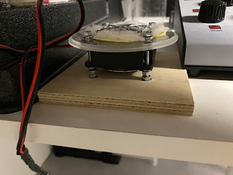
bottom with PC fan and dust filter
IMG_0417.jpeg

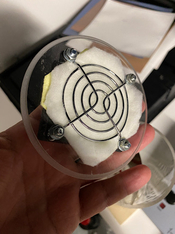
Top, also with PC fan and dust filter
IMG_0418.jpeg
 

chuckroast

Subscriber
Joined
Jun 2, 2023
Messages
3,087
Location
All Over The Place
Format
Multi Format
Elevating the temperature and/or blowing moving air over wet emulsion is a bad idea.

All you need to dry film is a clean place to hang it when wet. After final wash. add add 25ml isopropyl alcohol per litre of working strength PhotoFlo. Hang the film with weight on the bottom. Dip two (clean) fingers in the wetting solution and run them s along the front and back of the film simultaneously to remove excess liquid. Let the film hang until dry.
 

samcomet

Subscriber
Allowing Ads
Joined
Feb 4, 2008
Messages
378
Location
Sydney, Australia
Format
35mm RF
@chuckroast I must admit to using your method for the past 50 or more years. Never had an issue. BUT I have also bought an ALDI vegetable/fruit de-hydrator and now use it for RC and fibre prints. It has multiple shelves for 8 x 10 inch prints with adjustable temps and times. If I'm not in a rush I simply dry fibre face down on screens after using Delta blotting book and RC paper sit upright in a Paterson print dryer in my mostly dust free studio. FWIW
 

mshchem

Subscriber
Allowing Ads
Joined
Nov 26, 2007
Messages
15,927
Location
Iowa City, Iowa USA
Format
Medium Format
Hello everyone.

I have read quite often here and on other photo groups of the problems, people have with drying their film without spots and dust.

I had this problem, too, but solved it a few years ago when I built a little film dryer.

First of all, I wash my film in regular tap water but use demineralized water from the supermarket for the last two washing steps, then I put the development spools (I use the Jobo 1500 system) into a salad spinner to get rid of excess water. After that I used to place the spools into the dryer and let the film dry on the spool. This never caused any issues, it actually helped because the film could not develop a curl while drying - one of the reasons I never liked to use Tri-X and use HP5 instead.

You can also put some 4x5 sheet films into the dryer. I have to tubes of different lengths, the long tube is ok for up to six sheets of 4x5, the short tube for several Jobo spools.

It of course takes a few hours for the film to dry completely on the spool. But who cares.

I do not use it anymore, because I have built a drying cabinet that I can also use for papers, I‘ll probably post some images of the cabinet in the future, too. This dryer still is a functional, easy and small solution. You can get everything needed for less than 50 EUR / USD.


Dryer with short and long tube:
View attachment 357862#

bottom with PC fan and dust filter
View attachment 357863

Top, also with PC fan and dust filter
View attachment 357864

Looks quite functional, I look forward to seeing your latest version. I have a big cabinet dryer I bought from a photo shop, I would guess it's 50 years old, uses very gently moving air and a little heat, mostly my friends use it because they're in a hurry. If I'm not in a rush I let my films hang to dry naturally. I use nice old print dryers, well maintained. So much easier.
Best Regards Mike
 

chuckroast

Subscriber
Joined
Jun 2, 2023
Messages
3,087
Location
All Over The Place
Format
Multi Format
Looks quite functional, I look forward to seeing your latest version. I have a big cabinet dryer I bought from a photo shop, I would guess it's 50 years old, uses very gently moving air and a little heat, mostly my friends use it because they're in a hurry. If I'm not in a rush I let my films hang to dry naturally. I use nice old print dryers, well maintained. So much easier.
Best Regards Mike

The problem with moving air across wet emulsion is that it also moves particulates that are present in the air and embeds them into said emulsion. If you happen to have a Class 100 clean room to do this in, it's probably fine, but most normal darkrooms have some level of baseline dust that gets stirred up by moving air around. I have positive ventilation in my darkroom but it never, ever gets used when the film is drying for this very reason. Ditto no moving air anywhere near the time I am loading sheet film holders.
 

albada

Member
Allowing Ads
Joined
Apr 10, 2008
Messages
2,177
Location
Escondido, C
Format
35mm RF
The problem with moving air across wet emulsion is that it also moves particulates that are present in the air and embeds them into said emulsion. If you happen to have a Class 100 clean room to do this in, it's probably fine, but most normal darkrooms have some level of baseline dust that gets stirred up by moving air around. I have positive ventilation in my darkroom but it never, ever gets used when the film is drying for this very reason. Ditto no moving air anywhere near the time I am loading sheet film holders.

I have a HEPA filter over the intake of my DIY film-dryer, and get no dust on film. No spotting needed. And my darkroom is carpeted, so it's dustier than many. HEPA filters are your friend.

Mark
 
OP
OP

Thorsten

Member
Allowing Ads
Joined
May 20, 2015
Messages
48
Format
Medium Format
The problem with moving air across wet emulsion is that it also moves particulates that are present in the air and embeds them into said emulsion. If you happen to have a Class 100 clean room to do this in, it's probably fine, but most normal darkrooms have some level of baseline dust that gets stirred up by moving air around. I have positive ventilation in my darkroom but it never, ever gets used when the film is drying for this very reason. Ditto no moving air anywhere near the time I am loading sheet film holders.

The white stuff over the fans is a high class particle filter. I forgot the class, but it definitly is thick enough to keep all dust out. These filters over inlet and outlet are the reason why I use two fans. One alone could not get the air through two filters.

It probably would have worked if I had put the inlet with one filter on to and then blow everything out of the open bottom.
 

guangong

Member
Allowing Ads
Joined
Sep 10, 2009
Messages
3,589
Format
Medium Format
For 65+ years I have simply hung film from a line with weighted film clips at bottom, and never had any problems. Should dust be a problem, a simple solution would be a storage bag for suits, etc.
I am always amazed at self created problems and their solutions.
 

Kilgallb

Subscriber
Allowing Ads
Joined
Oct 14, 2005
Messages
830
Location
Calgary AB C
Format
4x5 Format
I got rid of my dust problem by using a diffusion enlarger, and changing fron 35mm to 4x5.
 

Sergey Ko

Member
Allowing Ads
Joined
Jul 13, 2021
Messages
119
Location
Vilnius, Lithuania
Format
Analog
Your device is interesting, but this is more technical creativity for one’s own pleasure than a really necessary thing.
In my former PRO photo life I used the special cabinet, even not in all labs. In my amateur photo life I use shower cabin. Normally there is no dust in it & bathroom temperature is higher, so in 1 hour the film is dry.
I think much more attention should be paid to the wetting agent and removing water drops.
 
Last edited:

koraks

Moderator
Moderator
Joined
Nov 29, 2018
Messages
26,657
Location
Europe
Format
Multi Format
this is more technical creativity for one’s own pleasure than a really necessary thing.

I've seen this or similar arguments a couple of times in this thread, and it has me scratching my head a bit.
Most of the photography we're doing isn't really necessary. It's a hobby for most of us. And since many of us work with film, apparently we like to tinker and fondle with things. Some like mixing their own developers, others like shooting wet plate or do alt. process printing, some do their own camera repairs, etc. None of this is really necessary!

I think we should all keep this in mind when commenting on someone's project. I'm going to try and do that, in any case. That's what I take from this thread.
And that you can make a very functional drying contraption with modest means. That, too.
 

chuckroast

Subscriber
Joined
Jun 2, 2023
Messages
3,087
Location
All Over The Place
Format
Multi Format
I've seen this or similar arguments a couple of times in this thread, and it has me scratching my head a bit.
Most of the photography we're doing isn't really necessary. It's a hobby for most of us. And since many of us work with film, apparently we like to tinker and fondle with things. Some like mixing their own developers, others like shooting wet plate or do alt. process printing, some do their own camera repairs, etc. None of this is really necessary!

I think we should all keep this in mind when commenting on someone's project. I'm going to try and do that, in any case. That's what I take from this thread.
And that you can make a very functional drying contraption with modest means. That, too.

I think that's certainly well taken. But in my view, moving air across wet emulsion is potentially damaging which is why I commented as I did. It's not a question of "necessity". As you point out, we all left "necessary" a long time ago :tongue: I think it's more a question of utility.

Even with the extra care of HEPA filtration, the cabinet is subject to ingesting particulate contaminants when it is opened and closed. These get blown around when the HEPA filtered air starts moving through the drying cabinet. Is it a big deal? I have no idea. Certainly,, the idea behind this is interesting enough, I'd just hate to see good negatives damaged thereby.
 

Sergey Ko

Member
Allowing Ads
Joined
Jul 13, 2021
Messages
119
Location
Vilnius, Lithuania
Format
Analog
I don't think I said anything offensive to the topicstarter...
You have to pay attention to dust, but not so fanatical. It is like the High End Audio technics -you add 100% efforts & money but receive 1% quality increase.
I played a lot with Minox 8x11, so I had a good practice :wink:
The best answer is from Kilgallb :smile:))
From Minox:
Aptekarsky Ogorod 4 by Sergey Kozlov, on Flickr
 
OP
OP

Thorsten

Member
Allowing Ads
Joined
May 20, 2015
Messages
48
Format
Medium Format
Well, the bathroom might work for some, but I still had problems with dust all the time. And yes, I admit, I am the kind of guy who really is annoyed if a good shot has a bit of dust somewhere.

On a strip of 36 exposures I always could find several photos with a bit of dust here or there and since I want to print my films in the darkroom and have never done any retouch work on prints (and do not intend to ever do it), such negatives are ruined for me. It just drives me mad, to look at a print and see one of these annoying white spots, knowing I cannot do anything, because it is deep in the emulsion of the film.

I would not have put the effort in this stuff, had I not had this problem.

Also I should point out, that my darkroom is in my basement, in a storage room that also includes my central heating, hot water and internet access systems. That room is always rather dusty - the enlarger is always completely covered when not in use.


And it actually got worse when I decided to enlarge only an FB paper which takes quite a bit to dry, for that I then built a complete drying cabinet.

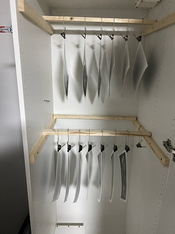
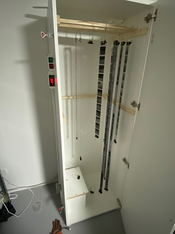
Instead of spend an hour or two cleaning an otherwise unimportant room everytime I want to make some prints, I decided it is cheaper (because I do value my spare time quite more than the 150 EUR it cost me to build that thing, call me lazy if you like) and more convenient, to built a cabinet which I can easily keep completely clean. Air (heated to 28 °C (80 °F I think) goes in at the bottom, out at the top, both holes covered with dust filters. The pictures are a bit older, by now there is a bit foam to seal the door.


IMG_0419.jpeg IMG_2023-12-28-224154.jpeg
 

runswithsizzers

Subscriber
Joined
Jan 19, 2019
Messages
1,960
Location
SW Missouri, USA
Format
Multi Format
@Thorsten, your film drying device is more elegant than the one I built. I previouly posted photos of that project <here>. My d.i.y. film dryer includes an incandescent light bulb to warm the air. If I was going to build another one, it would look more like yours.

I agree with those that say heat and moving air could theoreticallycause problems when drying film, but based on my practical experience using mild heat and gently moving air to dry about 2 dozen rolls -- I have not experienced anything that I would call a problem.

In the wintertime, when my basement air temperature is 60*F (15.5*C), the air that coming out of my diy drying rig is about 75*F (24*C). In the summer, the heated air is closer to 85-90*F (29-32*F). Typically, my film is almost dry when my 15 minute timer shuts off -- so sometimes I add another 5 or 10 minutes.

The air which is drawn into my diy drying rig passes through a generic foam filter (not HEPA). And my basement workspace is far from clean. My wife mixes up potting soil down there, and I do a fair bit of woodworking in the same area. I do clean my work bench with a shop vac and damp towels before processing film, but it would be impossible to get my basement anywhere near dust free. A few frames on each 36 exposure roll may have 1 or 2 small dust specks which are visible when viewing the scans at normal magnifications. But for me, that is nothing to worry about.
 

Kilgallb

Subscriber
Allowing Ads
Joined
Oct 14, 2005
Messages
830
Location
Calgary AB C
Format
4x5 Format
I got rid of my dust problem by using a diffusion enlarger, and changing fron 35mm to 4x5.
I still have a drying cabinet but no motorized air movement. I like to develop film first then go to printing after that. This allows me to use my 6x8 darkroom and dry my negatives elsewhere knowing dust will not get to them.

it also lets me do monochrome film then colour.
 

Burgy_Tog

Member
Allowing Ads
Joined
Jul 2, 2023
Messages
35
Location
UK
Format
DSLR
I built something similar earlier this year, I have put 20 rolls of film through out without issue, because the air is not being heated, the film dries flat and dust free.
IMG_4293 (1).jpg
IMG_4443.jpg
 

guangong

Member
Allowing Ads
Joined
Sep 10, 2009
Messages
3,589
Format
Medium Format
For removing occasional dust marks on print is why the gods made spotting dyes.
 

Burgy_Tog

Member
Allowing Ads
Joined
Jul 2, 2023
Messages
35
Location
UK
Format
DSLR
Wrong, spotting dyes were for those that were incapable of keeping their negs clean, the rest of us use anti-static brushes, IPA, and various other dust preventative methods, spotting dyes are the last resort.
 
Photrio.com contains affiliate links to products. We may receive a commission for purchases made through these links.
To read our full affiliate disclosure statement please click Here.

PHOTRIO PARTNERS EQUALLY FUNDING OUR COMMUNITY:


Ilford ADOX Freestyle Photographic Stearman Press Weldon Color Lab Blue Moon Camera & Machine
Top Bottom