• Welcome to Photrio!
    Registration is fast and free. Join today to unlock search, see fewer ads, and access all forum features.
    Click here to sign up

Dip & dunk 616 film.

Surprise

A
Surprise

  • 3
  • 0
  • 50
102391040027-2.jpg

A
102391040027-2.jpg

  • 7
  • 5
  • 144

Recent Classifieds

Forum statistics

Threads
201,783
Messages
2,830,129
Members
100,946
Latest member
李添翼
Recent bookmarks
0

Mike Kennedy

Member
Allowing Ads
Joined
Feb 5, 2005
Messages
1,594
Location
Eastern Cana
Format
Multi Format
I would like to have a go at this method to develop my "found film".Can't really find anything on the net.Would someone kindly point me to a site which would guide me,step by step,in this process.

Much Thanks
 

Konical

Member
Allowing Ads
Joined
Jun 1, 2003
Messages
1,824
Good Morning, Mike,

I understand that back in the days of orthochromatic film, the dip and dunk method was commonly used since it could be done under a red safelight. The idea is simply to have a tray of chemicals through which the film, held in a catenary curve shape, is passed back and forth until development is complete. Stop and fix would follow the same approach. This method becomes rather awkward with panchromatic film since a safelight can't be used, but I suppose that, with care, it can be done. Sorry I can't give any practical hints; by the time I got involved in photography, only pan film was generally available, and the tank/reel system was in use.

Konical
 

Paul Howell

Subscriber
Allowing Ads
Joined
Dec 23, 2004
Messages
10,098
Location
Scottsdale Az
Format
Multi Format
Older Kodak How to Take Good Pictures books from the 40's and early 50's provide instuctions on how see saw roll film though trays.
 

greybeard

Member
Allowing Ads
Joined
Jun 10, 2005
Messages
366
Location
Northern Cal
Format
Large Format
This film has presumably been on the roll for quite some time, so it may be a bit curly and difficult to handle by the seesaw method. A presoak might help (seesaw through plain water plus a bit of wetting agent for a minute or so).

The technique isn't all that hard to do, but it seems to work best if you use a fairly narrow tray (5x7, working across the short dimension) and let the film "ride" (gently!) against the inside bottom corners. Letting the film ride across the tray this way gives you some tactile feedback so that you don't end up seesawing it through the air above the developer. Presumably, you could also just use a deep enough tank to be sure that you don't wander away from the solution (this is in total darkness, remember). The ultimate deep tank would be a piece of plastic pipe with a cap on the far end; the tradeoff is developer volume versus manipulation skill. Given that the film is essentially irreplaceable, you might want to just invest in some pipe, a few caps, and lots of chemicals.

There are (or were) adjustable-reel tanks that would take these old film sizes. You might find one used, but back in the day they weren't all that easy to load, and given the film-curl issue, they probably wouldn't work any better today.
 
OP
OP

Mike Kennedy

Member
Allowing Ads
Joined
Feb 5, 2005
Messages
1,594
Location
Eastern Cana
Format
Multi Format
Thanks Greybeard,
The film is very brittle so I shall do a presoak.Lots of trays and chemicals.Think I'll go with HC-110.
Care to ballpark a time for developing Ansco All Weather Pan in dilution H (1:63)?

Mike
 

Photo Engineer

Subscriber
Allowing Ads
Joined
Apr 19, 2005
Messages
29,018
Location
Rochester, NY
Format
Multi Format
How it is done

Guys;

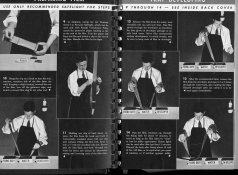
Here is Kodak's pictorial demo from their B&W manual published in 1947, the first year I did my own processing.

I hope this helps.

PE
 

Attachments

  • processing film demo.jpg
    processing film demo.jpg
    129.9 KB · Views: 148
OP
OP

Mike Kennedy

Member
Allowing Ads
Joined
Feb 5, 2005
Messages
1,594
Location
Eastern Cana
Format
Multi Format
Fantastic Photo Engineer !!!!!!!!!!!!!!!!
I shall post the results (if anything comes out).

Mike
 

MattKing

Moderator
Moderator
Joined
Apr 24, 2005
Messages
55,156
Location
Delta, BC Canada
Format
Medium Format
Guys;

Here is Kodak's pictorial demo from their B&W manual published in 1947, the first year I did my own processing.

I hope this helps.

PE

One point - it is absolutely imperative that while doing this you wear a white dress shirt and tie, as pictured :wink: :wink: :wink: :D

Matt

P.S. the last time I did this, it was with 616 film, and I was 40 years younger.

P.P.S. You may want to waste a roll of 120 film and practice this first - but don't just use water, because the developer is much more slippery than water.
 

Michel Hardy-Vallée

Membership Council
Subscriber
Allowing Ads
Joined
Apr 2, 2005
Messages
4,794
Location
Montréal, QC
Format
Multi Format
Guys;

Here is Kodak's pictorial demo from their B&W manual published in 1947, the first year I did my own processing.

I hope this helps.

PE


Oups! They did not recommend a stop bath... :wink:
 

Photo Engineer

Subscriber
Allowing Ads
Joined
Apr 19, 2005
Messages
29,018
Location
Rochester, NY
Format
Multi Format
The tie and white shirt would stop anything! :D

Seriously, I knew you would catch that. And, the reason is that it was optional, but also because the films of that era were not as hard as those currently manufactured.

But, AAMOF, I use a stop bath with my hand coatings and it works just fine.

PE
 

CRhymer

Subscriber
Allowing Ads
Joined
Feb 8, 2005
Messages
439
Location
Fort Smith,
Format
ULarge Format
Ron, were you not wearing that very tie in Montana? I have to say, "You don't look a day older than those pictures of you in 1947".:smile:

Mike, having done this a few times myself, I can stress (as Matt pointed out) that trying it out on a real roll of 120, with real images and real developer, is worth the trouble. I was quite surprised at how much a "dry" run helps when working in the dark with slippery film. I did a roll of Ansco All Weather Pan 616 about a year ago, in Rodinal, as I recall, because it was at hand. I used an old, cracked, taped up FR tank, and did some damage to the film in loading (very brittle). I have another roll around here somewhere (unexposed).

Good luck. You will be all set to do the rolls of 118 or122 you will probably find next.

Cheers,
Clarence
 

Photo Engineer

Subscriber
Allowing Ads
Joined
Apr 19, 2005
Messages
29,018
Location
Rochester, NY
Format
Multi Format
Ron, were you not wearing that very tie in Montana? I have to say, "You don't look a day older than those pictures of you in 1947".:smile:

Mike, having done this a few times myself, I can stress (as Matt pointed out) that trying it out on a real roll of 120, with real images and real developer, is worth the trouble. I was quite surprised at how much a "dry" run helps when working in the dark with slippery film. I did a roll of Ansco All Weather Pan 616 about a year ago, in Rodinal, as I recall, because it was at hand. I used an old, cracked, taped up FR tank, and did some damage to the film in loading (very brittle). I have another roll around here somewhere (unexposed).

Good luck. You will be all set to do the rolls of 118 or122 you will probably find next.

Cheers,
Clarence

Clarence;

I bought a new tie in 1963 after I left the Air Force. I was forced to get a new one for Kodak. Just think, I wore it for 32 years.

PE
 

Michel Hardy-Vallée

Membership Council
Subscriber
Allowing Ads
Joined
Apr 2, 2005
Messages
4,794
Location
Montréal, QC
Format
Multi Format
The tie and white shirt would stop anything! :D

Seriously, I knew you would catch that. And, the reason is that it was optional, but also because the films of that era were not as hard as those currently manufactured.

But, AAMOF, I use a stop bath with my hand coatings and it works just fine.

PE

Tee hee! How come the hardening in the emulsion a contributing factor to the importance of stop? Is a more hardened emulsion retaining more developer, hence requiring a stop bath for fast and thorough stopping? Or was it that the pinholes due to carbonate dev+acid stop were a reality back then?
 

Murray Kelly

Member
Allowing Ads
Joined
Jan 31, 2007
Messages
661
Location
Brisbane, Australia
Format
Sub 35mm
Guys;

Here is Kodak's pictorial demo from their B&W manual published in 1947, the first year I did my own processing.

I hope this helps.

PE
GEEZ! Does that take me back? I would get my folks to call out the minutes from the next room. I had the pantry with towels along the door. A bit later - 1949 at a guess.

Murray
 

Photo Engineer

Subscriber
Allowing Ads
Joined
Apr 19, 2005
Messages
29,018
Location
Rochester, NY
Format
Multi Format
Tee hee! How come the hardening in the emulsion a contributing factor to the importance of stop? Is a more hardened emulsion retaining more developer, hence requiring a stop bath for fast and thorough stopping? Or was it that the pinholes due to carbonate dev+acid stop were a reality back then?

Early film and paper emulsions could form blisters (not pinholes) from stop during this rough treatment. It has been reported in very old texts and that is how the story has continued to the present day and how it is applied to modern products.

PE
 

gainer

Subscriber
Allowing Ads
Joined
Sep 20, 2002
Messages
3,699
I remember lots of things from my early days. A Bullet, or was it Bullseye, Brownie that used 127 film, a cardboard flashbulb reflector, a walk-in closet with ruby bulb, but no tie. I didn't get to wear a tie until I was about 16. Even so, I got to see the miracle of contact prints on Velox paper coming up in a soup bowl or some other dish. Who timed film development? You could see the image coming up under the red light as you see-sawed it through the soup. I always wondered why we called it "soup". Timing contact prints was "1 mississippi, 2 mississippi-etc.
 

greybeard

Member
Allowing Ads
Joined
Jun 10, 2005
Messages
366
Location
Northern Cal
Format
Large Format
Ah, yes---Velox paper and ortho film.

Anyone else here start out with the Kodak "Tri-Chem-Pak", that came with developer ("Universal M-Q", as I recall--good for both film and paper), stop bath, and fixer, and a little package of 2-1/2 x 3-1/2 inch Velox paper?
 

MattKing

Moderator
Moderator
Joined
Apr 24, 2005
Messages
55,156
Location
Delta, BC Canada
Format
Medium Format
Anyone else here start out with the Kodak "Tri-Chem-Pak", that came with developer ("Universal M-Q", as I recall--good for both film and paper), stop bath, and fixer, and a little package of 2-1/2 x 3-1/2 inch Velox paper?

That is probably what I started with (or something similar), but I cannot remember for sure.

I was, after all, eleven years old at the time :smile:

Matt
 

Photo Engineer

Subscriber
Allowing Ads
Joined
Apr 19, 2005
Messages
29,018
Location
Rochester, NY
Format
Multi Format
Actually, the early developers came in test tubes with cork stoppers. You pulled out a stopper and dissolved the first chemical, then pulled the second one and etc.... It was great.

The bigger packs came in glass jars with paper cannisters inside. You dissolved the cannister (or the chemical in the jar) and then vice versa. It was a great time.

Our local pharmacist and our radio repair shop carried these chemicals as there was no such thing as a 'photo store' then.

PE
 

gainer

Subscriber
Allowing Ads
Joined
Sep 20, 2002
Messages
3,699
Our local pharmacist was a photo hobbyist and carried a wide range of photo supplies. I seem to remember getting my first taste of Varigam at his place. I still have a Varigam filter or two.
 
Photrio.com contains affiliate links to products. We may receive a commission for purchases made through these links.
To read our full affiliate disclosure statement please click Here.

PHOTRIO PARTNERS EQUALLY FUNDING OUR COMMUNITY:



Ilford ADOX Freestyle Photographic Stearman Press Weldon Color Lab Blue Moon Camera & Machine
Top Bottom