
• Welcome to Photrio!
    Registration is fast and free. Join today to unlock search, see fewer ads, and access all forum features.
    Click here to sign up

Dilutions

Boardwalk

A
Boardwalk

  • 3
  • 3
  • 46
Speculative Silence

D
Speculative Silence

  • 1
  • 0
  • 30

Recent Classifieds

Forum statistics

Threads
202,116
Messages
2,835,328
Members
101,121
Latest member
sprgn57
Recent bookmarks
0

noiretblanc-brian

Member
Allowing Ads
Joined
Jul 27, 2008
Messages
10
Format
35mm RF
I got a really really basic question that I would like to ask you gurus out there.

Is there a difference between dilutions 1:50 and 1+50?

To me, the former means 1 part stock + 49 parts water = 50 parts working solution, thus the "50" in "1:50" is the final volume. And the latter means 1 part stock + 50 parts water = 51 parts working solution.

The question has been in my head for years, but since I normally use higher dilutions of Rodinal / R09, such as 1+100 or 1+125, the extra 1 part of water does not seem to make a big difference to me (I hope).

Is my understanding right?

Thanks for your enlightenment!
 

Ian Grant

Subscriber
Allowing Ads
Joined
Aug 2, 2004
Messages
23,418
Location
West Midland
Format
Multi Format
Yes you're right 1+50 means add 1 part then another 50 parts making 51 parts, unless you can't count like Kodak :D

1:50 means take 1 part and dilute it to 50x the original volume which is the same as 1+49

So Ilford dilutions are typically 1+9 (1:10), 1+19 (1:20), 1+4 (1:5) and some companies listed both just to be totally clear.

Ian
 

Steve Smith

Member
Allowing Ads
Joined
May 3, 2006
Messages
9,110
Location
Ryde, Isle o
Format
Medium Format
Generally chemsist think that 1:50 means 1 part in a total volume of 50 whereas us 'normal' people think of it as 1 part and 50 parts.

The chemists' method is fine but what does 1:1 mean?!!


Steve.
 

wogster

Member
Allowing Ads
Joined
Nov 10, 2008
Messages
1,272
Location
Bruce Penins
Format
35mm
Generally chemsist think that 1:50 means 1 part in a total volume of 50 whereas us 'normal' people think of it as 1 part and 50 parts.

The chemists' method is fine but what does 1:1 mean?!!


Steve.

I think that would mean undiluted, or effectively 1+0. The one I can never figure out are the oddball Kodak ones, based on those weird imperial like measurements they use down there.... :whistling:
 

Steve Smith

Member
Allowing Ads
Joined
May 3, 2006
Messages
9,110
Location
Ryde, Isle o
Format
Medium Format

Dave Martiny

Member
Allowing Ads
Joined
May 24, 2006
Messages
122
Format
35mm
Generally chemsist think that 1:50 means 1 part in a total volume of 50 whereas us 'normal' people think of it as 1 part and 50 parts.

The chemists' method is fine but what does 1:1 mean?!!


Steve.

I agree with Steve, and hence, the colon notation for dilutions has become ambiguous.

I have taught math all my life, and I can attest that without fail, every math text book that I have seen uses the colon notation in the following way, that if A and B are to be mixed in the ratio of 2:3 (read, "2 to 3"), then there are 2 parts of A and 3 parts of B for a total of 5 parts. This makes A 40% of the mixture and B 60% of the mixture. There is no reason that this should change when the first number in the ratio is 1, as is often the case in photo chem mixtures. Thus, 1+9 should really be expressed as 1:9, not 1:10.

I am not familiar with chemistry text books, but apparently from what I have read here and elsewhere chemists have hijacked the colon usage to mean that 1:10 is meant to be a 10% solution, the same as 1+9, as Ian says. This is unfortunate, because once a notation takes on two meanings, its usefulness is greatly reduced, and confusion results. Search the archives and you will see that this is not the first thread that debates this issue.

The best answer is, like Ilford, to eliminate the colon and use the + notation.

It's hard to misunderstand 1+9.

Dave
 

Barry S

Member
Allowing Ads
Joined
Jan 28, 2007
Messages
1,350
Location
DC Metro
Format
Large Format
"...Thus, 1+9 should really be expressed as 1:9, not 1:10..." <<-------- This is exactly why we keep mathematicians out of labs! :smile: Brian was correct in his original post, a 1:10 dilution is equivalent to 1+9. This is a standard laboratory science convention, despite the usage in some of the photo world. I always use the X+Y convention for photography, to prevent misunderstandings.

The other measurement that's typically messed up is % solution. A 20% solution isn't 20g plus 100ml, but 20g in a total of 100 ml.
 

BetterSense

Member
Allowing Ads
Joined
Aug 16, 2008
Messages
3,151
Location
North Caroli
Format
35mm
Also, for most developers, once you get over 1:20 or so it wouldn't matter which way you read it. Certainly there is no practical difference between 1 part in 49 and 1 part in 50 for Rodinal.
 

Steve Smith

Member
Allowing Ads
Joined
May 3, 2006
Messages
9,110
Location
Ryde, Isle o
Format
Medium Format
I agree with Steve, and hence, the colon notation for dilutions has become ambiguous.

I have taught math all my life, and I can attest that without fail, every math text book that I have seen uses the colon notation in the following way, that if A and B are to be mixed in the ratio of 2:3 (read, "2 to 3"), then there are 2 parts of A and 3 parts of B for a total of 5 parts.

I agree with me too..... and you.

I have always associated the colon with a ratio but in my case it is usually with engineering and architectural drawings. i.e. scale 1:1 is full size and 50:1 is 1/50 of full size. Nothing to do with dilutions but still a ratio.


Steve.
 

Ian Grant

Subscriber
Allowing Ads
Joined
Aug 2, 2004
Messages
23,418
Location
West Midland
Format
Multi Format
I agree with me too..... and you.

I have always associated the colon with a ratio but in my case it is usually with engineering and architectural drawings. i.e. scale 1:1 is full size and 50:1 is 1/50 of full size. Nothing to do with dilutions but still a ratio.


Steve.

Actually everything to due with Dilution ratios it's identica :D

Ian
 

LudditeJay

Member
Allowing Ads
Joined
Aug 3, 2010
Messages
54
Format
Multi Format
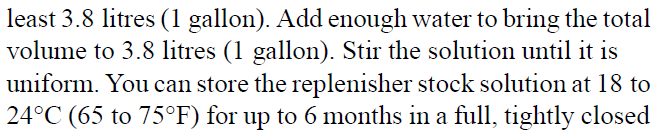
Interesting thread. I have also diluted my chemicals using the part to part method. I tend to use Kodak HC-110 and mix from concentrate. Well, the Kodak literature states that dilution E is 1:47, but they also stated the amounts of each.
http://www.kodak.com/global/en/professional/support/techPubs/j24/j24.pdf

828mL of concentrate to 39L of water.

39828mL divided by 828ml is ~48.1. The 828mL of concentrate is 1 part within 48.1 total parts.

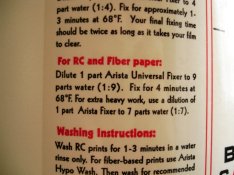
So, 1 part concentrate to 47 parts water sounds alright. That is how I have done it and never had a problem. My Ilford fixer stated 1+4, 1+9, etc, but my Arista fixer states it like Kodak.

Edit: I don't mix that much, it was just one of two different amounts Kodak uses as an example.
 

Attachments

  • DSC00299.JPG
    DSC00299.JPG
    187.7 KB · Views: 92

Steve Smith

Member
Allowing Ads
Joined
May 3, 2006
Messages
9,110
Location
Ryde, Isle o
Format
Medium Format
Actually everything to due with Dilution ratios it's identica :D

Well, yes. It is still a ratio. Perhaps I should do my next engineering drawing 1/4 full size and add a note "dilute 4:1" (or is it four times full size?).


Steve.
 

Ian Grant

Subscriber
Allowing Ads
Joined
Aug 2, 2004
Messages
23,418
Location
West Midland
Format
Multi Format
In the 1930's & 40's Kodak in the UK were more explicit so for D1 the three part A B C Pyro they stated clearly mix 1 Part A, I part B and 1 part C, whereas Eastman Kodak said mix 1:1:1. Ilford were explicit as well.

It's an Americanism of Kodak's doing, it's not used in much earlier Eastman Kodak formulae.

Also that Arista dilution says dilute 1 part Fixer to 9 parts water, that's incorrect English it's dilute 1 part with 9 parts which is to 10 parts.

Ian
 
Last edited by a moderator:

mhcfires

Member
Allowing Ads
Joined
May 18, 2008
Messages
593
Location
El Cajon, CA
Format
Multi Format
So then…1:1 dilution means add equal parts of water and developer, or whatever. Whenever I use D-76, which is not too often, I use the 1:1 dilution, which means to me equal parts of developer and water. ( I hope I haven't been doing it wrong for the last forty-five years! :confused: )
 

wogster

Member
Allowing Ads
Joined
Nov 10, 2008
Messages
1,272
Location
Bruce Penins
Format
35mm
So thenÂ…1:1 dilution means add equal parts of water and developer, or whatever. Whenever I use D-76, which is not too often, I use the 1:1 dilution, which means to me equal parts of developer and water. ( I hope I haven't been doing it wrong for the last forty-five years! :confused: )

No, it's more that Kodak isn't explicit about something that is one way in chemistry and a different way in mathematics, where as some other companies are. Kodak in the UK as Ian pointed out, used to do things a little differently then in the US, they were probably commanded from Rochester that they needed to use the US nomenclature rather then the existing British instructions. It's one of the reasons why my darkroom went metric in 1978, because some companies were explicit with instructions as to whether it was denominated in Imperial Measure or US and some companies were not. They all seemed to include metric, so it was easier to go that way.

BTW Kodak STILL does not specify whether a gallon means a 3.8L US gallon, or a 4.5L Imperial gallon, in a lot of their literature, so you still need to use the metric equivalents to know which they mean, which quite often is US measure.
 

LudditeJay

Member
Allowing Ads
Joined
Aug 3, 2010
Messages
54
Format
Multi Format
No, it's more that Kodak isn't explicit about something that is one way in chemistry and a different way in mathematics, where as some other companies are. Kodak in the UK as Ian pointed out, used to do things a little differently then in the US, they were probably commanded from Rochester that they needed to use the US nomenclature rather then the existing British instructions. It's one of the reasons why my darkroom went metric in 1978, because some companies were explicit with instructions as to whether it was denominated in Imperial Measure or US and some companies were not. They all seemed to include metric, so it was easier to go that way.

BTW Kodak STILL does not specify whether a gallon means a 3.8L US gallon, or a 4.5L Imperial gallon, in a lot of their literature, so you still need to use the metric equivalents to know which they mean, which quite often is US measure.


Unfortunately since what I learned in math class about ratios and their notation doesn't apply to a laboratory I agree they should be explicit about their use of the colon.

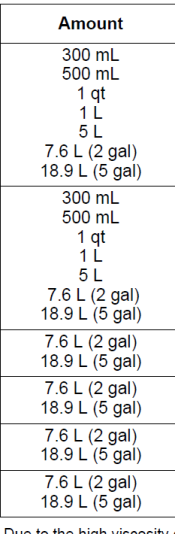
I am curious about what literature from Kodak is so vague. I haven't had much experience dealing with darkroom chemicals but the stuff the literature that I have needed to use has been quite explicit. All of the literature that I have come across is similar to the examples below, taken from documentation for D-76 and HC-110.
 

Attachments

  • Capture.PNG
    Capture.PNG
    21 KB · Views: 80
  • Capture2.PNG
    Capture2.PNG
    15.8 KB · Views: 78
  • Capture3.PNG
    Capture3.PNG
    23.3 KB · Views: 88

Ian Grant

Subscriber
Allowing Ads
Joined
Aug 2, 2004
Messages
23,418
Location
West Midland
Format
Multi Format
Kodak uses Litres outside the US because otherwise no one would understand them. Judging by posts even Kodak ex-employees don't understand them either.

A 1:1 ratio means no change in dimension, so Full strength or Full size :D

Ian
 

MattKing

Moderator
Moderator
Joined
Apr 24, 2005
Messages
55,385
Location
Delta, BC Canada
Format
Medium Format
While it is true that there are some inconsistencies within the Kodak documentation, in most cases there are both long form descriptions (i.e. "You can easily mix smaller volumes by mixing one part of the concentrate with four parts water.") and abbreviated descriptions (i.e. "Concentrate mix ratio 1:4") within the same document - both examples taken from J86 - the T-Max developer technical data sheet.

In many cases though, if there are tables in those documents, or in the product labels, they just use the abbreviated versions.

In the tables for HC110, Kodak uses 1:31 (as an example, for dilution B), but explicitly states at the top of the column that this refers to the "Ratio of Concentrate to Water" (not ratio of concentrate volume to total volume).

As for the US gallon vs. Imperial gallon question, it has been a long time indeed since I've seen any Kodak volume measures that didn't include the metric equivalent as well.
 

wogster

Member
Allowing Ads
Joined
Nov 10, 2008
Messages
1,272
Location
Bruce Penins
Format
35mm
Unfortunately since what I learned in math class about ratios and their notation doesn't apply to a laboratory I agree they should be explicit about their use of the colon.

I am curious about what literature from Kodak is so vague. I haven't had much experience dealing with darkroom chemicals but the stuff the literature that I have needed to use has been quite explicit. All of the literature that I have come across is similar to the examples below, taken from documentation for D-76 and HC-110.

The 2 examples actually do and they don't, it's only specified if you already *know* that a US gallon is 3.8L. Suppose we take a fellow in the UK who has never worked with metric, they don't know that 3.8L refers to a US gallon, so they assume, because they are in the UK that it means an Imperial gallon, but it doesn't, and an Imperial ounce is smaller then a US ounce (by about 4%), yet an imperial pint is larger, so is the quart and gallon, so if your mixing up a quart, you better darn well know whether it's imperial or US. If you need to consider metric to define an ounce, pint, quart or gallon, then might as well use metric measure. Which is what I did...
 

LudditeJay

Member
Allowing Ads
Joined
Aug 3, 2010
Messages
54
Format
Multi Format
Kodak uses Litres outside the US because otherwise no one would understand them. Judging by posts even Kodak ex-employees don't understand them either.

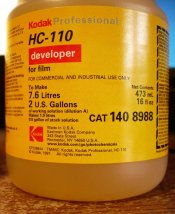
Well this bottle was purchased within the US and refers the user to Kodak literature J-24. It is also fairly explicit.

A 1:1 ratio means no change in dimension, so Full strength or Full size :D

Ian

In certain fields, but it can be used as a simple ration of solvent to solute.
 

Attachments

  • DSC00303.JPG
    DSC00303.JPG
    208.6 KB · Views: 95

LudditeJay

Member
Allowing Ads
Joined
Aug 3, 2010
Messages
54
Format
Multi Format
The 2 examples actually do and they don't, it's only specified if you already *know* that a US gallon is 3.8L. Suppose we take a fellow in the UK who has never worked with metric, they don't know that 3.8L refers to a US gallon, so they assume, because they are in the UK that it means an Imperial gallon, but it doesn't, and an Imperial ounce is smaller then a US ounce (by about 4%), yet an imperial pint is larger, so is the quart and gallon, so if your mixing up a quart, you better darn well know whether it's imperial or US. If you need to consider metric to define an ounce, pint, quart or gallon, then might as well use metric measure. Which is what I did...

I see your point. I've never ran into any issue as I always measure using the metric system as there is very little figuring to do.
 

michaelbsc

Member
Allowing Ads
Joined
Dec 18, 2007
Messages
2,103
Location
South Caroli
Format
Multi Format
No, it's more that Kodak isn't explicit about something that is one way in chemistry and a different way in mathematics, where as some other companies are. Kodak in the UK as Ian pointed out, used to do things a little differently then in the US, they were probably commanded from Rochester that they needed to use the US nomenclature rather then the existing British instructions. It's one of the reasons why my darkroom went metric in 1978, because some companies were explicit with instructions as to whether it was denominated in Imperial Measure or US and some companies were not. They all seemed to include metric, so it was easier to go that way.

BTW Kodak STILL does not specify whether a gallon means a 3.8L US gallon, or a 4.5L Imperial gallon, in a lot of their literature, so you still need to use the metric equivalents to know which they mean, which quite often is US measure.

Maybe we should begin to think of Kodak as Babylon.
 
Photrio.com contains affiliate links to products. We may receive a commission for purchases made through these links.
To read our full affiliate disclosure statement please click Here.

PHOTRIO PARTNERS EQUALLY FUNDING OUR COMMUNITY:


Ilford ADOX Freestyle Photographic Stearman Press Weldon Color Lab Blue Moon Camera & Machine
Top Bottom