
• Welcome to Photrio!
    Registration is fast and free. Join today to unlock search, see fewer ads, and access all forum features.
    Click here to sign up

Difference between Ilford Paper Fixer and "usual" fixer that is used for both film and paper?

Recent Classifieds

Forum statistics

Threads
202,793
Messages
2,845,655
Members
101,538
Latest member
Hazoret
Recent bookmarks
1
You could try a backyard archival test Mike. Use the fixer on a print and a roll of film. The dilution factor for the film is probably in the ballpark of other paper developers. Then hang a neg strip and the print outside, next to a neg strip and print from your previous fixer. Just see what happens over a period of time and weather conditions.

But I'd sell the fixer, and put the money toward purchasing new film and paper fixers. It's just not worth the risk.
 
I think the the pdf for Ilfospeed (above) is not the tech details of the OP's older fixer. Being a standard fixer it would surprise me if the pH were not around 5.0 or 5.5. But what does surprise me is the the OP's fixer does not have any precipitate of elemental sulphur after all those years. Maybe some additional ingredient?
 
Here is the Ilfospeed and Ilfofix tech sheet. Circa 1990.
 

Attachments

  • Ilfospeed fixer.pdf
    233.2 KB · Views: 159
are you sure?..the 1 litre bottles would go very far in filling up an Ilfospeed Roller Tranport. The rack themselves were very deep and wide (16 inch gate?) and there was also a replenishment tank underneath - so large it was mounted on castors. IIRC the contents of an entire 5 litre bootle would be needed to fill a rack and part of the rep tank.

From mmory there were some different sizes of smaller Ilfospeed processors, aimed more at the high end amateur/small professional market these replaced the Ilfoprint machine, I don't think they were sucessfull and only around avery short time. other companies also made small RT processors for RC paper. A UK importer and distributor John Blishen sold a VC-1614-VS a lcompact low price versatile processor, and in their 1982 BJP Annual advert say other sizes available.

The original Ilford liquid rapid fixer is Hypam itroduced in the 1950's, and it was buffered to use an optional hardener. It's likely that the Ilfospeed fixer became Ilford Rapid Fixer, Simon Galley stated that the only difference between Hypam and Ilford Rapid Fixer was the latter had reduced levels of buffering, making it cheaper to produce. To use a hardener you need a fixer with a high level of buffering as even a slight drop in pH has significan effect on the hardener efficiency.

Ian
 
You could try a backyard archival test Mike. Use the fixer on a print and a roll of film. The dilution factor for the film is probably in the ballpark of other paper developers. Then hang a neg strip and the print outside, next to a neg strip and print from your previous fixer. Just see what happens over a period of time and weather conditions.

But I'd sell the fixer, and put the money toward purchasing new film and paper fixers. It's just not worth the risk.

Thanks for the suggestions. It would be a must to test like that.
You've succeeded in leaving a bit of doubt in my mind, though. : )
I think I'll donate the lot to one of the 2 teaching darkrooms in town, description of the tests, copy of the tech sheet included. They could use it for the learners.
 
From mmory there were some different sizes of smaller Ilfospeed processors, aimed more at the high end amateur/small professional market these replaced the Ilfoprint machine, I don't think they were sucessfull and only around avery short time. other companies also made small RT processors for RC paper. A UK importer and distributor John Blishen sold a VC-1614-VS a lcompact low price versatile processor, and in their 1982 BJP Annual advert say other sizes available.

The original Ilford liquid rapid fixer is Hypam itroduced in the 1950's, and it was buffered to use an optional hardener. It's likely that the Ilfospeed fixer became Ilford Rapid Fixer, Simon Galley stated that the only difference between Hypam and Ilford Rapid Fixer was the latter had reduced levels of buffering, making it cheaper to produce. To use a hardener you need a fixer with a high level of buffering as even a slight drop in pH has significan effect on the hardener efficiency.

Ian

Is that why it was called Hypam? Ammonium thiosulphate?
 
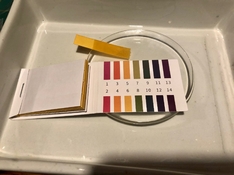
So, litmus paper found.
Looks pretty much 5-6.

PaperFixer31.jpg
 
Photrio.com contains affiliate links to products. We may receive a commission for purchases made through these links.
To read our full affiliate disclosure statement please click Here.

PHOTRIO PARTNERS EQUALLY FUNDING OUR COMMUNITY:


Ilford ADOX Freestyle Photographic Stearman Press Weldon Color Lab Blue Moon Camera & Machine
Top Bottom