
• Welcome to Photrio!
    Registration is fast and free. Join today to unlock search, see fewer ads, and access all forum features.
    Click here to sign up

Developing unknown film

Recent Classifieds

Forum statistics

Threads
201,990
Messages
2,833,402
Members
101,052
Latest member
frenetteaidan
Recent bookmarks
0

hchapman

Member
Allowing Ads
Joined
Apr 21, 2007
Messages
30
Location
La Honda, CA
Format
Multi Format
I was given a 35mm half-frame camera (Tessina). It uses special film reels which must be loaded from a separate film source, bulk or canister. A dozen rolls of exposed film were included with the camera. There is no information on what kind of film is in them. I'd like to develop them for the previous owner of the camera. They were likely shot in the early 1960s. I developed film from one of the canisters in Pyrocat HD along with some TMax 400 I loaded and shot with the Tessina. The TMax 400 developed fine but the unknown film came out all black. This old film has a thicker base than the TMax 400. I thought that if the film was C41 it would probably develop OK in the Pyrocat to give a BW negative? If it was color slide film would it turn black using the Pyrocat? Not sure what to do next to figure out how to develop this old unknown film.
Thank you for your help.
-Harlan
 

Gerald C Koch

Member
Allowing Ads
Joined
Jul 12, 2010
Messages
8,131
Location
Southern USA
Format
Multi Format
Try a two bath developer like Diafine where development is independent of film type.
 
OP
OP
hchapman

hchapman

Member
Allowing Ads
Joined
Apr 21, 2007
Messages
30
Location
La Honda, CA
Format
Multi Format
Hello Gerald,
Thank you for your suggestion. I should have been more specific: the film came out all black out to the edges, beyond the image area. So it was either completely fogged before development or it didn't get along with my developer.
 

Gerald C Koch

Member
Allowing Ads
Joined
Jul 12, 2010
Messages
8,131
Location
Southern USA
Format
Multi Format
Sounds like light fogging. Age fog usually still shows some image and is not completely black.
 

Tom1956

Member
Allowing Ads
Joined
May 6, 2013
Messages
1,989
Location
US
Format
Large Format
BTW--if there was any color film from the 60's it was C-22, if that matters. Slides were E-4.
 

Gerald C Koch

Member
Allowing Ads
Joined
Jul 12, 2010
Messages
8,131
Location
Southern USA
Format
Multi Format
Kodacolor-X was sold until 1974 and was processed in C-22 chemistry.
 

MattKing

Moderator
Moderator
Joined
Apr 24, 2005
Messages
55,295
Location
Delta, BC Canada
Format
Medium Format
It could also be transparency film.
 

Clovis Blevins

Member
Allowing Ads
Joined
Jun 4, 2013
Messages
33
Format
Multi Format
You said it came out all black but you didn't specify whether the emulsion side was black or the backing was black. If the undeveloped film has a medium gray emulsion and a shiny black backing that sands off easily with fine sandpaper, you're probably dealing with Kodachrome. If so, it can be developed as a negative in D-76. Do a trial run at 15 minutes on a snippet and stop/fix as you would any other BW film, then soak in a 10% solution of borax and scrub the black anti-halation backing off with a sponge. It could come out very dense and muddy, in which case you could bleach it.
 

Clovis Blevins

Member
Allowing Ads
Joined
Jun 4, 2013
Messages
33
Format
Multi Format
20130605_180518.jpg.noexif-1090621620.jpg16mm Kodachrome showing emulsion side and rem-jet anti-halation backing including an area sanded with 600 grit sandpaper to show how thin the coating is. Despite being thin, it is extraordinarily opaque.
 
OP
OP
hchapman

hchapman

Member
Allowing Ads
Joined
Apr 21, 2007
Messages
30
Location
La Honda, CA
Format
Multi Format
Thank you for your information Clovis, prompted me to look a bit closer. The developed and undeveloped film base looks nearly black. When I sand the back some white dust comes off but the base remains black in both the developed and undeveloped film. The emulsion looks a bit more tan than gray. A bit of undeveloped film put in fix slowly lightens a little and becomes slightly translucent but only to very bright light, nothing like BW film that goes clear.
So, likely some kind of color film? Transparency or negative?
 

Clovis Blevins

Member
Allowing Ads
Joined
Jun 4, 2013
Messages
33
Format
Multi Format
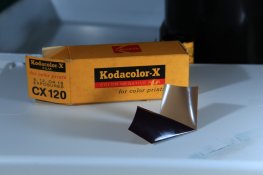
20130606.010455-1497340734.JPGI just happened to have a roll of Kodacolor lying around that expired in 1974. Familiar?
 
OP
OP
hchapman

hchapman

Member
Allowing Ads
Joined
Apr 21, 2007
Messages
30
Location
La Honda, CA
Format
Multi Format
That looks like it.
To my shame not knowing this, is Kodacolor negative or transparency, and would a modern color lab be able to develop it?
 

Clovis Blevins

Member
Allowing Ads
Joined
Jun 4, 2013
Messages
33
Format
Multi Format
Kodacolor is a color negative film. It's processed C-22, which has to be made in batches as this chemistry hasn't been produced in decades. This is only available at a handful of labs. If this is indeed the film you are dealing with and you can't source the chemical components and run c-22 yourself, expect to spend 30-40 dollars a roll having a lab do it with a turn around time of 1-6 months. But I now have some doubts that this is the film you're dealing with. The film base is very dark black with a nearly purple reflection. I dropped some of this in regular Kodak fixer to see if it reacted like your film. It turned dark pinkish tan and the black film base turned perfectly clear, but this was only discernable after wiping the softened emulsion off with a rag. I didn't try putting it into a developer first. Those results sound somewhat different than the results you described, so it may be another film stock from that era.
 

StoneNYC

Member
Allowing Ads
Joined
Aug 5, 2012
Messages
8,345
Location
Antarctica
Format
8x10 Format
Kodacolor is a color negative film. It's processed C-22, which has to be made in batches as this chemistry hasn't been produced in decades. This is only available at a handful of labs. If this is indeed the film you are dealing with and you can't source the chemical components and run c-22 yourself, expect to spend 30-40 dollars a roll having a lab do it with a turn around time of 1-6 months. But I now have some doubts that this is the film you're dealing with. The film base is very dark black with a nearly purple reflection. I dropped some of this in regular Kodak fixer to see if it reacted like your film. It turned dark pinkish tan and the black film base turned perfectly clear, but this was only discernable after wiping the softened emulsion off with a rag. I didn't try putting it into a developer first. Those results sound somewhat different than the results you described, so it may be another film stock from that era.

I have only seen (not yet attempted) to develop c-22 in c-41 and the instructions were to keep the temp at 70 degrees and develop it for 20 minutes, the c-22 can't handle the high heat of c-41, but will still develop it similarly with color after the color step.

Again, just what I've read.


~Stone | Sent w/ iPhone using Tapatalk
 

Clovis Blevins

Member
Allowing Ads
Joined
Jun 4, 2013
Messages
33
Format
Multi Format
I've seen some photos on the Internet of c-22 developed that way. Results were poor, but this could be due to lack of a good solvent such as benzyl alcohol to help carry the agents into the emulsion. Note that this process was discontinued around the time the EPA was formed. Benzyl alcohol isn't a very environmentally friendly solvent to go down the drain. Good luck.
 

StoneNYC

Member
Allowing Ads
Joined
Aug 5, 2012
Messages
8,345
Location
Antarctica
Format
8x10 Format
I've seen some photos on the Internet of c-22 developed that way. Results were poor, but this could be due to lack of a good solvent such as benzyl alcohol to help carry the agents into the emulsion. Note that this process was discontinued around the time the EPA was formed. Benzyl alcohol isn't a very environmentally friendly solvent to go down the drain. Good luck.

So you suggest putting that as an additive? How much would you add? Would it ruin the C-41 chemistry for following that with regular C-41 films?


~Stone | Sent w/ iPhone using Tapatalk
 

Clovis Blevins

Member
Allowing Ads
Joined
Jun 4, 2013
Messages
33
Format
Multi Format
I haven't tried it, but I imagine it would increase the activity inversely proportional to the depth within the emulsion. The first thing that comes to mind is that since different depths within the emulsion respond to different colors, you might see a color shift. It would be interesting.
 
OP
OP
hchapman

hchapman

Member
Allowing Ads
Joined
Apr 21, 2007
Messages
30
Location
La Honda, CA
Format
Multi Format
C41 development, some progress but still a puzzle

C41 Dev 6-17-13001 copy.jpg
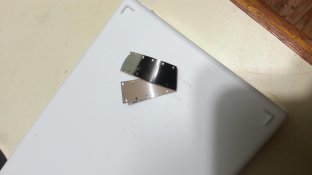
I picked up a C41 developing kit and used it to develop one of these unknown type rolls of film along with a roll of Portra 400 as a control. The Portra developed fine. The unknown film came out looking chocolate brown on the emulsion side and black on the film base side. Holding it up to bright light there are hints of images through a dark purple brown base. Was able to barely pick up an example on a scanner. It was scanned as a color negative but I can't tell if the images are color or monochrome through a colored base.
Does this sound like Kodachrome or would it be worth processing a roll as transparency film at a lab?
Thank you for your help on this.
-Harlan
 

StoneNYC

Member
Allowing Ads
Joined
Aug 5, 2012
Messages
8,345
Location
Antarctica
Format
8x10 Format
Are you sure it's not just B&W film? LOL.


~Stone | Sent w/ iPhone using Tapatalk
 
OP
OP
hchapman

hchapman

Member
Allowing Ads
Joined
Apr 21, 2007
Messages
30
Location
La Honda, CA
Format
Multi Format
It isn't BW film

The first thing I tried was developing it as BW film, didn't work, just got black emulsion with no hint of image. The C41 processing produced at least a bit of image.
 

StoneNYC

Member
Allowing Ads
Joined
Aug 5, 2012
Messages
8,345
Location
Antarctica
Format
8x10 Format
The first thing I tried was developing it as BW film, didn't work, just got black emulsion with no hint of image. The C41 processing produced at least a bit of image.

Well that doesn't make any sense... If you developed it with B&W chemistry it should ALWAYS produce an image... There's always silver in the film ... I develop c-41 and e6 in B&W chemistry sometimes so I'm confused by that result... :sad:

Anyone smarter than me want to help?

Was the first test roll a whole roll? Or only part?

The "black" one you said was B&W processes did you scrub the back to see if it is coated in the remjet layer?


~Stone | Sent w/ iPhone using Tapatalk
 

MattKing

Moderator
Moderator
Joined
Apr 24, 2005
Messages
55,295
Location
Delta, BC Canada
Format
Medium Format
It could be one of the films with a silver layer in the place of a rem-jet layer.

Rem-jet is removed mechanically, while the silver layer is removed by bleaching.
 
Photrio.com contains affiliate links to products. We may receive a commission for purchases made through these links.
To read our full affiliate disclosure statement please click Here.

PHOTRIO PARTNERS EQUALLY FUNDING OUR COMMUNITY:


Ilford ADOX Freestyle Photographic Stearman Press Weldon Color Lab Blue Moon Camera & Machine
Top Bottom